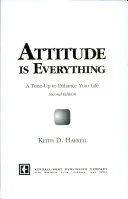
Attitude Is Everything
 76
76

Attitude Is Everything
Keith D. Harrell’s 1999 text, Attitude Is Everything, offers a robust examination of how internal states manifest externally. The book’s strength lies in its direct, no-nonsense approach to psychological mechanics, avoiding overly spiritual jargon while still touching on principles familiar to esoteric thought. A particularly effective section details the "inner critic" and provides methods for its deconstruction, a concept resonating with many who struggle with self-sabotage. However, its focus on actionable steps, while a benefit for some, can sometimes feel repetitive, especially for readers already steeped in motivational literature. The work’s limitation is its occasional lack of depth in exploring the *origins* of deeply ingrained negative attitudes, focusing more on management than root cause. Still, for those seeking a pragmatic guide to immediate mental recalibration, Attitude Is Everything provides a clear and direct path.
📝 Description
76
Keith D. Harrell's 1999 book argues that your attitude is not just a feeling, but an active force shaping your life.
Published in 1999, Keith D. Harrell's "Attitude Is Everything" proposes that personal mindset directly influences life outcomes. The book moves beyond basic positive thinking, advocating for the deliberate cultivation of mental states that can affect external circumstances. It is for individuals who feel limited by their present situation and seek practical methods to alter their perspective and, consequently, their experiences. The work addresses the mechanics of personal causation and the impact of internal dialogue on reality, appealing to those interested in self-empowerment.
Harrell's central idea is that 'attitude' functions as a dynamic power, not a fixed characteristic. He explains how perceived limitations frequently stem from ingrained thought patterns. The book stresses the importance of consciously choosing mental responses to difficulties, suggesting this choice is the main driver of personal achievement and contentment. It details how to actively manage one's internal dialogue to foster desired results.
Emerging in 1999, "Attitude Is Everything" connects with esoteric traditions that suggest mental projection holds power. While not explicitly occult, its emphasis on the mind's influence echoes New Thought movements from the late 19th and early 20th centuries. These traditions often posit that focused thought can manifest external reality, aligning with Harrell's focus on how internal states shape perceived outcomes. The book taps into a long-standing belief in the mind's creative capacity, a concept found in various spiritual and philosophical systems.
💡 Why Read This Book?
• You will learn to identify and dismantle specific self-limiting thought patterns, a skill honed through Harrell's "attitude adjustment" techniques, which offers a practical application of mental alchemy. • You will gain an understanding of the "Law of Attraction" principles as presented in 1999, focusing on how your internal state actively draws corresponding external conditions. • You will feel empowered by actionable strategies for reframing challenges, moving beyond passive acceptance to actively shaping your reality, a core tenet also found in Hermetic psychology.
⭐ Reader Reviews
Honest opinions from readers who have explored this book.
❓ Frequently Asked Questions
When was Attitude Is Everything first published?
Attitude Is Everything was first published in 1999, placing it within a wave of popular self-help and motivational literature.
What is the central philosophy of Keith D. Harrell's book?
The central philosophy is that one's personal attitude is the primary determinant of life experiences and outcomes, advocating for conscious cultivation of a positive and proactive mindset.
Does the book offer practical exercises?
Yes, the book is known for providing practical exercises and strategies designed to help readers actively change their attitudes and thought patterns.
Is this book related to the Law of Attraction?
While not explicitly a Law of Attraction text, it shares core principles regarding the power of thought and belief in shaping one's reality, concepts that are foundational to the Law of Attraction.
Who would benefit most from reading Attitude Is Everything?
Individuals seeking to improve their personal circumstances, overcome mental blocks, and take greater control of their lives through a shift in perspective would benefit most.
What makes this book different from other self-help books published around 1999?
Its direct, actionable approach and focus on the mechanics of attitude as a controllable force, rather than abstract concepts, distinguishes it from many contemporaries.
🔮 Key Themes & Symbolism
The Power of Internal Dialogue
Harrell emphasizes that the constant stream of thoughts and self-talk forms the bedrock of our attitudes. This internal dialogue, often operating subconsciously, dictates our reactions to events and shapes our perception of possibilities. The book details how to monitor this dialogue, identify negative loops, and actively reframe internal conversations to foster a more constructive and empowering perspective. This aligns with esoteric practices that focus on the power of the spoken or thought word to manifest reality.
Attitude as a Choice
A central tenet is that attitude is not a fixed personality trait but a conscious choice that can be cultivated and altered. The work provides methods for recognizing moments where an attitude is chosen, often reactively, and offers techniques for selecting a more beneficial response. This concept of volitional control over one's mental state echoes principles found in Stoic philosophy and later metaphysical traditions, which advocate for internal discipline.
Manifestation Through Mindset
The book posits that a consistently cultivated attitude acts as a magnet, attracting circumstances and opportunities that align with its prevailing energy. This is presented not as passive wishing but as an active process of aligning one's internal state with desired outcomes. By maintaining a determined, positive, and proactive attitude, individuals are guided to create an environment conducive to achieving their goals, a concept resonant with the Law of Attraction.
Overcoming Limiting Beliefs
Harrell addresses how deeply ingrained beliefs, often formed in childhood or through negative experiences, create perceived limitations. The work offers strategies to identify these 'limiting beliefs' and systematically challenge and replace them with empowering affirmations and perspectives. This process of excavating and transforming subconscious programming is a common theme in many psychological and spiritual disciplines.
💬 Memorable Quotes
Direct passages from the work, attributed to the author.
“Your attitude is the invisible force that dictates your destiny.”
— This statement highlights the core belief that one's internal disposition is the primary architect of their life's trajectory, more so than external factors.
“Stop blaming your circumstances and start taking responsibility for your mindset.”
— This emphasizes the principle of personal agency, urging readers to shift focus from external causes of problems to their internal responses and choices.
“The only thing you can truly control is your reaction.”
— This captures the essence of internal locus of control, suggesting that while external events are often uncontrollable, one's response to them remains within their power.
“Your thoughts are seeds; plant them wisely.”
— This metaphor illustrates the idea that our thoughts are the foundational elements that grow into our experiences, advocating for careful and intentional mental cultivation.
“A positive attitude doesn't mean ignoring problems, but facing them with strength.”
— This clarifies that genuine positivity is not about denial but about developing the inner fortitude and perspective to confront challenges effectively.
🌙 Esoteric Significance
Tradition
While not explicitly a product of a specific esoteric lineage, Attitude Is Everything draws heavily on principles found within the broader Hermetic and New Thought traditions. These traditions emphasize the mental and spiritual nature of reality and the power of the individual's consciousness to influence it. Harrell’s work can be seen as a modern, secularized interpretation of these age-old ideas, focusing on psychological mechanisms rather than overt spiritual practices. It translates the concept of 'as above, so below' into a psychological framework where internal states directly mirror and create external circumstances.
Symbolism
The book utilizes the concept of 'attitude' itself as a symbolic representation of an individual's internal energetic state. This 'attitude' acts as a sort of psychic compass or magnet, guiding one's interactions with the world and attracting corresponding experiences. The 'inner critic' functions as a symbolic antagonist, representing the ego's resistance to growth and positive change. Overcoming this internal saboteur is akin to a symbolic battle for control of one's consciousness.
Modern Relevance
Harrell's work remains relevant today, particularly within the fields of positive psychology and manifestation coaching. Contemporary thinkers and practitioners who focus on mindset shifts, cognitive behavioral techniques, and the principles of the Law of Attraction often cite or echo the core tenets presented in Attitude Is Everything. Its practical, step-by-step approach makes it accessible to modern audiences looking for actionable strategies to improve their lives, bridging the gap between ancient wisdom and contemporary self-help.
👥 Who Should Read This Book
• Individuals feeling stuck in negative patterns or circumstances, seeking concrete tools to shift their perspective and re-energize their approach to life. • Aspiring entrepreneurs and professionals who understand the importance of mental fortitude in achieving goals and wish to cultivate a proactive, resilient mindset. • Students of psychology and self-development interested in practical applications of mindset theory and the psychological underpinnings of personal success, as presented in 1999.
📜 Historical Context
Published in 1999, Keith D. Harrell's Attitude Is Everything emerged during a resurgence of interest in personal development and motivational psychology. The late 20th century saw a proliferation of self-help literature, building upon the foundations laid by earlier movements like New Thought and Transcendentalism. While Harrell's work is pragmatic, its emphasis on the power of thought and belief to shape reality aligns with esoteric traditions such as Hermeticism and Christian Science, which were influential in their time. The book's practical, actionable approach distinguished it from more philosophical or overtly spiritual texts. It arrived in a market already shaped by figures like Dale Carnegie and later, Tony Robbins, who were popularizing concepts of mindset mastery and goal achievement. Its reception was largely positive within the self-help sphere, resonating with a public seeking tangible tools for self-improvement in a rapidly changing world.
📔 Journal Prompts
Your dominant attitude: Identify your most frequent internal dialogue.
The 'inner critic' construct: Document its common pronouncements.
Reframing a daily challenge: Apply Harrell's techniques to a minor obstacle.
Chosen response to adversity: Detail a time you consciously selected your attitude.
Seeds of manifestation: What thought are you intentionally planting today?
🗂️ Glossary
Attitude
In Harrell's context, attitude is defined as the dynamic internal state of mind, comprised of thoughts, beliefs, and emotions, which actively shapes perception and influences behavior and outcomes.
Inner Critic
The internal voice of self-doubt, judgment, and negativity that often sabotages confidence and hinders progress. It represents the ingrained patterns of self-criticism.
Limiting Beliefs
Deeply held assumptions or convictions that restrict one's potential or perception of possibilities, often formed through past experiences or external influences.
Mindset
A broader term encompassing one's established set of attitudes, beliefs, and mental frames through which they interpret the world and approach challenges.
Personal Causation
The principle that individuals possess the power to influence their own lives and circumstances through their thoughts, attitudes, and actions.
Positive Reframing
The technique of consciously altering the interpretation of a situation or thought from a negative or limiting perspective to a positive or empowering one.
Self-Talk
The internal dialogue or conversation one has with oneself, which significantly impacts mood, motivation, and overall attitude.
This book appears in 1 collection
🔮 Readers Also Liked
Browse all →



![Qigong =: [Chi kung]](/img/thumb/qigong-chi-kung-wu-runjin-523499.webp)





From the “Affirmations” Collection
View all →








More Free Occult Philosophy Books
View all →