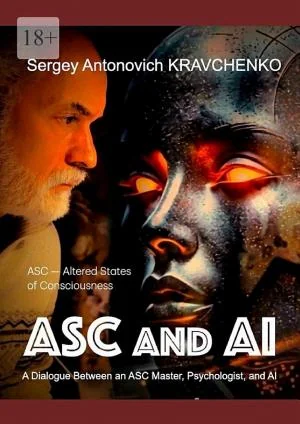
ASC and AI. A Dialogue Between an ASC Master, Psychologist, and AI
 74
74

ASC and AI. A Dialogue Between an ASC Master, Psychologist, and AI
Sergey Kravchenko’s "ASC and AI" offers a bracing, if sometimes uneven, exploration of consciousness and computation. The framing device—a dialogue between an ASC master, a psychologist, and an AI—is ambitious, aiming to synthesize subjective experience with objective analysis and artificial cognition. Kravchenko succeeds in posing vital questions about the future of intelligence, particularly in the section examining how ASC might offer insights into predicting and mitigating future risks, a concept explored through the lens of emergent patterns. However, the AI’s voice, while technically proficient, occasionally lacks the nuanced speculative depth one might hope for in such a groundbreaking premise. The psychologist’s contributions, while grounded, sometimes feel like placeholders for deeper philosophical inquiry. Despite these limitations, the book’s strength lies in its audacious attempt to bridge disparate domains, pushing the reader to reconsider the boundaries of sentience. The discussion around the potential for ASC to serve as a 'predictive modeling' tool for unforeseen societal shifts is particularly compelling. Ultimately, "ASC and AI" is a valuable, albeit imperfect, contribution to conversations about humanity's technological and conscious evolution.
📝 Description
74
Sergey Kravchenko's 2025 book stages a dialogue between an ASC master, a psychologist, and an AI.
This book presents a dialogue involving three distinct intelligences: an expert in Altered States of Consciousness (ASC), a psychologist, and an artificial intelligence. The central aim is to examine how these different forms of awareness and experience might find common ground and synergy. Kravchenko maps potential intersections between advanced technology, particularly AI, and the subjective experience of human consciousness, especially when accessed through ASC.
The work seeks to connect empirical data, subjective states, and computational processes. It is written for professionals in psychology, neuroscience, and AI research, offering a new lens through which to view their fields. The book also appeals to those interested in the future of consciousness studies and the evolving relationship between human and artificial sentience. It is for readers who consider how different modes of being, including altered human states and AI, might interact and develop.
Kravchenko's 2025 publication arrives during a period of significant AI growth and renewed focus on consciousness studies. This era echoes the philosophical discussions of mid-20th century cybernetics, but with a modern digital and neural emphasis. While thinkers like Norbert Wiener explored control and communication in biological and mechanical systems, Kravchenko's work specifically incorporates non-ordinary human states alongside AI. It situates the exploration of consciousness within both traditional esoteric frameworks and cutting-edge technological development.
💡 Why Read This Book?
• Gain a unique perspective on the future of intelligence by understanding how Altered States of Consciousness (ASC) might inform Artificial Intelligence development, as explored in the book's comparative analysis. • Discover potential methods for predicting and preventing future dangers through the synthesis of subjective human experience and AI's analytical power, a core thesis presented by the author. • Explore the intersection of psychology, neuroscience, and AI through the specific dialogue format, offering insights relevant to professionals and enthusiasts interested in the 2025 landscape of consciousness studies.
⭐ Reader Reviews
Honest opinions from readers who have explored this book.
❓ Frequently Asked Questions
What is the primary goal of the dialogue between the ASC Master, Psychologist, and AI?
The primary goal is to explore potential mutual enrichment and understanding between human consciousness (particularly in altered states), psychological frameworks, and artificial intelligence, aiming to better comprehend the future and its potential risks.
Who is the intended audience for "ASC and AI"?
The book is intended for professionals in psychology, neuroscience, and artificial intelligence, as well as for the general reader interested in future technologies and the nature of consciousness.
When was "ASC and AI" first published?
The book was first published on April 17, 2025, positioning it as a contemporary work engaging with current technological and philosophical trends.
Does the book suggest AI can achieve consciousness?
While the book explores the dialogue between human and artificial intelligence, it focuses more on their potential interactions and mutual influence rather than definitively stating AI can achieve consciousness.
What is the significance of Altered States of Consciousness (ASC) in the book?
ASC are presented as a unique source of human insight and experience that can potentially inform AI development and offer perspectives on understanding and navigating future challenges.
What is the author's background?
The author, Sergey Kravchenko, is presented as a figure knowledgeable in the areas discussed, facilitating a dialogue that bridges psychology, ASC, and AI.
🔮 Key Themes & Symbolism
Consciousness and Computation
This theme investigates the fundamental differences and potential convergences between human subjective experience, particularly within Altered States of Consciousness (ASC), and the logical processing of Artificial Intelligence. The book posits that ASC, often seen as purely subjective, may hold patterns or insights that computational models currently lack. It explores how the non-linear, intuitive nature of ASC might offer novel approaches to problem-solving or understanding complex systems, contrasting with AI's data-driven algorithms. The dialogue seeks to understand if AI can ever truly 'comprehend' subjective states or if it can only simulate them, and what the implications are for future human-AI interaction.
Future Prediction and Risk Mitigation
A significant focus is placed on how the combined perspectives of an ASC master, a psychologist, and an AI can contribute to understanding future trajectories and potential dangers. The book examines whether insights gleaned from altered states of consciousness, which can involve heightened intuition or perception of subtle patterns, can be integrated with AI's predictive modeling capabilities. This synthesis is presented as a potential method for foreseeing societal, technological, or existential risks that might be missed by traditional analytical methods alone. The goal is to enhance humanity's capacity for foresight and proactive risk management in an increasingly complex world.
Synergy of Diverse Intelligences
The core of the book lies in exploring the concept of synergistic intelligence – how different forms of knowing and being can interact to create a greater whole. It moves beyond viewing AI as merely a tool, suggesting a potential for a more collaborative relationship. The dialogue format itself embodies this theme, forcing distinct modes of intelligence to engage. The work questions what 'enrichment' means in this context: does AI enrich human understanding of consciousness, or does human consciousness, especially ASC, provide a richer dataset or framework for AI? It considers the evolution of intelligence itself.
Psychological Frameworks and AI
This theme studies how established psychological theories and methodologies can be applied to, or challenged by, the emergence of artificial intelligence. The psychologist's role in the dialogue serves to ground the discussion in human cognitive and emotional processes. The book explores how AI might be used to analyze psychological data on a massive scale, potentially leading to new therapeutic approaches or a deeper understanding of the human mind. Conversely, it questions whether AI's lack of embodied, emotional experience presents fundamental limitations in truly understanding human psychology, and how ASC might bridge this gap.
💬 Memorable Quotes
Direct passages from the work, attributed to the author.
“Can the patterns revealed in a deep trance state offer predictive value beyond statistical models?”
— This question probes the potential of subjective, intuitive knowledge gained through Altered States of Consciousness (ASC) to complement or even surpass the predictive capabilities of purely data-driven AI systems, suggesting a novel avenue for future foresight.
“The AI proposed that the psychologist's models of emotional response could be mapped onto reward functions.”
— This represents a concrete instance of AI attempting to understand human psychology through its own computational logic, translating complex human feelings into algorithmic parameters for learning and behavior.
“Understanding the future requires not just analysis, but also a form of experiential intuition.”
— This statement highlights the book's central thesis: that effective future prediction and risk mitigation likely necessitate a blend of logical, analytical approaches (often associated with AI) and intuitive, experiential insights (potentially derived from ASC).
“Could an ASC master guide an AI's learning process toward wisdom, not just data assimilation?”
— This question explores the possibility of using human consciousness experts, particularly those adept at altered states, to imbue AI with qualities beyond mere information processing, such as discernment or ethical understanding.
💡 Key Ideas
Editorial paraphrase of the work's core concepts — not direct quotes.
The dialogue aimed to find common ground between the subjective 'is' of consciousness and the objective 'is' of computation.
This paraphrased concept emphasizes the core philosophical challenge the book tackles: bridging the gap between the qualitative nature of human experience and the quantitative nature of artificial intelligence.
🌙 Esoteric Significance
Tradition
While not explicitly tied to a single esoteric lineage, "ASC and AI" draws heavily from traditions that explore consciousness beyond ordinary waking states, such as certain contemplative practices within Buddhism, shamanism, and Western esoteric schools focusing on psychic development. It engages with the concept of subjective reality and altered perception, themes resonant in Gnosticism and Hermeticism, particularly in their emphasis on inner knowledge and gnosis. The work departs from traditional dogma by framing these explorations within a dialogue with secular scientific disciplines and artificial intelligence, seeking empirical or computational parallels to esoteric insights.
Symbolism
The book implicitly engages with symbols of integration and transformation. The dialogue itself can be seen as a symbolic representation of the synthesis between the rational (AI, psychologist) and the intuitive/transcendent (ASC master). The concept of 'altered states' itself functions symbolically, representing pathways to expanded awareness and non-conventional understanding, much like traditional esoteric symbols aim to unlock deeper meanings. The AI, as a construct, symbolizes the cutting edge of materialist/computational understanding, serving as a foil against which the non-material aspects of consciousness are examined.
Modern Relevance
Contemporary thinkers in transhumanism and the philosophy of mind, particularly those exploring the potential for consciousness uploading or the creation of artificial general intelligence (AGI), find relevance in Kravchenko's work. The book's exploration of ASC as a source of unique data for AI aligns with modern research into psychedelics and their potential therapeutic or cognitive-enhancing applications. Furthermore, practitioners of mindfulness, meditation, and various forms of consciousness exploration may find the book offers a novel framework for understanding the implications of their practices in a technologically advancing world.
👥 Who Should Read This Book
• AI researchers and developers interested in exploring the potential for integrating insights from subjective human experience, particularly ASC, into machine learning models. • Psychologists and neuroscientists seeking to understand how artificial intelligence might augment or challenge current theories of mind and consciousness. • Philosophers and futurists contemplating the evolving nature of intelligence, sentience, and the potential risks and benefits of advanced AI and human consciousness augmentation.
📜 Historical Context
Published in 2025, Sergey Kravchenko's "ASC and AI" emerges from a milieu heavily influenced by the rapid acceleration of artificial intelligence research and a concurrent, though often more niche, resurgence of interest in consciousness studies and non-ordinary states. This era grapples with questions previously explored in the mid-20th century cybernetics movement, championed by figures like Norbert Wiener, which examined feedback loops and control systems in both biological and mechanical realms. However, Kravchenko's work distinguishes itself significantly by directly incorporating Altered States of Consciousness (ASC) as a crucial element in the dialogue, a dimension less central to early cybernetics. The book's dialogue format reflects a contemporary trend towards interdisciplinary synthesis, moving beyond singular disciplinary perspectives. It implicitly engages with contemporary thinkers in AI ethics and philosophy of mind, such as Nick Bostrom, who have extensively discussed existential risks, but adds the unique layer of subjective human experience as a critical factor in understanding and mitigating these risks. The work seeks to integrate insights from fields often considered disparate, presenting a novel synthesis for its time.
📔 Journal Prompts
The AI's proposed mapping of psychologist's models onto reward functions.
The potential for ASC insights to predict future risks.
The concept of mutual enrichment between human consciousness and AI.
The limitations of purely analytical AI in understanding subjective states.
Bridging the 'is' of consciousness with the 'is' of computation.
🗂️ Glossary
ASC
Abbreviation for Altered States of Consciousness. Refers to any mental state significantly different from the normal waking state, often induced by meditation, hypnosis, sensory deprivation, or psychoactive substances.
Artificial Intelligence (AI)
The simulation of human intelligence processes by machines, especially computer systems. This includes learning, problem-solving, and perception.
Psychologist
A professional specializing in the study of the human mind and behavior, employing various therapeutic techniques and theoretical frameworks.
ASC Master
An individual with profound expertise and experience in inducing, navigating, and understanding Altered States of Consciousness.
Mutual Enrichment
The concept that different systems or entities (in this case, human consciousness and AI) can positively influence and enhance each other's capabilities or understanding.
Predictive Modeling
The use of data analysis and algorithms to forecast future outcomes or trends, often employed in fields like finance, weather, and artificial intelligence.
Subjective Experience
The internal, personal, and qualitative nature of conscious experience, often contrasted with objective, measurable phenomena.
This book appears in 1 collection
🔮 Readers Also Liked
Browse all →









From the “Altered States of Consciousness” Collection
View all →





![EBOOK COLLECTION ( PART 8) [ CSI][h 33t]](/img/thumb/ebook-collection-part-8-csi-h-33t.webp)

More Free Occult Philosophy Books
View all →