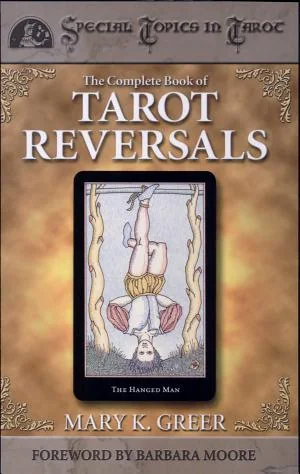
The Complete Book of Tarot Reversals
 75
75

The Complete Book of Tarot Reversals
Mary K. Greer’s *The Complete Book of Tarot Reversals* is the definitive text on a subject many Tarot practitioners either avoid or handle clumsily. Greer’s strength lies in her meticulous, almost academic, cataloging of reversed meanings, presented with a clarity that belies the complexity of the topic. She successfully elevates the reversed card from a mere inconvenience to a vital interpretive element. The book’s limitation, however, is its sheer density; while comprehensive, it can feel overwhelming for absolute beginners. A particularly insightful section details how reversed cards can indicate internalized issues or shadow aspects, as seen in her interpretation of the reversed Hierophant potentially signifying a personal rejection of tradition rather than an external institutional failing. This work is essential for anyone serious about advanced Tarot study.
📝 Description
75
Mary K. Greer's 1988 book argues that reversed Tarot cards offer crucial insights beyond their upright meanings.
This book addresses a common oversight in Tarot study: the interpretation of reversed cards. Greer argues that these reversed positions are not simply inversions or negative reflections, but represent shifts in energy, blockages, or internalized aspects of a card's core meaning. She systematically breaks down how to understand these complexities for all 78 cards, providing definitions, practical exercises, and interpretive strategies. The volume asserts that a complete Tarot reading must consider reversals, which can reveal subconscious dynamics, challenges, or hidden strengths. Readers learn to integrate these reversed meanings into the narrative of a spread, leading to more holistic and accurate readings.
Greer places her approach within the history of Tarot interpretation, noting how earlier traditions sometimes simplified or avoided reversed meanings. While the late 19th and early 20th centuries saw a resurgence of interest in Tarot, influenced by figures like Arthur Edward Waite and Pamela Colman Smith, Greer's work systematically tackles the reversed interpretations often overlooked in foundational modern decks. Her research connects historical study with contemporary psychological and esoteric understanding, demonstrating that reversed cards are not inherently negative but offer a fuller dimension to the Tarot's communication.
Mary K. Greer's work connects with a tradition of Tarot scholarship that seeks to expand the practice beyond surface-level interpretation. While early modern Tarot decks and their interpretations, influenced by figures like A.E. Waite, laid important groundwork, they often glossed over the significance of reversed cards. Greer builds upon this foundation by systematically analyzing these overlooked positions. Her approach aligns with a broader esoteric interest in understanding the subtle energies and psychological depths that Tarot can illuminate, bridging historical practices with modern psychological and divinatory insights.
💡 Why Read This Book?
• Gain a nuanced understanding of Tarot beyond simplistic upright meanings, learning how reversed cards reveal internal states and blocked energies. • Develop advanced interpretive skills to conduct fuller, more accurate readings by integrating the often-misunderstood reversed positions. • Explore a systematic approach to the entire Tarot deck, seeing each card's full potential for communication, fostering deeper self-awareness.
⭐ Reader Reviews
Honest opinions from readers who have explored this book.
❓ Frequently Asked Questions
When was The Complete Book of Tarot Reversals first published?
Mary K. Greer's seminal work, *The Complete Book of Tarot Reversals*, was first published in 2002, making it a foundational text for modern Tarotists exploring the nuances of reversed card meanings.
What is the primary benefit of studying Tarot reversals according to Mary K. Greer?
Greer argues that studying reversals provides a more complete and accurate reading by revealing internal processes, blocked energies, and subconscious influences, moving beyond surface-level interpretations.
Does Greer suggest reversed cards are always negative?
No, Greer explicitly refutes this common misconception. She posits that reversals indicate shifts in energy, internalization, or a need for re-evaluation, not necessarily misfortune.
How does this book differ from other Tarot guides?
Unlike many guides that offer brief or negative interpretations of reversals, Greer provides a systematic, in-depth analysis for every card, integrating them as essential components of a reading.
Who is the intended audience for this book?
The book is intended for intermediate to advanced Tarot readers who wish to deepen their understanding and interpretive skills beyond basic card meanings.
What historical context does Greer provide for Tarot reversals?
Greer touches upon the historical tendency in Tarot interpretation, particularly from the late 19th century onwards, to either ignore or oversimplify reversed card meanings, positioning her work as a corrective.
🔮 Key Themes & Symbolism
The Inverted Spectrum
This theme explores the concept that reversed cards do not inherently signify negativity but rather represent a spectrum of altered energies. Greer illustrates how a reversed card might indicate an internal focus, a blocked flow of energy, or a need for the querent to reclaim an aspect of the card's meaning. For example, a reversed Strength card could signify a struggle with inner resilience or a reliance on external validation rather than inner fortitude, prompting a deeper look at personal power dynamics.
Holistic Reading Frameworks
Greer provides practical methodologies for integrating reversed cards into a cohesive narrative within a Tarot spread. The emphasis is on a holistic interpretation where upright and reversed cards interact dynamically. This approach moves beyond treating reversals as isolated anomalies, encouraging readers to see them as crucial indicators of subconscious influences, developmental stages, or challenges that require attention for a complete understanding of the situation presented.
Psychological Depth in Divination
A significant theme is the application of psychological concepts to Tarot interpretation, particularly through reversals. Greer suggests that reversed cards often point to internalized issues, shadow aspects, or psychological patterns that may be operating unconsciously. This perspective aligns Tarot with modern psychological inquiry, using the cards as a mirror to explore the inner landscape and facilitate self-awareness and personal growth through the divinatory process.
Historical Re-evaluation of Tarot
The book implicitly engages in a re-evaluation of historical Tarot interpretations by systematically addressing the reversals that were often overlooked or minimized. By providing a comprehensive system for their study, Greer contributes to a more complete and nuanced understanding of Tarot's evolving tradition. This work encourages a critical look at past methods and promotes a more inclusive approach to the full symbolic language of the cards.
💬 Memorable Quotes
Direct passages from the work, attributed to the author.
“The reversed card is not necessarily a negative omen, but rather an indication that the energy is being expressed in a different way.”
— This core idea challenges the common fear of reversed cards, reframing them as neutral indicators of energetic shifts or internal focus rather than inherently bad outcomes.
“When a card is reversed, it is often turned inward.”
— This highlights a key interpretive strategy: reversed cards frequently point to internal states, subconscious influences, or personal experiences rather than external circumstances.
“A reading is incomplete if you ignore the reversed cards.”
— This emphasizes the book's central thesis—that a full and accurate Tarot reading requires the integration of both upright and reversed card meanings to capture the entire energetic picture.
“Reversals can show us what we need to reclaim or re-evaluate.”
— This suggests a therapeutic or self-developmental aspect to reading reversals, framing them as prompts for personal growth and the integration of disowned or overlooked parts of the self.
“The meaning of a reversed card can depend on its position in the spread.”
— This points to the contextual nature of Tarot interpretation, indicating that the specific placement of a reversed card within a layout significantly influences its precise meaning.
🌙 Esoteric Significance
Tradition
Greer's work firmly sits within the Western Esoteric tradition, particularly its modern psychological and Hermetic branches. While Tarot itself has varied origins, its widespread adoption into esoteric practice owes much to 19th-century occultists. Greer synthesizes this lineage with contemporary depth psychology, moving beyond purely symbolic or predictive interpretations. Her focus on internal states and blocked energies aligns with Hermetic principles of correspondence and the exploration of the microcosm (human psyche) reflecting the macrocosm (universal forces).
Symbolism
A key symbolic motif is the 'inversion' or 'turning inward' represented by reversals. Greer explores how this manifests across archetypes: the reversed Hierophant, for instance, might symbolize a personal rebellion against or questioning of established dogma, reflecting an internalized spiritual authority. Similarly, a reversed Hermit could represent isolation born of social anxiety rather than intentional solitude for wisdom, highlighting the internal versus external expression of the card's core energy.
Modern Relevance
Contemporary Tarot readers, particularly those interested in psychological astrology, Jungian archetypes, and shadow work, draw heavily on Greer's systematic approach. Her work is foundational for practitioners who view Tarot not just as a predictive tool but as a sophisticated system for self-exploration and personal development. Online Tarot communities, modern Tarot courses, and many contemporary authors on the subject reference or build directly upon her comprehensive cataloging of reversed meanings.
👥 Who Should Read This Book
• Intermediate to Advanced Tarot Readers: Those who have a solid grasp of upright card meanings and seek to deepen their interpretive skills by mastering the complexities of reversals. • Students of Esoteric Psychology: Individuals interested in how Tarot can be used as a tool for self-discovery, shadow work, and understanding subconscious patterns. • Comparative Divination Scholars: Researchers or practitioners interested in the evolution of Tarot interpretation and systematic approaches to symbolic systems.
📜 Historical Context
Published in 2002, Mary K. Greer’s *The Complete Book of Tarot Reversals* emerged during a period of significant popular and academic interest in Tarot, building upon the foundations laid by earlier occult revivals. The late 19th and early 20th centuries, particularly figures like Arthur Edward Waite (1909’s Pictorial Key to the Tarot) and Eliphas Lévi, had established much of the modern esoteric framework for Tarot symbolism, often emphasizing upright meanings. While some earlier practitioners discussed reversals, they were frequently treated as secondary or simply inverted versions of upright meanings. Greer’s work arrived in an era where psychological interpretations of Tarot, influenced by Carl Jung’s theories on archetypes and the unconscious, were gaining prominence. Her systematic approach to reversals offered a counterpoint to interpretations that focused solely on the positive or external aspects of the cards, providing a more nuanced and psychologically rich interpretive system for a growing global community of Tarot enthusiasts and scholars.
📔 Journal Prompts
How does the reversed meaning of a card you frequently draw resonate with your inner experience?
Reflect on a time a reversed card offered a crucial insight you initially overlooked.
Consider how internalizing a card's energy (as suggested by reversals) changes its outward manifestation.
Explore the potential for reversed cards to represent lessons yet to be learned or integrated.
How does viewing reversals as 'turned inward' alter your perception of a challenging reading?
🗂️ Glossary
Reversed Card
A Tarot card appearing upside down in a spread, suggesting a modified, internalized, blocked, or opposite interpretation of its upright meaning.
Internalized Energy
The concept, central to Greer's work, that reversed cards often signify energies or themes that are operating within the querent's psyche rather than external circumstances.
Blocked Flow
A state indicated by some reversed cards, where the natural or intended expression of a card's energy is obstructed, requiring attention or a change in approach.
Holistic Interpretation
An approach to Tarot reading that integrates the meanings of all cards in a spread, including both upright and reversed positions, to form a complete and nuanced understanding.
Shadow Aspects
In a psychological context applied to Tarot, these are the disowned, repressed, or unconscious parts of the personality that may be revealed through reversed card interpretations.
Archetypal Meaning
The fundamental, universal symbolic meaning associated with a Tarot card, often related to psychological patterns or mythic figures studied in Jungian psychology.
Divinatory System
A structured method or practice used for gaining insight into the past, present, or future, such as Tarot card reading, astrology, or rune casting.
This book appears in 1 collection
🔮 Readers Also Liked
Browse all →








From the “Tarot” Collection
View all →









More Free Occult Philosophy Books
View all →