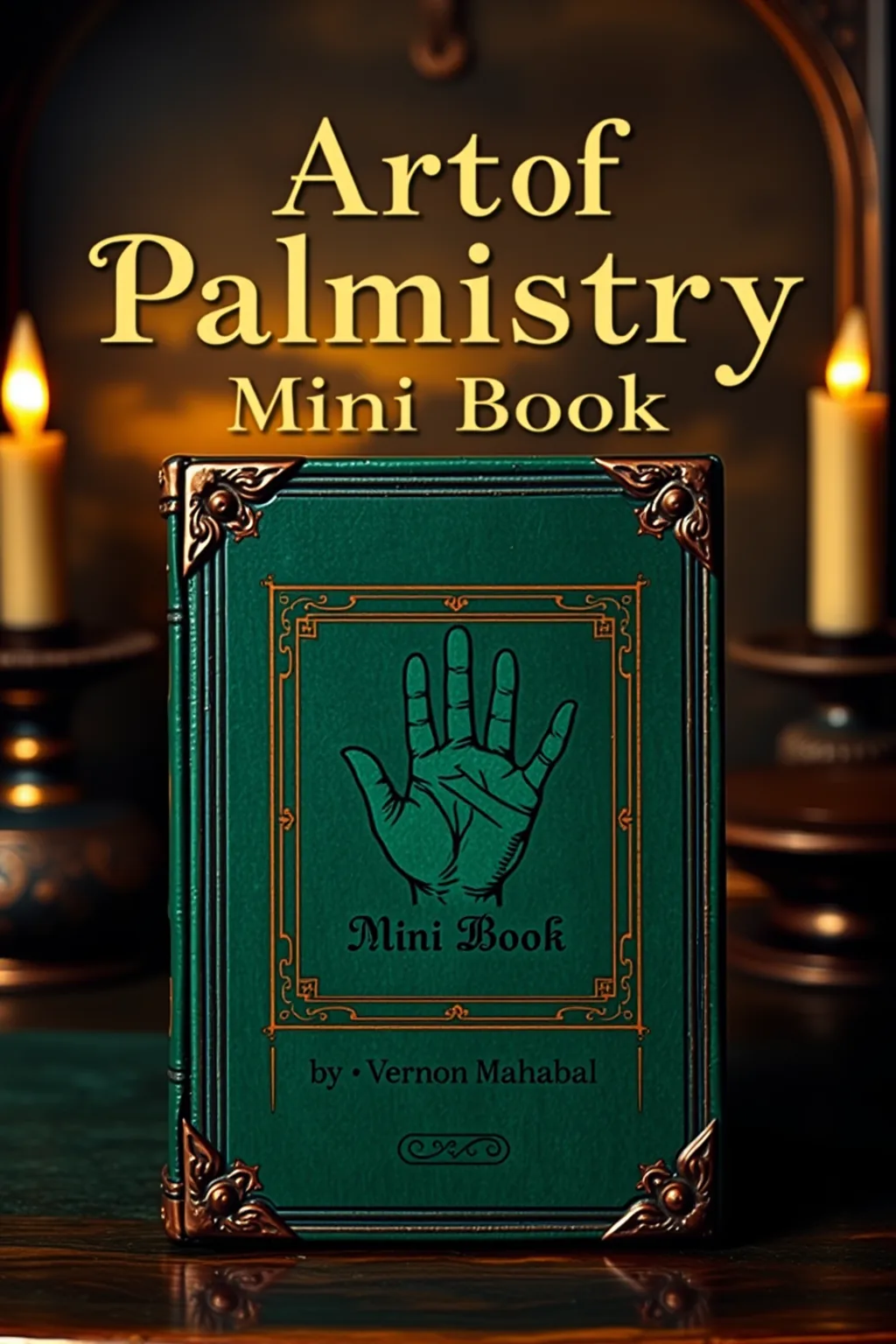
Art of Palmistry (Mini Book)
 61
61

Art of Palmistry (Mini Book)



Isolde Whitaker (Sacred Texts Editor) — Vernon Mahabal's 'Art of Palmistry' is a rare gem, distilling the complex art of palmistry into an accessible yet profoundly insightful mini-volume. Mahabal's expertise shines through as he navigates the subtle nuances of palmistry, revealing its deep roots in ancient wisdom traditions. He avoids sensationalism, instead focusing on the philosophical and spiritual underpinnings of this divinatory practice. The book is an excellent primer for those drawn to the esoteric, offering a clear path to understanding the symbolic language of the hand. It’s a valuable addition for any seeker looking to deepen their connection to self and the unseen forces that shape our lives. Highly recommended for its clarity and esoteric depth.
📝 Description
61
Vernon Mahabal's 'Art of Palmistry (Mini Book)' deciphers the palm's symbolism.
This short book by Vernon Mahabal explains the practice of palmistry. It looks at the meanings found in the lines, mounts, and fingers on a person's hand. Mahabal presents the palm as a map that shows a person's character and potential. The book encourages quiet thought and self-understanding through the study of chiromancy.
It aims to go beyond simple fortune telling. The book suggests palmistry offers a way to see how the universe and individual lives connect. It invites readers to explore personal experiences using the knowledge of palm reading. The goal is to reveal inner secrets through this ancient practice.
Palmistry, or chiromancy, is an ancient practice found across many cultures, from classical Greece and Rome to medieval Europe and India. It is often considered an esoteric art because it claims to reveal hidden knowledge about an individual's personality, future, or spiritual path through the physical features of the hand. Unlike empirical sciences, palmistry relies on symbolic interpretation and tradition, placing it within a broader category of divinatory and occult practices that seek to understand the unseen forces influencing human life.
💡 Why Read This Book?
This mini-book offers an accessible entry point into the profound practice of palmistry, revealing its spiritual and philosophical dimensions. It's ideal for seekers of hidden knowledge, students of esoteric arts, and practitioners looking to expand their divinatory toolkit with a timeless method of self-understanding and foresight. Discover the cosmic narrative written on your palms.
⭐ Reader Reviews
Honest opinions from readers who have explored this book.
❓ Frequently Asked Questions
Is palmistry a form of fortune-telling or spiritual insight?
Palmistry, as presented by Mahabal, transcends simple fortune-telling. It is an ancient esoteric art that offers profound spiritual insight into one's character, potential, and life path, acting as a mirror to the soul.
Can anyone learn palmistry from this book?
Yes, 'Art of Palmistry (Mini Book)' is designed to be accessible to beginners while offering depth for those with prior knowledge. Mahabal's clear explanations make the study of palmistry achievable for all earnest seekers.
What is the 'mini book' format?
The 'mini book' format indicates a concise yet comprehensive presentation of the subject matter. It provides essential knowledge and core principles without overwhelming the reader, making it an ideal starting point.
Does this book cover the scientific basis of palmistry?
This book focuses on the esoteric, symbolic, and spiritual interpretations of palmistry, rather than a strictly scientific explanation. It delves into the metaphysical connections between the hand and the human experience.
What makes Vernon Mahabal's approach unique?
Mahabal's approach is characterized by its blend of deep esoteric understanding and clear, accessible language. He emphasizes the philosophical significance of palmistry, presenting it as a tool for self-awareness and spiritual growth.
🔮 Key Themes & Symbolism
The Hand as a Cosmic Manuscript
This theme explores the profound concept of the palm as a living manuscript, imprinted with the energies and influences of the cosmos. It explores how lines, mounts, and shapes are not random markings but symbolic representations of karmic patterns, innate potentials, and spiritual journeys. The book suggests that by learning to read this script, one can gain a deeper understanding of their personal destiny and the universal forces at play in their life, fostering a sense of connection to the greater cosmic order.
Symbolism of Palm Lines and Mounts
Central to the art of palmistry is the intricate symbolism embedded within the palm's features. This theme unpacks the meanings of major lines like the Life Line, Head Line, and Heart Line, as well as the significance of the various mounts (Venus, Jupiter, Saturn, etc.). Mahabal guides the reader through interpreting these symbols, revealing how they correlate to personality traits, emotional states, intellectual capacities, and life experiences. The focus is on understanding the nuanced language of the hand as a map of the psyche and spirit.
Palmistry as a Tool for Self-Awareness and Spiritual Growth
Beyond prediction, this theme highlights palmistry's role as a powerful instrument for introspection and personal evolution. The book posits that by understanding the messages within one's palms, individuals can gain profound self-awareness, identify areas for personal development, and align themselves more consciously with their life's purpose. It encourages a perspective where the hand's markings serve as guidance for navigating challenges and embracing opportunities, fostering a path of spiritual awakening and holistic well-being.
💬 Memorable Quotes
Direct passages from the work, attributed to the author.
“Lines whisper tales of the soul's journey.”
— This evocative phrase suggests that the markings on the palm are not mere physical traits but hold profound spiritual narratives, offering insights into the soul's experiences, lessons, and evolution throughout its earthly existence.
“To read the palm is to read the self.”
— This statement emphasizes the introspective power of palmistry, positioning it as a direct pathway to self-knowledge. It implies that by deciphering the hand's language, one gains access to a deeper understanding of their own character, motivations, and inner landscape.
“The mounts are cradles of potential.”
— This metaphorical statement highlights the significance of the fleshy mounds on the palm, portraying them as areas where latent energies and inherent capabilities reside, waiting to be understood and cultivated for personal growth.
💡 Key Ideas
Editorial paraphrase of the work's core concepts — not direct quotes.
The hand is a universe in miniature.
This quote captures the core esoteric belief that the human hand, with its intricate lines and formations, mirrors the vastness and complexity of the cosmos, holding within it a microcosm of universal energies and individual destiny.
Destiny is not a fixed decree, but a flowing current.
This quote offers a nuanced view of fate, suggesting that while our palms may indicate potentials and tendencies, they do not represent an unchangeable future. It implies agency and the power of conscious choice to navigate and influence the course of one's life.
🌙 Esoteric Significance
Tradition
Palmistry is deeply rooted in various esoteric traditions, most notably those originating from Vedic India and Hellenistic Greece. Within these traditions, the hand is seen as a microcosm of the universe, reflecting astrological influences and karmic imprints. It is considered a sacred science, a form of sympathetic magic, and a tool for understanding the divine order and one's place within it. The practice is often linked to Hermeticism, Kabbalah, and other mystical philosophies that seek hidden knowledge and spiritual enlightenment through symbolic interpretation.
Symbolism
The symbolism in palmistry is rich and complex. Major lines like the Heart Line represent emotional life and relationships, the Head Line symbolizes intellect and mental processes, and the Life Line denotes vitality and life experiences. The mounts (e.g., Mount of Venus for love, Mount of Jupiter for ambition) represent innate energies and potentials. Fingers, thumb, and hand shapes all contribute to a complex symbolic language, offering insights into personality, character, strengths, weaknesses, and potential life trajectories. The patterns are interpreted as cosmic imprints guiding spiritual development.
Modern Relevance
In contemporary times, palmistry continues to resonate as a powerful tool for self-exploration and psychological insight. Beyond mere fortune-telling, it offers a framework for understanding personal patterns, motivations, and life challenges, fostering self-awareness and personal growth. In an era seeking deeper meaning and spiritual connection, palmistry provides a tangible yet mystical method to explore one's inner world and perceived destiny. Its enduring appeal lies in its ability to offer personalized guidance and a sense of connection to ancient wisdom, empowering individuals to navigate their lives with greater understanding and intention.
👥 Who Should Read This Book
This essential mini-book is a treasure for a diverse audience. Beginners in occult studies and divination will find a clear and accessible introduction to the foundational principles of palmistry. Scholars and practitioners of esoteric arts will appreciate its concise yet profound distillation of classic knowledge. Seekers of spiritual wisdom and self-discovery will find it an invaluable guide for understanding their inner landscape and life path. Anyone curious about the ancient art of reading the hand, and its potential for insight into character and destiny, will benefit immensely from Vernon Mahabal's expert guidance.
📜 Historical Context
The art of palmistry, or chiromancy, boasts a lineage stretching back thousands of years, with roots found in ancient India, China, Greece, and Rome. Its popularity surged during the medieval and Renaissance periods in Europe, often intertwined with astrology and other forms of divination. During these eras, palmistry was practiced by scholars, alchemists, and mystics, who viewed the hand as a divinely inscribed text reflecting both physical health and spiritual destiny. The dissemination of knowledge through printed books, even in compact formats, allowed these esoteric arts to reach a wider audience, fostering both popular interest and scholarly study. Vernon Mahabal's 'Art of Palmistry (Mini Book)' emerges from this rich historical collection, presenting a distillation of ancient wisdom for the modern seeker, bridging the gap between historical practice and contemporary understanding of this enduring divinatory art.
📔 Journal Prompts
Reflect on your dominant hand's primary lines. What narrative do they seem to tell about your core personality and life journey?
Examine the mounts on your palm. Which ones are most prominent, and how do you see those energies manifesting in your daily life?
Consider a significant event in your past. Can you see any subtle indicators on your palm that might have foreshadowed it, or how you navigated it?
How does the interpretation of your palm lines align with your conscious understanding of yourself? Where are the surprising correlations or divergences?
Imagine your palm as a map. What destination or significant landmark does it seem to point towards for your future growth or experience?
🗂️ Glossary
Chiromancy
The ancient practice of palm reading, involving the interpretation of the lines, mounts, and other features of the hand to gain insight into a person's character, destiny, and life path.
Mounts
The fleshy, raised areas on the palm, named after classical deities (e.g., Mount of Venus, Mount of Jupiter), each symbolizing specific character traits, potentials, and energies.
Life Line
A major palm line that typically curves around the base of the thumb, often interpreted as indicating vitality, general health, and significant life events or phases.
Head Line
Another primary line, usually running horizontally across the palm, symbolizing intellectual capacity, thinking patterns, and mental clarity.
Heart Line
A major horizontal line located in the upper palm, typically interpreted as reflecting emotional life, relationships, love affairs, and overall emotional well-being.
This book appears in 2 collections
🔮 Readers Also Liked
Browse all →








More by Vernon Mahabal
All books →



From the “Invocation” Collection
View all →




More Free Divination & Tarot Books
View all →