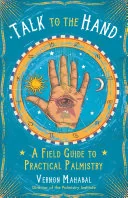
Talk to the Hand
 76
76

Talk to the Hand
Vernon Mahabal’s "Talk to the Hand" tackles palmistry with a refreshing, no-nonsense attitude. Unlike many esoteric texts that languish in vague pronouncements, Mahabal grounds his explanations in the practicalities of reading a hand. His Q&A format, born from years of direct engagement, effectively addresses common curiosities and misconceptions surrounding chiromancy. A particular strength lies in his clear correlation between hand features and psychological states, making the practice feel more analytical than purely speculative. However, the book occasionally leans towards being overly simplistic, potentially overlooking the nuanced interplay of features that seasoned practitioners might consider. For instance, while the Life Line is explained thoroughly, its interaction with the Mount of Venus could benefit from deeper exploration. Despite this, "Talk to the Hand" serves as an excellent, accessible primer for anyone wanting to understand the basics of reading palms, stripping away the melodrama to reveal a tool for self-reflection.
📝 Description
76
Vernon Mahabal's 2018 book, Talk to the Hand, clarifies palmistry through a question-and-answer format.
Talk to the Hand is a practical guide to palmistry, published in 2018 by Vernon Mahabal. The book addresses common questions about reading hands, aiming to make the practice understandable. Mahabal, an expert in the field, structured the text around inquiries he frequently received, providing direct answers and advice for application. It serves as a clear introduction for anyone interested in understanding character and emotions by examining the lines and mounts on the palm. The work is suitable for those seeking to apply palmistry for personal insight or to better understand others. It appeals to both skeptics wanting logical explanations and practitioners aiming to improve their interpretive abilities. Students of esoteric studies and psychology enthusiasts will also find it valuable, as will individuals interested in self discovery through divination. The book emphasizes the analytical aspects of chiromancy, moving away from overly academic or ritualistic methods.
Mahabal's guide breaks down palmistry into key elements. It details how to interpret the primary lines, such as the Life, Head, and Heart lines, and connects them to personality traits, emotional states, and life events. The book also explains the significance of mounts, hand shapes, finger proportions, and skin texture as indicators. This approach makes the complex subject of palm reading more accessible for the reader.
Palmistry, or chiromancy, has ancient roots, with key developments occurring in Hellenistic Greece and medieval Europe. Mahabal's modern, direct approach in Talk to the Hand connects with this long lineage. Published in 2018, the book appeared during a time of renewed interest in divination and personal development, following earlier figures who helped reintroduce esoteric subjects to a wider audience. The book's format reflects contemporary access to specialized knowledge.
💡 Why Read This Book?
• You will learn to connect specific hand features, such as the "Heart Line" and its relationship to emotional expression, to practical character analysis, a skill directly taught through Mahabal's question-driven approach. • Gain an understanding of how palmistry, as presented in this 2018 work, functions as a diagnostic tool for potential life tendencies, moving beyond fatalistic interpretations by focusing on observable hand mounts and lines. • Discover the analytical framework Mahabal uses to interpret the "Head Line," offering insights into cognitive styles and decision-making processes that can be applied to self-understanding.
⭐ Reader Reviews
Honest opinions from readers who have explored this book.
❓ Frequently Asked Questions
What is the primary purpose of palmistry according to Vernon Mahabal in 'Talk to the Hand'?
Mahabal presents palmistry primarily as an analytical tool for character and emotion analysis, aiming to provide insight and foster greater self-understanding rather than dictating a fixed future.
How does 'Talk to the Hand' differ from other books on palmistry?
The book is structured around common questions Mahabal received, making it a practical field guide. It focuses on demystifying the 'tricks of the trade' and offering accessible interpretations of hand features.
Is palmistry presented as a definitive science in this book?
Mahabal frames palmistry as an 'ancient science' and a tool for reflection. The emphasis is on understanding potentials and tendencies, not on absolute prediction or fixed destiny.
What specific hand features does Vernon Mahabal explain in 'Talk to the Hand'?
The book covers major and minor lines (like the Life, Head, and Heart Lines), hand shapes, finger characteristics, and the mounts on the palm, correlating each with psychological and emotional traits.
Who is Vernon Mahabal, the author of 'Talk to the Hand'?
Vernon Mahabal is described as a world-acclaimed palmistry expert whose extensive experience informs the practical, question-and-answer format of the book, first published in 2018.
Can 'Talk to the Hand' help someone understand their emotions better?
Yes, Mahabal explicitly states that palmistry is an 'unsurpassed tool for character and emotion analysis.' The book details how to interpret lines like the Heart Line to gain such understanding.
🔮 Key Themes & Symbolism
Lines as Psychological Maps
The core of Mahabal's approach in "Talk to the Hand" is the interpretation of palm lines not as indicators of fate, but as maps of psychological and emotional landscapes. The book meticulously details how the "Life Line," "Head Line," and "Heart Line" correspond to vital energy, intellect, and emotional capacity, respectively. Mahabal presents these as dynamic indicators, offering insights into an individual's inherent tendencies and how they process experiences. This theme moves palmistry from fortune-telling towards a form of psychometric analysis accessible through the hand's unique topography.
The Hand Shape and Temperament
Beyond the lines, "Talk to the Hand" explores the significance of overall hand shapes and their correlation with basic temperaments. Mahabal categorizes hands (e.g., Earth, Air, Fire, Water) and links them to elemental qualities and personality archetypes. This provides a foundational understanding before examining finer details. The book suggests that the general structure of the hand offers a broad outline of a person's core nature and approach to life, serving as an initial diagnostic layer in chiromancy.
Mounts as Emotional Centers
The fleshy mounds on the palm, known as mounts (e.g., Mount of Venus, Mount of Jupiter), are presented in "Talk to the Hand" as indicators of emotional energy and areas of potential strength or challenge. Mahabal explains how the prominence or flatness of these mounts can reflect the intensity of desires, ambitions, or affections associated with them. This theme highlights the nuanced interpretation possible by examining these specific zones, adding another layer to the character analysis derived from palmistry.
Palmistry as Self-Reflection
A central thesis of "Talk to the Hand" is the utility of palmistry as a tool for self-reflection and personal growth. Mahabal consistently frames the practice not as a deterministic science, but as a means to achieve greater self-awareness. By understanding the potentials indicated in one's own palm, individuals can consciously work with their strengths and address potential challenges. This theme positions palmistry as a form of introspective practice, empowering individuals to make informed choices about their lives.
💬 Memorable Quotes
Direct passages from the work, attributed to the author.
“Palmistry is an ancient science and an unsurpassed tool for character and emotion analysis.”
— This foundational statement frames the book's perspective: palmistry is presented not as mere superstition, but as a systematic method for understanding human psychology through physical traits.
“Everyone has the ability to tap its potential for insight, reflection, and greater understanding.”
— Mahabal emphasizes the accessibility of palmistry, suggesting that the skills needed to interpret a hand are within reach for any interested individual, fostering an empowering approach to self-discovery.
“Talk to the Hand reveals the tricks of the trade and is organized around the most popular questions and inquiries.”
— This highlights the book's practical, clarifying approach. It promises to uncover the methodology behind palmistry in a format designed for clarity and direct application.
“It serves as a fascinating field guide for those who want a quick, accurate understanding.”
— The book is positioned as an immediately useful resource, offering concise yet effective guidance for anyone seeking rapid comprehension of palmistry's core principles and applications.
💡 Key Ideas
Editorial paraphrase of the work's core concepts — not direct quotes.
Interpretation: The book positions palmistry as a practical system for self-awareness, emphasizing that understanding one's palm offers pathways to personal insight and growth.
This paraphrased concept underscores Mahabal's focus on palmistry as a tool for introspection. It suggests that reading the hand is less about predicting the future and more about understanding one's present capabilities and inclinations.
🌙 Esoteric Significance
Tradition
Mahabal's work operates within the broad lineage of Western Esotericism, specifically drawing from the divinatory arts. While not strictly Hermetic or Kabbalistic, it aligns with the philosophical current that seeks knowledge of the hidden order of the universe through symbolic interpretation of natural phenomena. Palmistry, as explored here, functions as a form of natural magic, where the human body (the hand) is seen as a microcosm reflecting macrocosmic principles or inherent human potentials.
Symbolism
The primary symbols in "Talk to the Hand" are the lines and mounts of the palm. The "Heart Line," for example, symbolizes emotional disposition and relationships, a concept found across various esoteric traditions that associate specific bodily features with psychological states. The "Head Line" represents intellect and cognitive processes, linking to the esoteric understanding of mind and consciousness. The various mounts, like the "Mount of Venus," are seen as energetic centers reflecting desires and vitality, akin to planetary influences in astrology.
Modern Relevance
Contemporary thinkers and practitioners in fields like somatic psychology and self-help psychology may find resonance with Mahabal's approach. His emphasis on palmistry as a tool for self-awareness and understanding emotional patterns aligns with modern therapeutic goals. Practices focused on embodied cognition and understanding personality through physical markers can be seen as indirectly influenced by or paralleling the ancient divinatory arts that Mahabal makes accessible.
👥 Who Should Read This Book
• Individuals new to divination seeking a grounded, practical introduction to palmistry, who will appreciate the clear explanations of lines and mounts. • Psychology enthusiasts interested in alternative methods of character analysis and understanding emotional expression, benefiting from the book's focus on psychological correlation. • Self-improvement seekers looking for tools to enhance self-awareness and personal reflection, as Mahabal frames palmistry as a method for understanding one's own potentials and tendencies.
📜 Historical Context
Vernon Mahabal's "Talk to the Hand" emerged in 2018, a period marked by a resurgence of interest in esoteric practices, often facilitated by online accessibility. While palmistry itself has roots stretching back to ancient India and Greece, with notable contributions from figures like Johannes Indagine in the 16th century, Mahabal's work represents a modern, pragmatic iteration. It arrived decades after the New Age movement had popularized many occult disciplines, yet it distinguishes itself through a direct, question-and-answer format that eschews mystical jargon. Unlike the more academic or ceremonial approaches found in some historical texts, Mahabal's book functions as a practical guide, potentially drawing readers who might be wary of more overtly spiritual claims. Its publication context places it alongside a general trend of clarifying ancient arts for contemporary audiences.
📔 Journal Prompts
The significance of your "Life Line" and its perceived duration: how does this inform your current approach to vitality?
Reflecting on the "Head Line's" shape and clarity: what does it suggest about your primary modes of thinking?
Consider the prominence of the "Mount of Venus": how does this relate to your expression of affection and energy?
The interplay between your "Heart Line" and "Head Line": what insights does their relative depth offer about emotional versus logical decision-making?
Interpreting the overall hand shape associated with your palm: how does this elemental association align with your core personality traits?
🗂️ Glossary
Chiromancy
The practice of divination and character analysis through the study of the palm, including lines, mounts, and hand shape. It is synonymous with palmistry.
Life Line
A major line on the palm, typically curving around the base of the thumb. It is traditionally interpreted as relating to vitality, physical health, and significant life events.
Head Line
Another major line, usually running horizontally across the palm. It is associated with intellect, learning, communication style, and cognitive processes.
Heart Line
The uppermost horizontal line on the palm, associated with emotional disposition, romantic relationships, and the state of the heart.
Mounts
The fleshy, raised pads on the palm, named after classical planets (e.g., Mount of Venus, Mount of Jupiter). They are believed to indicate specific character traits and energies.
Hand Shapes
The overall form of the hand (e.g., square, rectangular, spatulate) and fingers, often categorized into elemental types (Earth, Air, Fire, Water) to indicate broad personality characteristics.
Field Guide
In the context of the book, this refers to a practical, easy-to-use manual designed for quick reference and application of palmistry principles in real-time readings.
This book appears in 1 collection
🔮 Readers Also Liked
Browse all →









From the “Palmistry” Collection
View all →







More Free Occult Philosophy Books
View all →