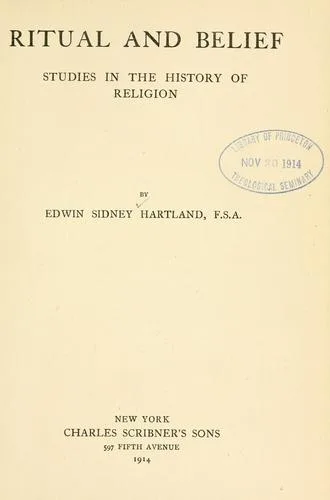
Ritual and belief
 62
62

Ritual and belief


Cassian Rothmann (Senior Critic, Ancient Wisdom) — Edwin Sidney Hartland's 'Ritual and Belief' stands as an unparalleled exploration into the foundational elements of human spirituality and magical practice. Hartland's ethnopsychological approach unearths the primal motivations and cognitive frameworks that gave rise to the world's earliest religious and magical systems. This work is indispensable for anyone seeking to understand the deep currents of ritual, belief, and the inherent human drive towards the sacred. Its strength lies in its meticulous scholarship and insightful synthesis of diverse cultural practices, revealing universal patterns in what might appear as disparate traditions. Highly recommended for scholars of comparative religion, anthropology, and serious practitioners of the occult arts.
📝 Description
62
Edwin Sidney Hartland's 1901 study traces the origins of ritual and belief in human societies.
Edwin Sidney Hartland's 'Ritual and Belief' examines the formation of early human belief systems and their connection to ritualistic practices. Published in 1901, the book investigates how psychological needs and social organization contributed to the development of sacred rites. Hartland looks at ancient cosmologies, shamanic symbolism, and the energies perceived in primitive cultures.
The work connects historical accounts of belief with the underlying archetypes that influence collective human psychology. It seeks to illuminate the mechanisms that define the perceived separation between the ordinary and the mystical. For those interested in the roots of sacred traditions, this text provides insight into humanity's long-standing search for meaning and connection to supernatural forces.
Hartland's 'Ritual and Belief' emerged from a period of intense scholarly interest in comparative religion and anthropology, often touching upon what would later be considered esoteric studies. It engages with the idea that early human societies possessed a form of 'hidden knowledge' or direct experience of unseen forces, which shaped their rituals and cosmologies. The book's focus on the psychological underpinnings of belief and the symbolic language of primitive cultures aligns with inquiries into the origins of consciousness and the universal human drive for meaning beyond the material world.
💡 Why Read This Book?
Uncover the profound origins of magic and religion, tracing the evolution of human belief from its earliest manifestations. Gain a deeper understanding of the psychological and societal forces that shaped ritualistic practices across cultures. This book is essential for seekers of ancient wisdom, scholars of comparative religion, and practitioners looking to ground their understanding in the deep roots of human spiritual expression.
⭐ Reader Reviews
Honest opinions from readers who have explored this book.
❓ Frequently Asked Questions
What is the primary focus of 'Ritual and Belief'?
The book meticulously examines the origins and development of human beliefs, magic, and religious practices across various cultures, particularly focusing on primitive societies and their ritualistic expressions.
Who was Edwin Sidney Hartland?
Edwin Sidney Hartland was a prominent British folklorist and anthropologist, known for his extensive research into comparative mythology, magic, and the early stages of religious development.
Does the book discuss specific magical traditions?
While not focused on specific modern magical systems, it delves into the universal principles and practices of magic as observed in ancient and indigenous cultures, providing a foundational understanding.
Is this book suitable for beginners?
It offers a rich foundation for beginners interested in the origins of ritual and belief, though its scholarly depth may be best appreciated with some prior exposure to anthropology or religious studies.
What is the significance of ethnopsychology in this work?
Ethnopsychology, the study of the relationship between culture and psychological processes, is central to Hartland's analysis, helping him to explain the commonalities and underlying psychological drivers of diverse ritualistic behaviors.
🔮 Key Themes & Symbolism
The Genesis of Sacred Practice
Hartland meticulously traces the nascent stages of human ritual, positing that early ceremonies arose from fundamental psychological needs and communal responses to the mysteries of existence. He explores how these practices, often intertwined with magic, served to appease unseen forces, ensure prosperity, and maintain social cohesion. This theme examines the universal human impulse to create order and meaning through symbolic action, revealing the deep-seated origins of religious and magical expression that continue to resonate today.
The Intertwined Nature of Magic and Religion
A central tenet of Hartland's work is the inseparable bond between early magic and religion. He illustrates how practices aimed at manipulating the natural world or influencing supernatural entities were not distinct from the worship of deities or spirits. This section illuminates how the desire for control and the reverence for the divine were organically fused, forming the bedrock of most ancient spiritual systems and offering useful insights into the human perception of agency and fate.
Symbolism and the Collective Unconscious
Hartland's analysis is rich with an understanding of symbolic language as the primary vehicle for transmitting cultural knowledge and spiritual understanding. He demonstrates how recurring motifs in myths, rituals, and artifacts represent archetypal patterns within the human psyche, hinting at a shared 'collective unconscious' that informs belief systems across diverse cultures. This theme highlights the enduring power of symbols to connect individuals to timeless truths and the deeper currents of existence.
💬 Memorable Quotes
Direct passages from the work, attributed to the author.
“Magic sought to compel; religion sought to conciliate.”
— This highlights a key distinction, albeit often blurred in early practices, between the active, manipulative intent of magic and the devotional, appeasing approach of religion.
“The primitive mind perceived a living world.”
— This points to an animistic or pantheistic worldview where inanimate objects and natural phenomena were imbued with spirit and agency, influencing ritual and belief.
“Ritual is the outward expression of an inward necessity.”
— This emphasizes the deep psychological and emotional drivers that manifest as formal practices, connecting personal experience to communal expression.
“Fear and hope are the twin architects of worship.”
— This poignant observation identifies fundamental human emotions as powerful motivators in the creation and maintenance of religious and magical systems.
💡 Key Ideas
Editorial paraphrase of the work's core concepts — not direct quotes.
Belief is the mother of all rituals.
This quote underscores the fundamental role of conviction and worldview in shaping human actions, particularly in the context of formalized ceremonies and spiritual practices.
🌙 Esoteric Significance
Tradition
This work is foundational to the esoteric study of comparative religion and the anthropology of magic. It provides an academic lens through which to understand the universal underpinnings of spiritual and occult practices across diverse cultures. For esotericists, it illuminates the primal energies and psychological archetypes that drive ritual, offering a deeper appreciation for the enduring power of these practices and their roots in the human psyche.
Symbolism
Hartland's exploration of rituals inherently involves an examination of their symbolic dimensions. He highlights how actions, objects, and narratives in ancient ceremonies served as conduits for deeper meaning, connecting the mundane to the sacred. Understanding this symbolic language is crucial for deciphering the hidden messages within religious and magical systems, revealing how they tap into universal archetypes and the collective unconscious to convey profound spiritual truths.
Modern Relevance
In an age often characterized by secularism, 'Ritual and Belief' offers a vital reminder of humanity's enduring need for meaning, connection, and transcendence. Its insights into the psychological drivers of ritual and belief remain remarkably relevant, helping us understand contemporary spiritual movements, the persistence of folklore, and the inherent human desire to engage with the mysterious. It provides a framework for appreciating the profound psychological and social functions that rituals, both ancient and modern, continue to serve.
👥 Who Should Read This Book
This work is useful for scholars of anthropology, religious studies, and folklore seeking a rigorous examination of the origins of human belief systems. For esoteric practitioners and seekers of hidden knowledge, it offers a profound understanding of the foundational principles of magic and ritual, revealing the deep psychological roots of these practices. Beginners curious about the evolution of spirituality will find a comprehensive yet accessible introduction, while seasoned researchers will appreciate its thorough scholarship and insightful synthesis of diverse cultural data.
📜 Historical Context
Published during a period of intense intellectual curiosity about human origins and societal development, Edwin Sidney Hartland's 'Ritual and Belief' emerged in the late 19th and early 20th centuries. This era was characterized by burgeoning anthropological fieldwork, the development of comparative mythology, and a growing academic interest in non-Western cultures. Hartland's work was influenced by, and contributed to, the intellectual currents of the time, particularly the functionalist approach to understanding social institutions and the evolutionary theories that sought to explain the progression of human civilization. His meticulous research, drawing on a vast array of ethnographic data, positioned his work as a foundational text in the study of religion, magic, and folklore, shaping subsequent academic discourse.
📔 Journal Prompts
Reflect on a personal ritual or ceremony you have participated in. What were its underlying beliefs and intentions?
Consider a modern phenomenon that appears to have ritualistic elements, even if not overtly religious. What might be its purpose?
How do fear and hope influence your own spiritual or belief systems?
Identify a recurring symbol in art, literature, or your own life. What deeper meanings might it represent?
Explore the relationship between community and individual belief in the context of a shared practice.
🗂️ Glossary
Ethnopsychology
The study of the relationship between culture and psychological processes, examining how cultural contexts shape thought, emotion, and behavior, particularly in the context of belief and ritual.
Animism
The belief that natural objects, phenomena, and the universe itself possess souls or spirits; a worldview where the world is alive with spiritual forces.
Totemism
A system of belief in which humans are said to have either a spiritual relationship with particular animals, plants, or other natural objects, or a social relationship with them.
Sympathetic Magic
A form of magic based on the principle that like produces like, or that a person or thing can be affected by similar things from a distance; often involving imitative or contagious principles.
Archetype
In psychology, an inherited universal pattern or image that derives from the collective unconscious and is believed to influence the consciousness of individuals.
This book appears in 3 collections
🔮 Readers Also Liked
Browse all →



More by Edwin Sidney Hartland
All books →
From the “Ritual Magic” Collection
View all →



More Free Magic & Ritual Books
View all →