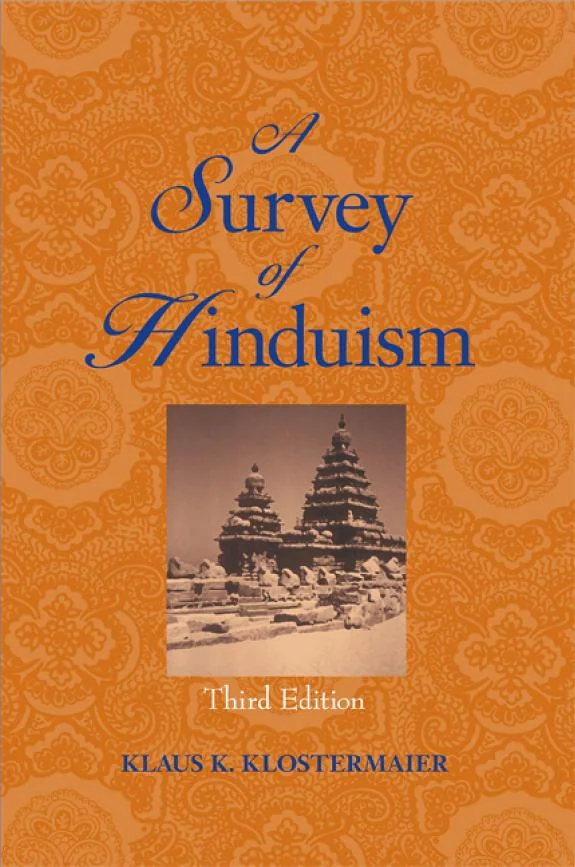
A Survey of Hinduism
 80
80

A Survey of Hinduism
Klaus K. Klostermaier’s *A Survey of Hinduism* (2010) offers a robust, if sometimes dense, academic exploration of its subject. The strength lies in its meticulous detail and broad scope, particularly in the updated sections addressing interreligious relations and Hindu scientific contributions. Klostermaier's treatment of the origins of Hinduism and its subsequent historical development is particularly illuminating, providing a clear chronological framework. However, the sheer volume of information can occasionally feel overwhelming for those without prior academic grounding in the subject; the prose, while precise, lacks a certain accessibility. A notable passage is the discussion on Hindu measures of time, which provides a fascinating glimpse into a different cosmological perspective, illustrating the text's capacity for presenting complex, non-Western concepts. This work is a valuable, albeit demanding, resource for serious students of religion.
📝 Description
80
Klaus K. Klostermaier's 2010 A Survey of Hinduism offers a detailed look at one of the world's oldest religions.
Published in its third edition in 2010, this volume systematically examines the historical development, sacred texts, philosophical underpinnings, and diverse practices of Hinduism. It moves beyond superficial understandings, providing a clear view of the faith's evolution and its place in global religious discourse. The work is structured for serious students of comparative religion, philosophy, and cultural studies. Academics, researchers, and individuals with a sustained interest in the origins and evolution of major world religions will find its depth and breadth valuable. The book situates Hinduism in relation to other major faiths, including Buddhism, Christianity, and Islam, highlighting historical interactions and theological dialogues. Its updated bibliography reflects ongoing academic conversations surrounding Vedic traditions and their modern manifestations.
The survey addresses core concepts such as dharma, karma, samsara, and moksha. It also covers the Hindu pantheon of deities, the significance of rituals, and philosophical schools like Vedanta and Yoga. The book critically examines the history and development of these elements within the tradition.
This survey situates Hinduism within the broader spectrum of world religions, acknowledging its ancient roots and complex philosophical systems. It engages with concepts like dharma, karma, and moksha, which are central to many traditions concerned with cosmic order, spiritual liberation, and the cycle of existence. By detailing philosophical schools such as Vedanta and Yoga, the book touches upon traditions that have long been subjects of esoteric study, exploring their metaphysical claims and practices.
💡 Why Read This Book?
• Gain a structured understanding of Hinduism's historical evolution, from its Vedic origins to its modern global presence, as detailed in the book's historical sections. • Explore the interconnectedness of major religious traditions by examining Hinduism's historical relations with Buddhism, Christianity, and Islam, a topic given dedicated attention. • Grasp complex philosophical concepts like *dharma* and *karma* through the book's systematic exposition of Hindu worldview and sacred writings, providing clarity beyond introductory texts.
⭐ Reader Reviews
Honest opinions from readers who have explored this book.
❓ Frequently Asked Questions
When was the third edition of A Survey of Hinduism published?
The third edition of Klaus K. Klostermaier's A Survey of Hinduism was published on March 10, 2010, bringing updated information and new chapters to the classic text.
What new topics are covered in the 2010 edition?
The 2010 edition includes new chapters on the origins of Hinduism, its historical interactions with Buddhism, Christianity, and Islam, Hindu science, and Hindu measures of time, alongside updated chronologies and bibliographies.
Does the book cover the history of Hinduism?
Yes, A Survey of Hinduism provides a comprehensive look at the history of the tradition, tracing its development through various periods and movements.
What sacred writings are discussed in A Survey of Hinduism?
The book delves into the sacred writings of the Hindus, examining key texts and their significance within the tradition's philosophical and theological framework.
What is the Hindu worldview according to the book?
The work explores the Hindu worldview, encompassing concepts such as dharma, karma, samsara, and moksha, offering insights into the fundamental beliefs and principles.
What major Hindu traditions are examined?
A Survey of Hinduism discusses the specifics of the major traditions within the faith, providing an overview of their practices and beliefs.
🔮 Key Themes & Symbolism
Historical Development
This work meticulously charts the historical trajectory of Hinduism, beginning with its ancient Vedic roots and tracing its evolution through millennia. It addresses the formation of key doctrines, the rise of devotional movements like Bhakti, and the adaptation of traditions in response to external influences. The book emphasizes continuity and change, providing context for understanding the diverse practices and philosophies present today. The 2010 edition specifically enhances this by detailing historical relations with other major world religions.
Sacred Texts and Philosophy
Central to understanding Hinduism is its vast corpus of sacred literature and its intricate philosophical systems. The survey examines key texts such as the Vedas, Upanishads, Puranas, and the Bhagavad Gita, exploring their theological and ethical content. It also elucidates major philosophical schools, including Vedanta, Yoga, and Samkhya, detailing concepts like *karma*, *samsara*, and *moksha*. This section offers a scholarly gateway to the intellectual foundations of Hindu thought.
Worldview and Practice
The book articulates the Hindu worldview, which encompasses a complex understanding of cosmic order (*dharma*), the cycle of birth and rebirth (*samsara*), and the ultimate goal of liberation (*moksha*). It explores the significance of rituals, worship (*puja*), and the role of deities within the Hindu pantheon. The survey presents these elements not as static doctrines but as dynamic aspects of lived religious experience across various traditions and regions.
Hinduism in Dialogue
The updated third edition places significant emphasis on Hinduism's historical interactions and dialogues with other religious traditions. It dedicates attention to the relationships with Buddhism, Christianity, and Islam, examining areas of mutual influence, theological comparison, and historical encounter. This comparative approach highlights Hinduism's engagement with diverse belief systems and its role within the broader field of global spirituality.
💬 Memorable Quotes
Direct passages from the work, attributed to the author.
“Hinduism is not a monolithic religion but a family of religions.”
— This statement underscores the immense diversity within Hinduism, highlighting that it encompasses a wide spectrum of beliefs, practices, and philosophical interpretations rather than a single, unified doctrine.
“The concept of dharma guides individual conduct and cosmic order.”
— This interpretation points to dharma as a fundamental principle in Hinduism, serving as both a moral compass for personal action and a concept that explains the underlying structure and functioning of the universe.
“Samsara is the cycle of birth, death, and rebirth.”
— This succinctly defines samsara, a core doctrine in Hindu philosophy, representing the continuous process of transmigration that beings undergo, driven by karma.
“Moksha represents the ultimate goal of liberation from samsara.”
— This highlights moksha as the supreme spiritual aspiration in Hinduism – the release from the endless cycle of existence and suffering, achieving a state of ultimate freedom.
“Hindu science includes unique measures of time.”
— This interpretation points to the book's exploration of Hindu cosmology and scientific understanding, specifically noting the presence of distinct systems for measuring temporal cycles.
🌙 Esoteric Significance
Tradition
While primarily an academic survey, *A Survey of Hinduism* engages with concepts that hold profound esoteric significance. It provides a structured framework for understanding the philosophical underpinnings of practices often explored in esoteric circles, such as Yoga and Vedanta. The work's detailed exposition of *dharma*, *karma*, and *moksha* offers a scholarly lens through which esoteric practitioners can examine the theoretical basis of their traditions, connecting them to ancient Indian roots and cosmological views.
Symbolism
The book implicitly touches upon numerous symbols central to esoteric traditions. Concepts like the cyclical nature of time (*yugas*) represent cosmic rhythms and universal patterns. The divine forms, such as Vishnu or Shiva, can be interpreted as archetypal forces or manifestations of ultimate reality, explored through their mythologies and iconographies. The emphasis on *moksha* as liberation points towards esoteric goals of spiritual transcendence and union with the divine.
Modern Relevance
Contemporary esoteric movements, particularly those focused on Eastern philosophies, mindfulness, and consciousness studies, draw heavily on the foundational concepts detailed in this survey. Thinkers and practitioners in fields like transpersonal psychology and modern Yoga philosophy often reference the philosophical schools and cosmological frameworks presented. The book's updated analysis of Hinduism's interfaith relations also informs contemporary discussions on religious pluralism and syncretism within esoteric thought.
👥 Who Should Read This Book
• Students of comparative religion and philosophy seeking a comprehensive academic overview of Hinduism, its history, and its core tenets. • Researchers interested in the origins and development of major world religions, particularly those exploring the Vedic tradition and its subsequent evolution. • Individuals with a sustained interest in Eastern spiritualities who desire a detailed, textually grounded understanding beyond introductory materials.
📜 Historical Context
Published in 2010, Klaus K. Klostermaier's third edition of *A Survey of Hinduism* arrived in an era of advanced academic discourse on Eastern religions. It built upon a foundation laid by scholars like R.C. Zaehner and F. Max Müller, who had previously engaged with Vedic and Puranic literature. The intellectual currents of the late 20th and early 21st centuries emphasized comparative religion and post-colonial studies, influencing how traditions like Hinduism were examined. Klostermaier's work situates Hinduism within this global academic conversation, explicitly detailing its historical interactions with Buddhism, Christianity, and Islam, a departure from earlier, more insular studies. The book's reception within academia acknowledged its comprehensive scope, serving as a standard reference for students and scholars alike, though its dense academic style distinguished it from popular introductions.
📔 Journal Prompts
The concept of *dharma* as explored in the text.
Hindu measures of time and their cosmological implications.
The historical relationship between Hinduism and Buddhism.
The philosophical schools of Vedanta and Yoga.
The meaning of *moksha* within the Hindu worldview.
🗂️ Glossary
Dharma
A fundamental concept in Hinduism, encompassing duty, righteousness, cosmic order, and the inherent nature of things. It guides individual conduct and societal structure.
Karma
The principle of cause and effect, where actions (karma) in this life and previous lives determine future consequences and influence the cycle of rebirth.
Samsara
The continuous cycle of birth, death, and rebirth (reincarnation) that living beings are subject to in Hindu philosophy. It is often associated with suffering.
Moksha
The ultimate spiritual goal in Hinduism, signifying liberation from the cycle of samsara and the attainment of freedom, peace, or union with the divine.
Vedas
The oldest and most foundational scriptures of Hinduism, considered to be revealed knowledge. They contain hymns, rituals, and philosophical insights.
Upanishads
A collection of philosophical texts that form the theoretical basis of Hinduism. They explore concepts like Brahman (ultimate reality) and Atman (the self).
Bhagavad Gita
A key scripture within the Mahabharata epic, featuring a dialogue between Prince Arjuna and Lord Krishna, offering profound teachings on dharma, karma, and devotion.
This book appears in 1 collection
🔮 Readers Also Liked
Browse all →








From the “Hinduism” Collection
View all →



More Free Sacred Texts & Gnosticism Books
View all →