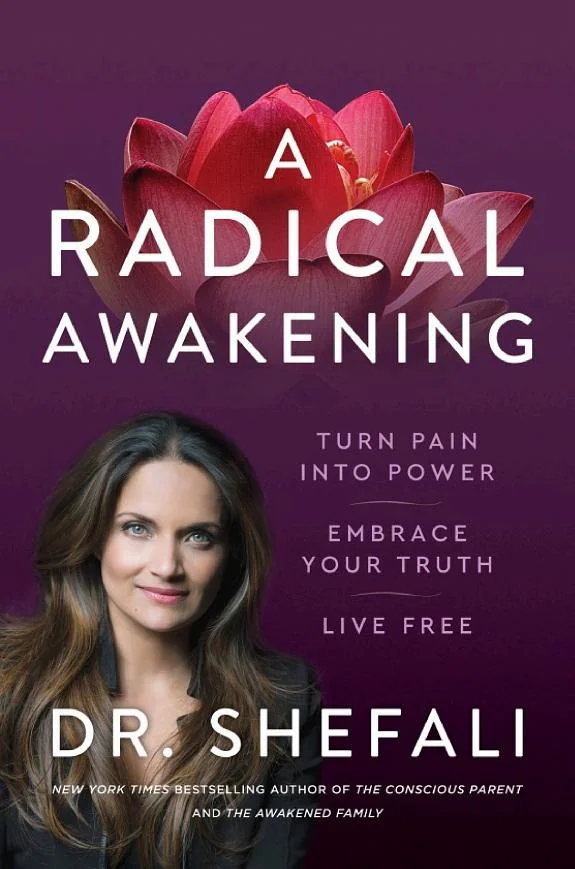
A Radical Awakening
 84
84

A Radical Awakening
Shefali Tsabary’s *A Radical Awakening* attempts a profound reorientation of the self, moving beyond conventional therapeutic models to suggest a return to a fundamental state of consciousness. The book’s strength lies in its direct challenge to the pervasive cultural narratives that shape female identity, particularly its critique of the "false self" constructed by societal pressures. Tsabary offers a compelling framework for understanding how deeply ingrained conditioning can obscure one's true nature. However, the text occasionally risks becoming overly prescriptive, at times presenting its specific path to awakening as the singular solution, which may alienate readers who find resonance with other spiritual or psychological traditions. A particularly potent section explores the concept of "unconditional presence" as an antidote to egoic reactivity, illustrating the book's core message with accessible, albeit sometimes generalized, examples. Ultimately, *A Radical Awakening* serves as a potent call to re-examine the foundations of one's identity and to seek liberation through conscious awareness.
📝 Description
84
Shefali Tsabary's 2021 book, A Radical Awakening, challenges how we understand consciousness.
Clinical psychologist Shefali Tsabary published "A Radical Awakening" in 2021. The book proposes a new way for people, especially women, to view their inner lives and the world around them. It acts as a guide to move past ingrained fears, social pressures, and false ideas about oneself. The goal is to help readers achieve a greater sense of presence, awareness, and contentment by questioning standard psychological and cultural conditioning. Tsabary advocates for a return to our natural state of being, which she describes as the constant presence of consciousness.
This book is for individuals who feel limited by societal expectations, personal worries, or a general lack of fulfillment. It connects with those who sense a gap between their outward lives and an inner need for authenticity and deeper meaning. Readers aiming to discard limiting beliefs, stop self-defeating habits, and build a more aware and free existence will find its ideas useful. It is for anyone prepared to question the stories that have shaped their identity and begin a path toward understanding themselves.
Published in 2021, "A Radical Awakening" arrives during a time of increased interest in mental wellness and personal growth. Tsabary's work connects with contemporary spiritual trends that seek direct paths to expanded consciousness outside of organized religion. It draws on psychological theory while also echoing existential philosophies that focus on inherent being and the nature of self. The book's emphasis on shedding illusions and recognizing an underlying presence aligns with nondual traditions.
💡 Why Read This Book?
• Learn to identify and dismantle the "false self" constructed by societal expectations, a concept central to Tsabary's 2021 work, enabling a more authentic expression of your true nature. • Understand the practice of "unconditional presence" as a means to disengage from fear-based thought patterns, a core technique advocated in the book for achieving greater inner peace. • Discover how to transcend personal and cultural conditioning by recognizing your inherent identity as consciousness itself, a philosophical anchor presented throughout *A Radical Awakening*.
⭐ Reader Reviews
Honest opinions from readers who have explored this book.
❓ Frequently Asked Questions
What is the core message of Shefali Tsabary's 'A Radical Awakening'?
The book's core message is that individuals, particularly women, can achieve fulfillment by transcending societal conditioning and illusions to rediscover their true, conscious nature. It guides readers to awaken from a 'false self' to their inherent state of being.
Who is the intended audience for 'A Radical Awakening'?
The primary audience is women who feel constrained by societal expectations and personal fears, seeking authenticity and liberation. It's also for anyone ready to challenge their conditioning and cultivate a more conscious existence.
When was 'A Radical Awakening' first published?
'A Radical Awakening' by Shefali Tsabary was first published on May 18, 2021.
How does 'A Radical Awakening' differ from standard self-help books?
It moves beyond standard self-help by positing a radical shift in consciousness, focusing on transcending the ego and societal conditioning to reconnect with one's true nature as consciousness itself, rather than just improving external circumstances.
What does the book mean by 'awakening'?
In the context of 'A Radical Awakening,' 'awakening' refers to a state of heightened conscious awareness where one recognizes their true self as pure consciousness, free from the illusions and limitations imposed by the ego and cultural conditioning.
Does the book offer practical exercises?
Yes, while not a manual of step-by-step techniques, the book guides readers through introspective processes and encourages the practice of 'unconditional presence' to recognize and disengage from fear-based thought patterns.
🔮 Key Themes & Symbolism
Transcending the False Self
This theme centers on the distinction between the egoic self, constructed by societal narratives and personal fears, and the authentic self, identified with pure consciousness. Tsabary argues that much of our perceived identity is a "false self" built to navigate external expectations. The work encourages readers to recognize the illusory nature of this constructed identity, which often leads to anxiety and a lack of fulfillment. By deconstructing these layers, the book aims to facilitate a return to one's inherent state of being, free from the constraints of conditional existence and external validation.
The Power of Presence
Central to achieving the 'radical awakening' is the cultivation of "unconditional presence." This concept involves being fully aware of the present moment without judgment or resistance, particularly in the face of challenging thoughts or emotions. Tsabary posits that by anchoring oneself in present-moment awareness, one can observe the workings of the ego and fear-based reactions without identifying with them. This practice serves as a direct antidote to the anxieties and illusions that perpetuate the false self, allowing for a more liberated and conscious engagement with life.
Societal Conditioning and Liberation
The book critically examines how societal structures, particularly those impacting women, impose restrictive norms and expectations that contribute to psychological distress and a diminished sense of self. Tsabary identifies these external pressures as significant contributors to the "false self." The process of awakening, therefore, involves actively challenging and transcending this conditioning. Liberation is framed not as an external achievement but as an internal realization of one's fundamental nature as consciousness, independent of societal approval or prescribed roles.
Awakening as a Return to Consciousness
Rather than a journey of acquisition, awakening is presented as a return to what is already present: pure consciousness. This perspective shifts the focus from self-improvement to self-recognition. The work suggests that the essential self is not something to be built or earned, but rather something to be uncovered by shedding the accumulated layers of egoic identification and conditioning. This understanding aligns with various contemplative traditions that emphasize the inherent luminous nature of awareness, accessible through direct experience.
💬 Memorable Quotes
Direct passages from the work, attributed to the author.
“The ego is simply the story we tell ourselves about ourselves.”
— This concise statement highlights the constructed nature of the egoic self. It suggests that our sense of identity is not an inherent truth but a narrative built from past experiences, beliefs, and societal inputs, which can be re-examined.
“To be present is to witness the mind without being captivated by it.”
— This captures the essence of mindfulness as presented in the book. It differentiates between observing mental activity and being swept away by it, emphasizing awareness as a tool for disengagement from egoic thought loops.
“Our deepest fears are often reflections of cultural illusions, not personal truths.”
— This interpretation suggests that many anxieties are not innate but are learned responses to societal expectations and norms. It encourages readers to question the origin of their fears and differentiate them from their core identity.
“Awakening is not about becoming someone new, but recognizing who you always were.”
— This emphasizes the non-dualistic approach to self-discovery. The book posits that the true self is not a future attainment but a present reality obscured by conditioning, which can be revealed through inner work.
“The illusion of separation is the root of much suffering.”
— This reflects a common theme in consciousness studies, suggesting that the feeling of being a separate, isolated entity is a primary source of distress. True liberation comes from recognizing interconnectedness or fundamental unity.
🌙 Esoteric Significance
Tradition
While not strictly adhering to a single esoteric lineage, *A Radical Awakening* draws heavily from traditions emphasizing consciousness as fundamental reality, akin to Advaita Vedanta or certain Gnostic philosophies. Its focus on transcending the ego and recognizing the self as pure awareness aligns with non-dualistic spiritual paths. Tsabary's approach can be seen as a modern, psychologically informed interpretation of ancient contemplative insights, making esoteric concepts accessible without necessarily invoking specific deities or complex ritualistic frameworks.
Symbolism
The book's primary symbolic motif is the "false self" versus the "true self." The false self can be seen as a symbolic representation of the illusory ego, often depicted metaphorically as a mask, a cage, or a constructed persona. The "true self," conversely, symbolizes pure consciousness, often represented by concepts of light, emptiness, or boundless presence. The act of "awakening" itself functions symbolically as a shedding of illusion, a breaking of chains, or a return to an original, unadulterated state of being.
Modern Relevance
Tsabary's work is highly relevant to contemporary movements in somatic psychology, trauma-informed care, and the growing field of psychedelic-assisted therapy, where exploring consciousness and deconstructing egoic structures are key objectives. Thinkers and practitioners interested in the intersection of psychology and spirituality, mindfulness-based interventions, and critical examinations of societal conditioning find her framework valuable for personal and clinical application.
👥 Who Should Read This Book
• Women feeling trapped by societal expectations and seeking a path to authentic self-expression, who will find Tsabary's critique of the "false self" particularly informative. • Individuals interested in consciousness studies and non-dual philosophies, who can explore the book's integration of psychological concepts with principles of pure awareness. • Therapists and coaches seeking to deepen their understanding of ego-dissolution and consciousness-based approaches to healing, offering a complementary perspective to traditional modalities.
📜 Historical Context
Published in 2021, *A Radical Awakening* emerged during a period of heightened societal introspection, particularly concerning mental health, identity politics, and critiques of Western cultural norms. Clinical psychologist Shefali Tsabary's work arrived amidst a burgeoning interest in mindfulness, consciousness studies, and decolonization of the mind, movements that questioned established psychological paradigms. It follows in the lineage of thinkers like Carl Jung, who explored the collective unconscious and archetypes, and contemporary figures such as Eckhart Tolle, whose 1997 book *The Power of Now* popularized concepts of presence and ego transcendence. Tsabary's specific focus on the female experience and the "false self" also speaks to feminist critiques of patriarchal conditioning that have been developing since the mid-20th century. The book's reception is situated within a discourse that increasingly seeks to integrate psychological well-being with spiritual or existential inquiry, moving beyond purely behavioral or cognitive approaches.
📔 Journal Prompts
Identify a "false self" narrative imposed by cultural conditioning.
Reflect on a moment of "unconditional presence" experienced recently.
Examine a deep-seated fear and its connection to societal illusions.
Consider how your "true self" might express itself unhindered.
Map the transition from egoic reactivity to conscious observation.
🗂️ Glossary
False Self
The constructed identity built from societal expectations, cultural norms, and personal fears. It is the persona we adopt to gain approval and avoid pain, obscuring our authentic nature.
True Self
The fundamental essence of being, identified with pure consciousness. It is the unconditioned, authentic self that exists prior to and independent of egoic constructs and societal conditioning.
Awakening
A state of conscious realization where one recognizes their true nature as consciousness itself, transcending the illusions and limitations of the ego and conditioning.
Unconditional Presence
The practice of being fully aware in the present moment without judgment or resistance. It involves observing thoughts and emotions without identifying with them, anchoring oneself in pure awareness.
Conditioning
The ingrained patterns of thought, belief, and behavior shaped by upbringing, culture, and societal influences. It forms the basis of the "false self."
Ego
The sense of self derived from personal history, beliefs, and societal roles. In this context, it is often synonymous with the "false self" and the source of fear and illusion.
Illusion
Beliefs or perceptions that are not based on reality, often stemming from egoic identification and cultural conditioning. These create a distorted view of oneself and the world.
This book appears in 1 collection
🔮 Readers Also Liked
Browse all →









From the “Spiritual Awakening” Collection
View all →







More Free Magic & Ritual Books
View all →