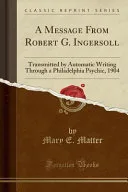
A Message From Robert G. Ingersoll
 82
82

A Message From Robert G. Ingersoll
The premise of receiving posthumous messages from a noted skeptic like Robert G. Ingersoll is inherently fascinating. Mary E. Matter's work, originating from a 1904 automatic writing session, attempts to bridge the chasm between Ingersoll's earthly pronouncements against religion and a potential afterlife perspective. The text offers a glimpse into a spiritual world, describing a guide and encounters with "developed spirits." However, the excerpt provided lacks the depth needed to fully substantiate its claims or offer truly novel spiritual philosophy. While the concept of a "spiritual mind" grasping "fuller meaning" is intriguing, the description remains somewhat vague. The strength lies in its unique point of origin and its attempt to reconcile seemingly contradictory viewpoints. Its limitation is the brevity and the abstract nature of the revelations, leaving the reader wanting more concrete examples of these universal mysteries. The passage detailing the psychic's silence upon returning to their "own sphere" to absorb the "wonderful and beautiful works" is evocative, hinting at immense spiritual revelation. Ultimately, this work serves as a curious artifact of early 20th-century spiritualism, rather than a profound spiritual treatise.
📝 Description
82
In 1904, automatic writing claimed to transmit messages from the deceased atheist Robert G. Ingersoll.
A Message From Robert G. Ingersoll purports to be a direct communication from the spirit of the famous orator, channeled through automatic writing in Philadelphia in 1904. The text presents Ingersoll's supposed experiences and insights after his physical death. It details his understanding of the afterlife and the evolution of the self in non-physical existence.
The book is of interest to those who study spiritualism, mediumship, and theories of consciousness continuing after death. It may also attract readers curious about how figures known for skepticism in life might be portrayed in alleged post-mortem communications. The work emerges from a period when spiritualist phenomena and psychic channeling were subjects of widespread public and intellectual attention.
This book was written during a peak period of spiritualist activity in the early 20th century. At this time, many individuals claimed to receive messages from spirits, often through methods like automatic writing. The era saw a strong current of interest in life after death and the potential for communication with the deceased, often blending with philosophical and religious debates of the day.
💡 Why Read This Book?
• Gain a unique perspective on the afterlife as potentially perceived by a historical skeptic, informed by the 1904 spiritualist movement. • Explore the concept of spiritual guides and "developed spirits" as presented in the text, offering a specific framework for understanding post-mortem existence. • Contemplate the idea of a "spiritual mind" grasping "fuller meaning" through silent observation, a notion presented directly in the excerpt, distinct from typical spiritual doctrines.
⭐ Reader Reviews
Honest opinions from readers who have explored this book.
❓ Frequently Asked Questions
Who was Robert G. Ingersoll and why is his alleged message significant?
Robert G. Ingersoll (1833-1899) was a prominent American orator, writer, and lecturer, known as 'The Great Agnostic' for his eloquent arguments against organized religion and his advocacy for atheism and humanism. His alleged message is significant because it purports to offer his perspective from beyond the grave, potentially reconciling his earthly skepticism with spiritual realities.
What is automatic writing and how was it used in this book?
Automatic writing is a paranormal communication method where a person's hand escreves messages from a supernatural source, often without conscious volition. In 'A Message From Robert G. Ingersoll,' a Philadelphia psychic used this technique in 1904 to channel what is presented as Ingersoll's post-mortem experiences and thoughts.
When was 'A Message From Robert G. Ingersoll' first published?
The work 'A Message From Robert G. Ingersoll' was first published on February 19, 2017, although the original transmission via automatic writing is dated to 1904.
What kind of spiritual experiences does the book describe?
The book describes the author's (as channeled through the psychic) return to their 'own sphere' after death, witnessing 'wonderful and beautiful works.' It mentions a spiritual guide who helps open 'many mysteries of the universe' and the presence of highly developed spirits focused on good.
Does this book offer proof of the afterlife?
The book presents itself as a communication from a deceased individual, offering a purported glimpse into the afterlife. However, like all channeled material, its acceptance relies on the reader's belief in spiritualism and mediumship, rather than empirical proof.
What is the 'Philadelphia Psychic' referred to in the book?
The 'Philadelphia Psychic' is the unnamed individual who, in 1904, allegedly received the messages from Robert G. Ingersoll through the method of automatic writing. This psychic acted as the conduit for the communication presented in the book.
🔮 Key Themes & Symbolism
Posthumous Communication
The central theme is the possibility of direct communication from deceased individuals, specifically Robert G. Ingersoll. The work explores the mechanism of this communication through automatic writing, a practice popular in the early 20th century. It posits that consciousness persists and can offer insights from a non-physical perspective, challenging the materialist views Ingersoll himself espoused during his life.
Spiritual Evolution
The text touches upon the concept of spiritual development and evolution after death. It describes a journey into an 'own sphere' where the spiritual mind is further developed through witnessing profound realities. The presence of 'developed spirits' suggests a hierarchy or progression within the afterlife, where entities attain higher states of being and understanding.
Mysteries of the Universe
The book suggests that the afterlife offers access to a deeper comprehension of universal truths. A spiritual guide facilitates this understanding, opening 'many mysteries.' This theme aligns with esoteric traditions that seek hidden knowledge and universal laws, implying that the physical realm limits perception but the spiritual realm expands it.
Reconciling Skepticism and Spirituality
Perhaps the most intriguing aspect is the potential spiritual perspective of a prominent skeptic like Ingersoll. The work implicitly asks whether a non-believer might encounter and acknowledge spiritual realities after death, offering a unique angle on the perennial debate between materialism and spiritualism. It explores the possibility of expanded awareness beyond earthly dogma.
💬 Memorable Quotes
Direct passages from the work, attributed to the author.
“The wonderful and beautiful works I saw were too much for my developed spiritual mind.”
— This indicates that the spiritual realm contains experiences of immense beauty and complexity that surpass even a refined spiritual understanding, hinting at the boundless nature of existence beyond the physical.
“by remaining silent I seemed to grasp the fuller meaning of much that was shown me by my guide”
— This highlights the importance of passive reception and contemplation in spiritual learning, suggesting that true understanding comes not from active seeking but from internalizing divine revelations.
“whose kind and loving words opened many mysteries of the universe to my better understanding.”
— This emphasizes the role of benevolent spiritual guides in facilitating knowledge and dispelling ignorance about the cosmos, portraying the afterlife as a place of learning and illumination.
“There were spirits so developed for good”
— This suggests a hierarchy or classification of spirits based on their moral and spiritual advancement, indicating that the afterlife is populated by beings of varying degrees of purity and wisdom.
💡 Key Ideas
Editorial paraphrase of the work's core concepts — not direct quotes.
I never spoke again until I had returned to my own sphere.
This line suggests a profound transition and immersion in a new reality upon death or spiritual transition, implying a period of silent integration before conscious interaction in the afterlife.
🌙 Esoteric Significance
Tradition
This work aligns with the broader spiritualist tradition, which emerged prominently in the mid-19th century and continued into the 20th. While not strictly tied to Hermeticism, Kabbalah, or Gnosticism, spiritualism shares with them an interest in the non-physical realms, communication with unseen entities, and the pursuit of spiritual knowledge. It departs from more structured esoteric systems by focusing on direct, often personal, communications from deceased individuals rather than ancient texts or complex symbolic systems.
Symbolism
The primary symbolism lies in the concept of the 'own sphere,' representing a distinct plane of existence or spiritual environment accessible after death. The 'guide' functions as a common symbolic motif in esoteric traditions, representing wisdom, mentorship, and the bridge between the human and the divine or higher consciousness. 'Developed spirits' symbolize the ideal state of spiritual evolution and purity.
Modern Relevance
In contemporary times, this work appeals to a renewed interest in consciousness studies, near-death experiences, and the exploration of non-ordinary states of awareness. It connects to modern mediumship practices and discussions around life after death that persist outside mainstream religious or scientific paradigms. Thinkers and practitioners in consciousness research and those exploring transpersonal psychology might find its premise relevant to ongoing debates about the nature of reality and existence.
👥 Who Should Read This Book
• Students of spiritualism and early 20th-century paranormal phenomena seeking primary or secondary source material on mediumship. • Researchers interested in the intellectual history of skepticism and its potential engagement with spiritual concepts, particularly concerning figures like Robert G. Ingersoll. • Individuals exploring comparative studies of afterlife beliefs, automatic writing, and channeled communications across different historical periods and movements.
📜 Historical Context
Published in 2017, 'A Message From Robert G. Ingersoll' draws from the fertile ground of early 20th-century spiritualism, particularly the phenomenon of automatic writing. The original transmission occurred in 1904, a period brimming with interest in the unseen and the continuation of life after death, fueled by the aftermath of spiritualist mediums like the Fox sisters and the Theosophical Society's influence. This era was marked by a vigorous intellectual clash between scientific materialism, epitomized by figures like Ingersoll himself, and the burgeoning metaphysical movements. While Ingersoll famously critiqued religious dogma, the spiritualist movement offered alternative frameworks for understanding existence beyond the physical. This book emerges within that dichotomy, presenting a posthumous perspective from a staunch critic of organized religion, potentially engaging with concepts debated by contemporaries such as Sir Arthur Conan Doyle, a prominent advocate for spiritualism, and Bertrand Russell, a philosopher often associated with logical positivism and skepticism.
📔 Journal Prompts
Reflect on the concept of the 'own sphere' as described by the channeled Ingersoll.
Consider the role of a 'guide' in opening 'mysteries of the universe' as presented in the text.
Analyze the implications of 'developed spirits' for understanding spiritual progression.
Compare Ingersoll's alleged post-mortem views with his earthly skeptical philosophy.
Explore the practice of automatic writing as a conduit for posthumous messages.
🗂️ Glossary
Automatic Writing
A method of paranormal communication where a person's hand writes messages from a spiritual source without conscious control or awareness of the content being written.
Own Sphere
A term used to describe the spiritual realm or plane of existence that an individual enters or returns to after physical death.
Spiritual Mind
Refers to the non-physical aspect of consciousness, believed to be capable of perceiving and understanding realities beyond the scope of the physical senses or intellect.
Spiritual Guide
An entity or consciousness from a higher spiritual plane that assists and teaches individuals on their spiritual path, particularly in the afterlife.
Developed Spirits
Beings in the spiritual realm who have achieved a high level of moral, intellectual, and spiritual advancement through evolution.
Mysteries of the Universe
Profound truths or hidden knowledge concerning the nature of existence, reality, and the cosmos that are not readily apparent or understood in the physical world.
Philadelphia Psychic
The unidentified individual residing in Philadelphia who acted as the medium for channeling the messages attributed to Robert G. Ingersoll in 1904.