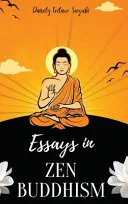
Essays in ZEN BUDDHISM
 81
81

Essays in ZEN BUDDHISM
D.T. Suzuki's Essays in Zen Buddhism offers a potent, albeit at times dense, distillation of his lifelong engagement with Zen. He masterfully elucidates concepts like *satori* and the function of the *koan* with a clarity that belies their inherent ineffability. A particular strength lies in his historical tracing of Zen's lineage, connecting its philosophical underpinnings to its practical application. However, the collection’s academic rigor, while commendable, can present a barrier for the uninitiated; certain passages assume a familiarity with Buddhist terminology that may leave newcomers adrift. Suzuki’s assertion that Zen transcends dualistic thinking, exemplified in his discussion of the limitations of Western logic when applied to Eastern thought, remains a powerful argument. Ultimately, this volume serves as an indispensable, if demanding, resource for understanding Zen's core philosophy through the eyes of its most influential Western interpreter.
📝 Description
81
Daisetz Teitaro Suzuki's Essays in Zen Buddhism first appeared in the early 20th century, shaping Western understanding of Zen.
Compiled from Daisetz Teitaro Suzuki's writings, Essays in Zen Buddhism examines the core ideas and practices of Zen. This collection is not a basic introduction but a thorough look at Zen's central principles and experiential aspects. Suzuki, who played a major role in bringing Eastern philosophy to the West during the 20th century, explains how reality is non-dualistic, the importance of intuition, and how enlightenment comes from direct experience, not just intellectual understanding.
This book is for dedicated students of Buddhism, comparative philosophy, and contemplative practices. It will especially interest those already familiar with Buddhist ideas who want to grasp Zen's unique perspective. Anyone interested in the history of religious thought in the 20th century, particularly how Asian philosophies entered Western academic and public life, will find much here. It also serves practitioners aiming to deepen their theoretical knowledge of Zen.
Originally published as separate essays, this compilation reflects the intellectual environment of the mid-20th century, a time of considerable Western interest in Eastern spirituality. Suzuki's work, influenced by his interactions with figures like William James, helped form both academic and popular views of Buddhism. His approach contrasted with more academic or ritualistic interpretations, focusing instead on Zen's experiential and psychological elements. This period saw Western thinkers actively searching for alternatives to purely materialist viewpoints.
Suzuki's work is situated within the transmission of Mahayana Buddhist thought, specifically Zen, to Western audiences in the early to mid-20th century. He engaged with Western philosophical and psychological currents, attempting to bridge Eastern contemplative traditions with Western intellectual frameworks. His writings emphasized the experiential and intuitive aspects of Zen, distinguishing it from more scholastic or ritualistic forms of Buddhism that were also being introduced. This effort placed his work within a broader esoteric milieu concerned with spiritual awakening and alternative modes of consciousness.
⭐ Reader Reviews
Honest opinions from readers who have explored this book.
❓ Frequently Asked Questions
When was D.T. Suzuki's 'Essays in Zen Buddhism' first published?
The original publication date for 'Essays in Zen Buddhism' by D.T. Suzuki was November 8, 2023, though his essays were widely disseminated and influential long before this compilation.
What is the primary focus of D.T. Suzuki's 'Essays in Zen Buddhism'?
The book focuses on the philosophical and experiential aspects of Zen Buddhism, exploring concepts like satori, koans, and emptiness, aiming to convey the essence of Zen practice.
Who was D.T. Suzuki and why is he important for Zen Buddhism?
D.T. Suzuki (1870-1966) was a Japanese scholar and author who was instrumental in introducing Zen Buddhism to the Western world through his numerous writings and lectures.
Does this book explain how to practice Zen meditation?
While it discusses the philosophical underpinnings and experiential goals of Zen, the book is primarily an exploration of concepts rather than a direct instructional manual for meditation techniques.
What is 'satori' as described in Suzuki's essays?
Satori, as interpreted by Suzuki, refers to a moment of awakening or intuitive apprehension of truth, a direct experience of enlightenment that transcends intellectual understanding.
Are the essays in this collection suitable for absolute beginners to Buddhism?
The essays assume some familiarity with Buddhist terminology and concepts. While informative, beginners might find it beneficial to consult introductory texts on Buddhism before looking at Suzuki's more advanced philosophical discussions.
🔮 Key Themes & Symbolism
Intuitive Understanding
Suzuki emphasizes that Zen's ultimate truths cannot be grasped through logic or empirical reasoning alone. The essays explore the concept of intuitive insight, or 'seeing into one's own nature,' as the direct path to understanding. This involves transcending the subject-object duality that characterizes ordinary consciousness, leading to a non-conceptual apprehension of reality. The work suggests that intellectual study can only prepare the ground for this direct experience, which is often described as sudden and transformative.
The Role of Koans
The collection dedicates significant attention to the *koan*, a paradoxical question or statement used in Rinzai Zen to break down the practitioner's reliance on rational thought. Suzuki explains how *koans* are not puzzles to be solved intellectually but rather tools designed to exhaust the discursive mind, forcing a confrontation with the limits of conceptualization. This process, when undertaken correctly, can precipitate the experience of *satori*, leading to a shift in consciousness and a deeper realization of the nature of reality.
Emptiness and Non-Duality
Central to Zen, as presented by Suzuki, is the understanding of emptiness (*sunyata*) not as nihilistic void but as the absence of inherent, independent existence. The essays interpret this as the ground of all phenomena, a state of pure potentiality and interconnectedness. This concept is intrinsically linked to non-duality, the recognition that fundamental reality is beyond all conceptual distinctions, including subject/object, self/other, and being/non-being. This realization is the aim of Zen practice.
Zen's Historical Trajectory
Suzuki meticulously traces the historical development of Zen Buddhism, particularly its transmission from India through China to Japan. He highlights key figures and philosophical shifts that shaped its unique character, distinguishing it from other Mahayana schools. The essays demonstrate how Zen evolved to emphasize direct experience, mindfulness in daily life, and a profound appreciation for the present moment, adapting its expression while retaining its core principles across different cultural contexts.
💬 Memorable Quotes
Direct passages from the work, attributed to the author.
“The aim of Zen is to help us see into the nature of our own being and awaken to the truth of our own selves.”
— This statement expresses Suzuki's focus on direct, personal realization. It emphasizes that Zen's purpose is not external doctrine but internal awakening, an experiential understanding of one's own fundamental nature.
“A koan is not a problem to be solved, but a door to be opened.”
— This highlights the function of the koan as a catalyst for breaking intellectual barriers. It suggests that the koan's purpose is experiential, leading to a shift in perception rather than a logical conclusion.
“Emptiness is not nothingness; it is the fullness of all possibilities.”
— This interpretation of *sunyata* (emptiness) reframes it from a negative concept to a positive one. It suggests that emptiness is the unmanifest potential from which all phenomena arise, the ground of being.
“Satori is a glimpse into the absolute, a sudden illumination of the mind.”
— This describes the experience of *satori* as a moment of useful insights and clarity. It suggests a non-linear, instantaneous apprehension of reality that transcends ordinary consciousness.
💡 Key Ideas
Editorial paraphrase of the work's core concepts — not direct quotes.
Zen finds its expression not in elaborate doctrines but in the simple, direct experience of life.
This quote underscores Zen's practical and experiential orientation. It contrasts Zen's emphasis on immediate awareness and mindful engagement with more theoretical or dogmatic religious systems.
🌙 Esoteric Significance
Tradition
Suzuki's work bridges Eastern Buddhism with Western esoteric thought, particularly its interest in consciousness and direct experience. While not explicitly aligned with Western Hermeticism or Kabbalah, his emphasis on intuitive insight, the limitations of rationalism, and the attainment of a higher state of consciousness (*satori*) echoes themes found in various mystical traditions. He introduced concepts like *sunyata* (emptiness) and the non-dual nature of reality in ways that appealed to Western seekers exploring alternatives to materialist philosophies, positioning Zen as a profound spiritual path relevant to modern consciousness.
Symbolism
While *Essays in Zen Buddhism* is primarily philosophical, key symbolic motifs emerge. The *koan*, as a paradoxical riddle, symbolizes the breakdown of conventional logic and the mind's limitations. The concept of *emptiness* (*sunyata*) functions symbolically, representing not a void but the unconditioned, boundless potential from which all forms arise—a state of pure being beyond conceptualization. The act of *sitting* (zazen), though not always detailed explicitly, is an implicit symbol of mindful presence and the direct engagement with the present moment, central to realizing the non-dual nature of reality.
Modern Relevance
Suzuki's articulation of Zen has profoundly influenced contemporary mindfulness movements, Western Buddhist psychology, and contemplative studies. Thinkers and practitioners in fields ranging from neuroscience investigating altered states of consciousness to therapists exploring non-ordinary states of mind draw upon his foundational explanations. His work continues to be a primary reference for those seeking to understand Zen's philosophical depth and its potential for cultivating psychological insight and a more direct, less ego-centric experience of existence in the 21st century.
👥 Who Should Read This Book
['• Students of comparative religion and philosophy seeking to understand the transmission of Eastern thought to the West in the 20th century.', '• Practitioners of meditation and contemplative disciplines interested in the theoretical framework and experiential goals of Zen Buddhism.', "• Academic researchers in religious studies or East Asian philosophy who require foundational texts on Zen's core concepts and historical development."]
📜 Historical Context
Daisetz Teitaro Suzuki’s *Essays in Zen Buddhism*, a compilation of his influential writings, emerged during a period of intense global exchange of philosophical and religious ideas. The mid-20th century saw a burgeoning Western interest in Eastern mysticism, partly fueled by earlier works from the Theosophical Society and figures like Alan Watts. Suzuki’s scholarship, dating from the early 1900s and continuing through the 1950s, played a central role in shaping the Western academic and popular understanding of Zen. His approach distinguished itself from more scholastic Buddhist studies by emphasizing Zen’s experiential and psychological dimensions. While scholars like Edward Conze were also translating and analyzing Buddhist texts, Suzuki’s unique ability to articulate Zen's non-dualistic and intuitive aspects, often in dialogue with Western philosophical concepts, made his work particularly resonant. His writings helped establish Zen as a distinct and vital spiritual tradition, moving beyond mere exoticism to be considered a profound philosophical system.
📔 Journal Prompts
The nature of *satori* as described by Suzuki: a direct, non-conceptual apprehension.
The function of the *koan* in dismantling rational thought.
Suzuki's interpretation of *sunyata* as boundless potentiality.
The contrast between Zen's emphasis on direct experience and doctrinal religion.
The historical context of Zen's introduction to the West through Suzuki's work.
🗂️ Glossary
Satori
A Japanese Buddhist term for awakening or enlightenment. In Zen, it refers to a sudden, intuitive flash of insight into the true nature of reality, transcending ordinary conceptual understanding.
Koan
A paradoxical anecdote or riddle used in Zen Buddhism, primarily in the Rinzai school, to provoke doubt and test a student's progress in Zen practice by disrupting rational thought.
Sunyata
A Sanskrit term often translated as 'emptiness' or 'voidness'. In Mahayana Buddhism, it signifies the lack of inherent, independent existence in all phenomena, and is understood as the ultimate nature of reality.
Zazen
A seated meditation practice central to Zen Buddhism. It typically involves mindful attention to the breath and body, aiming to cultivate stillness, awareness, and insight into the nature of the mind.
Mahayana Buddhism
One of the two major branches of Buddhism (the other being Theravada). Mahayana, meaning 'Great Vehicle,' emphasizes the Bodhisattva path and the concept of emptiness, with Zen being a prominent school within it.
Non-duality
The philosophical or spiritual concept that reality is ultimately a single, undivided whole, transcending all dualistic distinctions such as subject/object, mind/body, or self/other.
Dharma
A term with multiple meanings in Buddhism, often referring to the teachings of the Buddha, cosmic law, or the fundamental nature of reality.