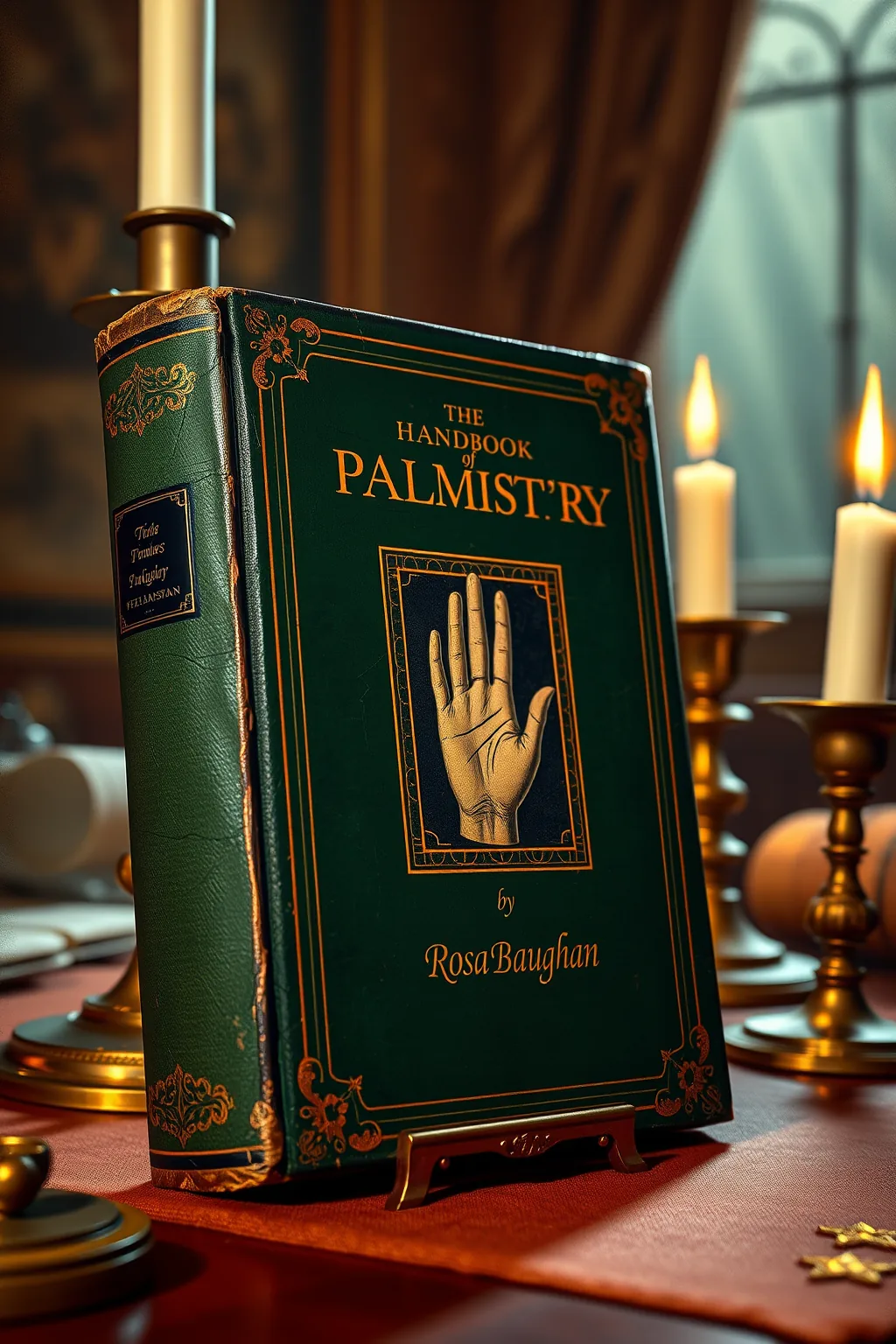
The Handbook of Palmistry
 81
81

The Handbook of Palmistry
Rosa Baughan's "The Handbook of Palmistry" offers a detailed, if somewhat dry, exposition of chiromancy. Its strength lies in its methodical breakdown of hand features, linking thumb and finger shapes directly to aptitudes – a practical angle absent in many more mystical treatments. The original blurb's assertion about judging people at a glance, while hyperbolic, points to the book's core intent: character assessment through physical signs. However, the prose can be dense, occasionally making the connection between observation and interpretation feel strained. The section on the thumb's indications of temperament, for instance, is particularly thorough but requires careful study. While it lacks the evocative language of some later esoteric texts, its factual grounding makes it a reliable reference for understanding late 19th-century palmistry.
📝 Description
81
Rosa Baughan's 1885 handbook offers a detailed guide to palmistry.
Published in 1885, Rosa Baughan's The Handbook of Palmistry presents chiromancy as a method for understanding personality and character, not just as a fortune-telling tool. Baughan focuses on the physical characteristics of the hand, including its shape, texture, the thumb, and fingers, as indicators of innate qualities. Her system combines observations of the palm's mounts and lines with physiognomy, aiming for a complete picture of the individual. The book guides readers through analyzing hand shapes, finger types, and subtle markings that suggest a person's potential and inclinations.
This volume suits those interested in applying palmistry for character assessment. It is of value to students of esoteric arts wanting to learn late 19th-century hand analysis methods. Readers who prefer a systematic approach, based on careful observation and description, will find it useful. It is especially helpful for individuals seeking to complement their understanding of human nature with historical interpretive systems. Those curious about the connections between physical appearance and perceived personality traits will also find it engaging.
Rosa Baughan's 1885 work appeared during a time of considerable interest in spiritualism and occult studies in Victorian England. This period saw a revival of hermetic traditions and a widespread acceptance of divination practices, often mixed with contemporary scientific ideas. Baughan's book fits within this milieu, focusing specifically on physiognomy and chiromancy as tools for understanding the individual.
💡 Why Read This Book?
• Learn to correlate specific finger shapes and thumb indications with inherent temperaments and aptitudes, as detailed in Baughan's late 19th-century analysis. • Gain insight into the historical context of physiognomy and chiromancy, understanding how works like this were presented as methods for character assessment in 1885. • Develop a nuanced understanding of how the physical form of the hand, particularly the mounts and finger textures, was interpreted to reveal individual potential and predispositions.
⭐ Reader Reviews
Honest opinions from readers who have explored this book.
❓ Frequently Asked Questions
When was Rosa Baughan's "The Handbook of Palmistry" first published?
Rosa Baughan's "The Handbook of Palmistry" was first published in 1885, placing it firmly within the late Victorian era's surge of interest in esoteric subjects.
What is the primary focus of "The Handbook of Palmistry"?
The book primarily focuses on using palmistry, specifically the form and texture of the thumb and fingers, to understand a person's temperament and aptitudes, viewing it as a method for judging character.
Does the book discuss palm lines as well as hand shape?
Yes, while emphasizing the thumb and fingers, the work also explores the indications manifested by the general form and texture of the hand, which would include interpretations of mounts and lines.
Is "The Handbook of Palmistry" suitable for beginners?
It is suitable for beginners interested in a structured, observational approach to palmistry, particularly those curious about its historical presentation as a character assessment tool.
What historical period does this book represent in palmistry?
The book represents late 19th-century palmistry, a time when practitioners sought to systematize and legitimize such arts, often linking them with scientific observation and character analysis.
Can "The Handbook of Palmistry" be used to predict the future?
While it touches on aptitudes and predispositions, the book's emphasis is on character assessment rather than fortune-telling, aligning with a physiognomic rather than purely divinatory approach.
🔮 Key Themes & Symbolism
Physiognomy and Character
Baughan posits that the physical form of the hand, particularly the thumb and fingers, offers direct insights into a person's inherent temperament and aptitudes. This aligns with the broader late 19th-century interest in physiognomy – the assessment of character from outward appearance. The work meticulously details how variations in finger length, shape, and the texture of the skin can be interpreted to understand an individual's personality, intellectual capacities, and emotional predispositions, moving beyond simple fortune-telling to a form of characterological science.
The Thumb as an Indicator
A significant focus of "The Handbook of Palmistry" is the thumb, which Baughan presents as a crucial indicator of will, logic, and individuality. The size, flexibility, and angle of the thumb are analyzed in detail, with specific interpretations assigned to different formations. This emphasis reflects a belief that the thumb, as the most opposable digit, holds a unique key to understanding a person's drive, their capacity for reason, and their overall strength of character, differentiating it from other contemporary palmistry manuals.
Chiromancy as Applied Science
Rosa Baughan's approach treats palmistry as a systematic method for understanding human nature, rather than solely a mystical art. By correlating detailed observations of hand structures – including the mounts and finger characteristics – with established psychological or temperamental traits, she sought to legitimize chiromancy. The book's original blurb suggests judging people 'at a glance,' highlighting an aspiration to make palmistry a practical, observational tool for discerning character, akin to early psychological profiling.
💬 Memorable Quotes
Direct passages from the work, attributed to the author.
“Indications of Temperament & Aptitudes Manifested by the Form & Texture of the Thumb & Fingers.”
— This phrase, from the original blurb, captures the book's core thesis: that the physical characteristics of the hand's digits are direct correlates to an individual's innate personality traits and abilities.
“The proper study of mankind is Man.”
— This classic aphorism, often attributed to Alexander Pope, frames Baughan's work within a broader philosophical tradition concerned with self-knowledge and understanding human nature through empirical observation.
“The Face is the Mirror o.”
— Though incomplete in the provided blurb, this phrase links palmistry to other physiognomic practices, suggesting that just as the face reveals the mind, the hand offers complementary insights into character.
“To judge people at a glance.”
— This ambitious claim from the original blurb highlights the practical, observational goal Baughan sets for her readers: to quickly discern core aspects of a person's character through the study of their hand.
“Indications of Temperament & Aptitudes”
— This phrase directly states the book's primary objective: to decode the signs within the hand that reveal a person's fundamental disposition and inherent talents or potential skills.
🌙 Esoteric Significance
Tradition
Baughan's work aligns with the Western Hermetic tradition, particularly its branches concerned with natural magic and physiognomy. It draws upon the ancient Greek and Roman understanding of chiromancy, which sought to correlate physical attributes with character and destiny. While not explicitly Kabbalistic or Gnostic, it participates in the broader esoteric milieu of the 19th century that sought to find correspondences between the macrocosm and the microcosm, viewing the human body, and specifically the hand, as a map of the individual's inherent nature.
Symbolism
The primary symbolism in Baughan's work resides in the hand itself, particularly the distinct mounts (Venus, Jupiter, Saturn, Apollo, Mercury, Mars, Luna) which are interpreted as representing different planetary influences and corresponding character traits. The shape and texture of the fingers, and the unique formation of the thumb, further act as symbolic indicators, with each element contributing to a holistic symbolic language for understanding human psychology and potential.
Modern Relevance
Modern practitioners of chiromancy and esoteric psychology often reference late 19th and early 20th-century texts like Baughan's as foundational. Contemporary approaches to personality assessment, even within secular psychology, sometimes echo the idea that physical characteristics can offer clues to temperament. Esoteric schools focusing on Hermeticism or traditional divination continue to study such works for their systematic approach to reading the hand as a map of the psyche.
👥 Who Should Read This Book
• Aspiring palmists seeking a structured, historically grounded method for analyzing character through hand features, especially the thumb and fingers. • Students of esoteric history interested in late 19th-century occultism and the Victorian era's engagement with divination and physiognomy. • Individuals curious about the correlation between physical form and personality, looking for a systematic approach to understanding temperament and aptitudes via chiromancy.
📜 Historical Context
Rosa Baughan's "The Handbook of Palmistry" emerged in 1885, a period characterized by a fervent Victorian interest in spiritualism, occultism, and the burgeoning field of psychology. This era saw numerous attempts to codify and legitimize esoteric practices, often drawing parallels with scientific methodologies. Baughan’s work fits within this milieu, presenting palmistry not as mere superstition but as a detailed system for character analysis, focusing on the physical manifestations of temperament and aptitude. Contemporaries like Helena Blavatsky were simultaneously exploring Eastern philosophies and ancient wisdom through the Theosophical Society, though Baughan’s focus remained distinctly on Western chiromancy and physiognomy. While not subject to widespread controversy or censorship, such works were part of a broader intellectual current challenging established norms, seeking hidden truths in ancient systems and physical forms.
📔 Journal Prompts
The indications of temperament manifested by the thumb's shape.
How the texture of the fingers might reveal aptitudes.
Connecting the form of the hand to the concept of 'judging people at a glance'.
The specific meaning of a particular finger's length relative to others.
Interpreting the signs on the palm concerning one's own potential.
🗂️ Glossary
Chiromancy
The practice of discerning character, aptitudes, and future events through the examination of the palm of the hand, including lines, mounts, and finger formations.
Phrenology
A pseudoscience popular in the 19th century that claimed to determine character, personality traits, and mental abilities by measuring and examining the lumps and bumps on a person's skull.
Temperament
The inherent nature or disposition of a person, referring to the combination of mental and emotional traits, often considered to be biologically based.
Aptitudes
Natural abilities or talents that enable a person to learn or perform a task or skill with relative ease and proficiency.
Physiognomy
A branch of pseudoscience that claims to be able to determine a person's character or personality traits based on their facial features or overall physical appearance.
Mounts
The fleshy, raised portions of the palm, each associated with a planet and believed to indicate specific character traits or influences when prominent or lacking.
Texture
In palmistry, refers to the feel and quality of the skin on the hand, which is interpreted alongside other features to provide a more nuanced understanding of temperament.