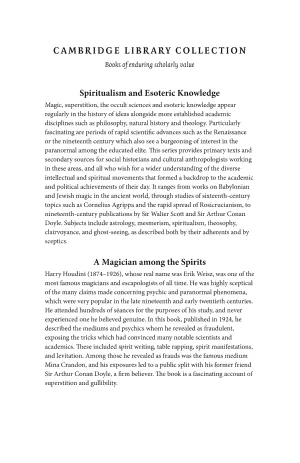
A Magician Among the Spirits
 78
78

A Magician Among the Spirits
Houdini’s 1924 ‘A Magician Among the Spirits’ is less a mystical exploration and more a forensic dissection of spiritualist fakery. The Great Houdini, a titan of escape artistry, turned his analytical mind to the spectral stage, meticulously cataloging the tricks of fraudulent mediums. His writing possesses a directness, fueled by a clear disdain for those who capitalized on grief. A particular strength lies in his detailed explanations of how common séance effects, like phantom voices or moving objects, were achieved through simple mechanical or psychological means. For instance, his discussion of how a supposedly spirit-controlled trumpet could be manipulated by a hidden assistant is chillingly practical. The limitation, however, is that the book’s focus is almost exclusively on debunking; it offers little exploration into the genuine psychological comfort spiritualism may have provided for some. Ultimately, 'A Magician Among the Spirits' stands as a potent, if one-sided, early exposé of paranormal fraud from a master of illusion.
📝 Description
78
Published in 1924, Harry Houdini's 'A Magician Among the Spirits' exposes fraudulent mediums.
Harry Houdini's 1924 book, 'A Magician Among the Spirits,' is his direct critique of the spiritualist movement prevalent in the early 20th century. Houdini, a renowned illusionist, uses his background to debunk the methods employed by mediums and psychics who exploited public grief. He meticulously details how phenomena like ectoplasm, spirit photography, and table tipping were faked, drawing on principles of misdirection, psychology, and stagecraft.
The book addresses the cultural climate following World War I, where many sought solace in contacting deceased loved ones. Houdini viewed these mediums as charlatans preying on the vulnerable, leading him into public opposition with prominent spiritualists. His work stands as a significant, albeit controversial, intervention against perceived psychic fraud, appealing to skeptics and historians interested in the era's occult beliefs and the psychology of deception.
This book fits within a tradition of skepticism and critical examination of supernatural claims, particularly those arising from periods of societal upheaval. While spiritualism itself is an esoteric tradition promising communication with the dead, Houdini's work represents a counterpoint, using rationalist and scientific methods to demystify alleged paranormal events. His approach aligns with a lineage of investigators who sought to expose trickery and credulity, framing the desire for spiritual contact through the lens of psychological manipulation and performance art.
💡 Why Read This Book?
• Learn specific methods fraudulent mediums used to simulate spirit communication, as detailed in Houdini's exposé chapters on ectoplasm and spirit photography. • Understand the psychological principles of misdirection and suggestion that Houdini observed being exploited during séances in the early 20th century. • Gain insight into Harry Houdini's personal crusade against spiritualist charlatans, particularly his motivations and methods during the 1920s spiritualist boom.
⭐ Reader Reviews
Honest opinions from readers who have explored this book.
❓ Frequently Asked Questions
When was 'A Magician Among the Spirits' first published?
'A Magician Among the Spirits' was first published in 1924, during the height of the spiritualist movement in America.
What was Harry Houdini's main motivation for writing this book?
Houdini's primary motivation was to expose fraudulent mediums who he believed were exploiting grieving individuals by faking supernatural communication.
Does Houdini discuss specific mediums in his book?
Yes, Houdini addresses numerous mediums and spiritualists by name, detailing their alleged deceptions and the methods they employed to create illusions.
What kind of phenomena does Houdini attempt to debunk?
The book covers phenomena such as spirit photography, ectoplasm, table-tilting, spirit voices, and materialization, explaining them through rational means.
Is this book a historical account or a practical guide to debunking?
It serves as both: a historical account of the spiritualist movement's fraudulent elements and a practical guide demonstrating debunking techniques based on magic and psychology.
What was the reception of 'A Magician Among the Spirits' upon its release?
The book was met with significant attention and controversy, aligning with Houdini's public persona as a crusader against spiritualist fraud, though spiritualists naturally disputed his claims.
🔮 Key Themes & Symbolism
The Art of Deception
Houdini’s central thesis is that many alleged supernatural occurrences are merely elaborate deceptions, akin to stage magic. He leverages his intimate knowledge of illusionary techniques to explain phenomena like ectoplasm and spirit voices. The book details how misdirection, confederates, and cleverly constructed props could fool even the most eager believers. This theme underscores his belief that rational explanation, rooted in the principles of performance and psychology, can unravel claims of the paranormal, positioning magic not as a supernatural force but as a sophisticated human art.
Spiritualism and Exploitation
The work serves as a stark critique of the spiritualist movement of the early 20th century, particularly its exploitation of the bereaved. Houdini recounts instances where mediums preyed on individuals seeking solace after World War I, charging exorbitant fees for fabricated communications with the dead. He argues that this commercialization of grief and hope is morally reprehensible and undermines genuine human connection. His exposé aims to protect the public from such charlatans by revealing their methods.
Skepticism vs. Belief
Houdini champions a rigorous skepticism, advocating for critical examination of extraordinary claims. He contrasts his own investigative approach with the often unquestioning faith of spiritualist adherents. The book explores the psychological factors that make people susceptible to belief in the supernatural, including wishful thinking and the desire for comfort. By presenting logical explanations, Houdini encourages readers to question phenomena that defy empirical evidence and to rely on reason over emotional appeals.
The Magician as Investigator
This book positions the magician not just as an entertainer but as a critical investigator of alleged psychic phenomena. Houdini applies his professional skills in observation, analysis, and understanding human psychology to dissect spiritualist claims. He demonstrates how the principles of stage magic are directly applicable to debunking claims of the paranormal. His work highlights the unique perspective a magician brings to understanding deception, making him an ideal candidate to critique the spiritualist movement of his era.
💬 Memorable Quotes
Direct passages from the work, attributed to the author.
“The public is eager to believe, and the cleverest among the fraudulent mediums know just how to play upon this eagerness.”
— Here, Houdini identifies the fundamental dynamic of spiritualist fraud: the medium's manipulation of the audience's desire to believe, especially in the face of loss or uncertainty.
“I have made it my business to find out how these things are done.”
— This statement captures Houdini's investigative approach. It reflects his methodical commitment to uncovering the practical, often mundane, explanations behind seemingly inexplicable phenomena.
“The methods of the spiritualists are easily explained by those who understand the science of conjuring.”
— This highlights Houdini's central argument: that the tricks of spiritualism are not supernatural but are, in fact, well-understood principles of magic and illusion.
💡 Key Ideas
Editorial paraphrase of the work's core concepts — not direct quotes.
There is no more important message to give the world than that of the necessity of looking out for yourselves.
This quote emphasizes Houdini's core philosophy: advocating for personal critical thinking and self-reliance rather than blindly accepting pronouncements, especially from those claiming supernatural authority.
Many people are willing to be deceived.
A blunt assessment of human psychology, this quote suggests that a significant part of the success of fraudulent mediums lies not just in their skill, but in the audience's predisposition to accept their claims.
🌙 Esoteric Significance
Tradition
While Houdini himself wasn't a practitioner of traditional esoteric lineages like Hermeticism or Kabbalah, his work critically engages with the spiritualist movement, which often incorporated elements from these traditions, particularly Theosophy. He approaches the subject from a rationalist, skeptical viewpoint, acting as a counterpoint to the more mystical interpretations prevalent in esoteric circles. His significance lies in applying principles of natural philosophy and empirical investigation to phenomena often relegated to the supernatural or esoteric.
Symbolism
The primary 'symbol' Houdini deconstructs is the séance itself—a ritualistic space designed to evoke the presence of spirits. He breaks down the symbolic elements: the darkened room, the draped table, the spirit trumpet, and the ethereal ectoplasm, revealing them as props in a carefully staged performance. He reframes these symbols not as conduits to the beyond, but as tools of deception. The absence of genuine spiritual manifestation becomes, in his analysis, a symbol of rational order prevailing over superstition.
Modern Relevance
Houdini's meticulous debunking techniques remain relevant for contemporary critical thinking and skepticism. His work informs modern discussions about misinformation, pseudoscientific claims, and the psychology of belief, particularly in the age of online 'psychics' and digital mediums. Thinkers and organizations focused on scientific literacy and debunking continue to reference his methods. His legacy influences how we analyze paranormal claims, urging a scientific and evidence-based approach, a principle championed by groups like the Skeptics Society.
👥 Who Should Read This Book
• Skeptics and critical thinkers seeking historical examples of paranormal debunking techniques. • Students of early 20th-century American culture and the history of spiritualism. • Performers and enthusiasts of magic interested in the intersection of illusion and belief.
📜 Historical Context
Published in 1924, 'A Magician Among the Spirits' emerged during a fervent period for spiritualism, amplified by the trauma of World War I and the subsequent loss of millions. This era saw a surge in mediums claiming to channel the deceased, offering solace to the grieving. Houdini’s book was a direct assault on this burgeoning industry, challenging figures like Arthur Conan Doyle, who was a prominent defender of spiritualism. The Society for Psychical Research, while investigating such claims, often adopted a more academic approach, whereas Houdini engaged in public, often confrontational, debunking. His work was controversial, met with fierce opposition from spiritualist organizations who saw him as a threat to their credibility and livelihood, yet it resonated with a growing skeptical public.
📔 Journal Prompts
The mechanics of ectoplasm as described by Houdini.
Houdini's critique of mediums exploiting grief after World War I.
The psychological appeal of spiritualism versus Houdini's rational explanations.
Analyzing a modern paranormal claim through Houdini's investigative lens.
The role of misdirection in both magic and spiritualist séances.
🗂️ Glossary
Spiritualism
A religious movement, popular in the 19th and early 20th centuries, that asserted the possibility of communicating with the spirits of the dead.
Medium
A person believed to be able to communicate with the spirits of the dead or to act as a conduit for supernatural forces.
Ectoplasm
A supposed gelatinous or viscous substance emitted by spiritualist mediums during séances, often claimed to be the physical manifestation of spirits.
Séance
A meeting where spiritualists attempt to contact the spirits of the dead, typically held in a darkened room.
Debunking
The act of exposing the falseness or hollowness of a myth, idea, or belief.
Misdirection
The technique of diverting attention from one thing to another, commonly used by magicians to conceal their actions.
Charlatan
A person falsely claiming to have a special knowledge or skill, especially in medicine; a fraud.
This book appears in 1 collection
🔮 Readers Also Liked
Browse all →








From the “Spiritualism” Collection
View all →

More Free Occult Philosophy Books
View all →