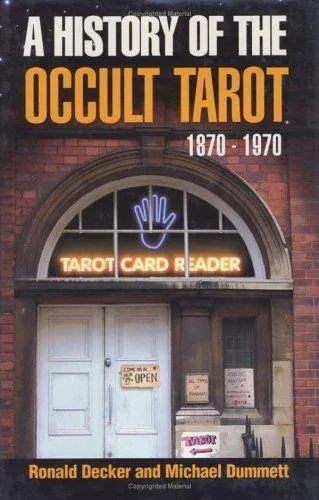
A history of the occult tarot, 1870-1970
 76
76

A history of the occult tarot, 1870-1970
Decker and Dummett's 'A History of the Occult Tarot, 1870-1970' offers a rigorous, if occasionally dense, examination of a pivotal century for the cards. Its strength lies in its scholarly approach, meticulously detailing the lineage of occult interpretations, particularly the significant influence of the Hermetic Order of the Golden Dawn and its members like Arthur Edward Waite. The authors effectively demonstrate how the tarot transitioned from a parlor game to a cornerstone of Western esoteric practice. A limitation, however, is the sheer academic weight, which may prove daunting for casual readers seeking only practical divination techniques. The detailed analysis of the Rider-Waite-Smith deck's creation, for instance, highlights a fascinating interplay between symbolism and artistic execution, but requires sustained attention. Ultimately, this is a foundational text for understanding the historical architecture of occult tarot, rather than a guide to its contemporary use.
📝 Description
76
Decker and Dummett's 1991 book traces the occult tarot's development between 1870 and 1970.
This volume details the transformation of the tarot from a game and divination tool into a complex symbolic system during the occult revival. Between 1870 and 1970, figures like Eliphas Lévi and members of the Hermetic Order of the Golden Dawn assigned Kabbalistic, astrological, and magical correspondences to the cards. The authors examine how these interpretations shaped the tarot's use in spiritual development and magical practice. The book moves beyond simple card meanings to show the intellectual and historical forces that influenced its mystical applications. It is a meticulous chronicle of the occult tarot's evolution and its integration into various esoteric traditions. Researchers of cartomancy, occult history, and the academic study of tarot will find this work valuable. It addresses the historical construction of occult systems and the academic underpinnings of tarot scholarship.
This book situates the tarot within the late 19th and early 20th century occult revival in Western esotericism. It connects tarot's symbolic reinterpretation to the broader resurgence of interest in Hermetic philosophy, Kabbalah, and ceremonial magic. The authors show how these traditions, particularly through organizations like the Golden Dawn, influenced the way tarot cards were understood and employed, moving their application from simple fortune-telling to a system for magical and spiritual advancement.
💡 Why Read This Book?
• Gain a precise understanding of the Hermetic Order of the Golden Dawn's role in codifying occult tarot interpretations from 1888 onwards, a contribution unmatched in its historical impact. • Learn about the specific correspondences between tarot Major Arcana and the Kabbalistic Tree of Life as developed during the late 19th century, a core concept often superficially treated elsewhere. • Discover the historical evolution of the Rider-Waite-Smith deck's symbolism, including the precise contributions of A.E. Waite and Pamela Colman Smith, offering a depth of knowledge unavailable in general tarot books.
⭐ Reader Reviews
Honest opinions from readers who have explored this book.
❓ Frequently Asked Questions
What is the primary focus of 'A History of the Occult Tarot, 1870-1970'?
The book meticulously chronicles the development of occult interpretations of tarot cards between 1870 and 1970, focusing on how esoteric societies and thinkers integrated the cards into systems like Kabbalah and Hermeticism.
Who were some key figures influencing the occult tarot during this period?
Key figures include Eliphas Lévi, whose early works laid groundwork, and members of the Hermetic Order of the Golden Dawn like Arthur Edward Waite, who commissioned the influential Rider-Waite-Smith deck.
How did the tarot's role change between 1870 and 1970?
The tarot evolved from a game and simple fortune-telling tool into a complex system of spiritual and magical symbolism, deeply integrated with Western esoteric traditions and philosophies.
What is the significance of the Rider-Waite-Smith deck in this historical context?
The Rider-Waite-Smith deck, published in 1909, is central as it visually codified many occult interpretations developed during this era, particularly Waite's Kabbalistic and symbolic associations.
Is this book suitable for beginners interested in reading tarot cards?
While it provides crucial historical context, the book is scholarly and academic, making it more suitable for researchers and serious students of esoteric history than for those seeking introductory divination guides.
What is the relationship between the book's authors, Decker and Dummett?
Michael Dummett, a renowned tarot historian, is the original author, and Ronald Decker is credited with a significant contribution or revision, as indicated by the publication details.
🔮 Key Themes & Symbolism
Golden Dawn's Tarot Codification
This work extensively details how the Hermetic Order of the Golden Dawn, founded in 1888, systematically integrated tarot symbolism into its magical curriculum. It examines how members like A.E. Waite and Aleister Crowley developed complex correspondences linking the Major Arcana to the Kabbalistic Tree of Life and astrological principles, transforming the tarot into a key instrument for ritual and self-initiation within their system.
The Rider-Waite-Smith Deck
The book provides a deep dive into the creation and symbolic intent behind the Rider-Waite-Smith deck, first published in 1909. It analyzes the innovative approach of illustrating all 78 cards, including the Pips, with meaningful scenes, a departure from earlier decks. This section explores the collaborative effort and the specific esoteric doctrines that informed Pamela Colman Smith's iconic artwork under Arthur Edward Waite's direction.
Tarot as Esoteric Philosophy
Beyond divination, the book charts the tarot's redefinition as a vehicle for complex esoteric philosophies during the specified century. It illustrates how thinkers used the cards to represent concepts from Hermeticism, Gnosticism, and Renaissance magical traditions, viewing the deck as a symbolic map of the cosmos, human psychology, and the path of spiritual evolution.
Academic vs. Esoteric Approaches
The work navigates the intersection of scholarly historical research and the esoteric traditions it describes. It carefully distinguishes between historical fact, the interpretations of occultists, and later academic analysis, providing a critical framework for understanding how the occult tarot has been studied and practiced over time.
💬 Memorable Quotes
Direct passages from the work, attributed to the author.
“The occult tarot is not merely a divinatory tool, but a complex symbolic language reflecting esoteric doctrines.”
— This statement highlights the central argument that the tarot's significance during this period transcended simple fortune-telling, becoming a codified system for expressing profound mystical and philosophical ideas within occult circles.
“The Hermetic Order of the Golden Dawn played a central role in mapping the tarot onto the Kabbalistic Tree of Life.”
— This emphasizes the significant, systematic work done by the Golden Dawn in associating each tarot card with specific Sephiroth and paths on the Tree of Life, thereby embedding the cards within a detailed metaphysical framework.
“Arthur Edward Waite sought to imbue the tarot with a deeper, more philosophical meaning beyond popular cartomancy.”
— This interpretation points to Waite's specific intention to elevate the tarot's status by connecting it to esoteric philosophy and spiritual development, moving away from purely predictive or superficial applications.
“Pamela Colman Smith's visual interpretations brought new levels of narrative and symbolic depth to the tarot.”
— This acknowledges the artistic contribution of Smith, suggesting that her illustrative style for the Rider-Waite-Smith deck was instrumental in conveying complex symbolic meanings visually, making them more accessible and impactful.
“The period from 1870 to 1970 marks a critical phase in the tarot's occult revival and intellectualization.”
— This frames the book's temporal scope as a distinct and vital era where the tarot underwent a significant transformation, becoming a subject of serious esoteric study and symbolic reconstruction.
🌙 Esoteric Significance
Tradition
This work sits firmly within the Hermetic and Kabbalistic traditions that flourished during the late 19th and early 20th centuries. It details how the tarot, particularly the Major Arcana, was mapped onto the Kabbalistic Tree of Life by figures associated with the Hermetic Order of the Golden Dawn, transforming it from a divinatory tool into a symbolic representation of cosmic and spiritual processes.
Symbolism
Key symbols explored include the Major Arcana's correspondence with the paths and Sephiroth of the Kabbalistic Tree of Life, representing stages of spiritual ascent and descent. The Fool (0) and the World (XXI), for instance, are examined in terms of their positions and meanings within these esoteric frameworks, illustrating the tarot's function as a map of consciousness and creation.
Modern Relevance
Contemporary esoteric practitioners, particularly those working with Hermeticism, Kabbalah, and ceremonial magic, continue to draw heavily on the interpretations codified during this 1870-1970 period. The Rider-Waite-Smith deck, a product of this era, remains the most widely used deck, and its symbolic language, as detailed in this book, informs modern tarot study and practice globally.
👥 Who Should Read This Book
• Researchers of Western Esotericism: Individuals studying the history and development of occultism, secret societies, and their philosophical underpinnings will find invaluable primary source analysis. • Serious Tarot Students: Those seeking to understand the historical evolution of tarot symbolism beyond basic interpretations, particularly its connection to Kabbalah and Hermeticism, will gain crucial context. • Comparative Religion Scholars: Academics interested in how different belief systems adopt and adapt symbolic systems, like the tarot, for spiritual and magical purposes during a specific historical period.
📜 Historical Context
The period between 1870 and 1970 was a fertile ground for the occult tarot, deeply intertwined with the broader Western esoteric revival. This era saw the decline of purely folkloric divination and the rise of organized esoteric societies aiming to synthesize ancient wisdom traditions. Figures like Eliphas Lévi in the mid-19th century laid the groundwork, but it was the Hermetic Order of the Golden Dawn, founded in 1888, that systematically integrated the tarot into its magical system. Their members, including Arthur Edward Waite and Aleister Crowley, developed detailed Kabbalistic and astrological correspondences. This intellectual ferment occurred alongside other spiritual movements, such as Theosophy, which also explored ancient symbolism. The reception was largely within these esoteric circles, with wider academic engagement only beginning much later. The publication of the Rider-Waite-Smith deck in 1909 marked a significant point, solidifying a particular occult interpretation that would dominate for decades.
📔 Journal Prompts
The mapping of tarot Major Arcana onto the Kabbalistic Tree of Life: explore one specific path or Sephirah connection.
Arthur Edward Waite's conceptualization of the Rider-Waite-Smith deck's symbolism.
The Hermetic Order of the Golden Dawn's influence on tarot interpretation.
The transition of tarot from game to esoteric philosophical system, circa 1870-1970.
Pamela Colman Smith's visual language within the Rider-Waite-Smith deck.
🗂️ Glossary
Kabbalah
A body of mystical teachings and esoteric traditions associated with Judaism, often involving complex symbolic systems like the Tree of Life, which became influential in Western esotericism.
Hermeticism
A philosophical and religious tradition based on writings attributed to Hermes Trismegistus, emphasizing divine wisdom, the correspondence between macrocosm and microcosm, and spiritual alchemy.
Major Arcana
The trump cards of a tarot deck, typically numbered 0 through 21, which represent significant life lessons, archetypal forces, and spiritual milestones.
Hermetic Order of the Golden Dawn
A late 19th-century secret society that was influential in the development of modern Western occultism, integrating Kabbalah, Hermeticism, astrology, and tarot into its teachings.
Rider-Waite-Smith Deck
An iconic tarot deck first published in 1909, notable for its full-scene illustrations on all 78 cards, created by Pamela Colman Smith under the direction of Arthur Edward Waite.
Sephiroth
The ten divine emanations or attributes described in Kabbalistic cosmology, forming the structure of the Tree of Life.
Cartomancy
The practice of divination using playing cards or tarot cards.
🔮 Readers Also Liked
Browse all →








More Free Divination & Tarot Books
View all →