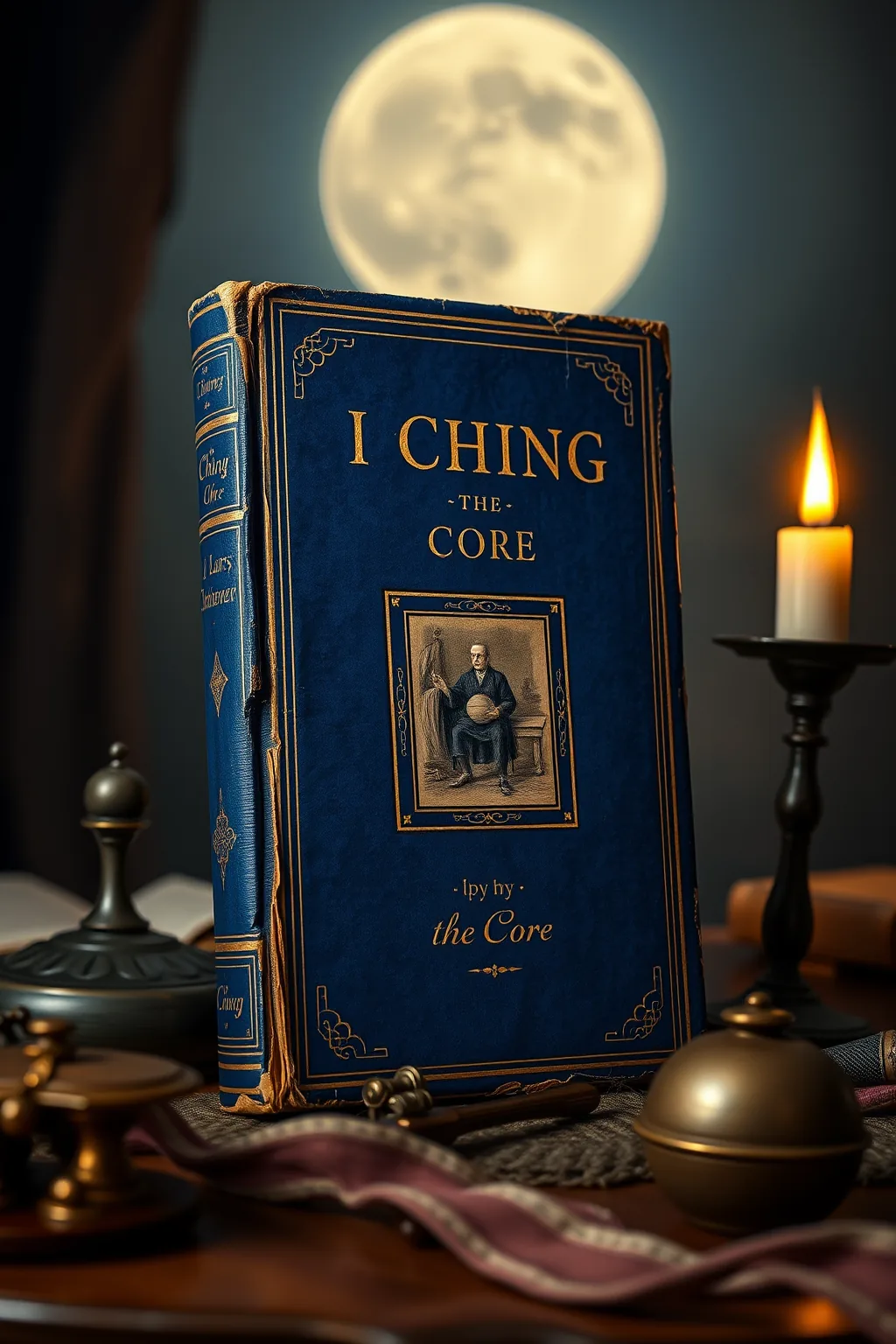
I Ching - the Core
 61
61

I Ching - the Core



Marcus Thorne (Esoteric Sciences Reviewer) — Lars Christensen's 'I Ching - the Core' offers a luminous and deeply insightful exploration of this foundational text of Eastern esotericism. Christensen avoids superficial interpretations, instead guiding readers towards a profound understanding of the I Ching's philosophical underpinnings and its role as a dynamic system of cosmic interconnectedness. The book excels in revealing the symbolic language of the hexagrams, presenting them not as static pronouncements but as fluid expressions of universal principles. Ideal for dedicated students of divination, philosophers, and anyone seeking a more profound engagement with ancient wisdom, 'I Ching - the Core' is an indispensable addition to any esoteric library, offering clarity and depth for both novice and seasoned practitioners.
📝 Description
61
Lars Christensen's 'I Ching - the Core' (2017) deciphers the Book of Changes beyond simple divination.
Published in 2017, Lars Christensen's 'I Ching - the Core' examines the ancient Chinese oracle. The book goes beyond its use as a fortune-telling tool, instead focusing on the I Ching as a system that maps cosmic patterns and their connection to human life. Christensen breaks down the complexities of the 64 hexagrams and their changing lines, explaining the subtle forces that influence existence. It discusses concepts like the cyclical nature of time, the balance of Yin and Yang, and the archetypal energies that shape both our internal experiences and the external world.
This volume serves as an initiatory text for those seeking a deeper comprehension of reality's underlying structures. Its aim is to provide guidance for personal development and spiritual understanding. The book offers philosophical insights and practical advice for approaching life's changes with greater awareness and composure. It presents a method for engaging with a dialogue between ancient symbolism and contemporary concerns.
The I Ching is a foundational text within Chinese philosophy and esoteric traditions, dating back millennia. It is understood not only as a divinatory tool but as a cosmological map reflecting universal principles. Christensen's work situates itself within this understanding, treating the Book of Changes as a system for comprehending the dynamic interplay of forces that govern the universe and human affairs. It connects the ancient text to contemporary needs for self-understanding and navigating life's complexities.
💡 Why Read This Book?
Unlock the profound wisdom of the I Ching with 'I Ching - the Core'. This book is for seekers who desire more than surface-level divination, offering deep insights into cosmic patterns, personal transformation, and the philosophy of change. Ideal for students of Eastern thought, practitioners of esoteric arts, and anyone yearning for a richer understanding of life's interconnectedness.
⭐ Reader Reviews
Honest opinions from readers who have explored this book.
❓ Frequently Asked Questions
What is the I Ching?
The I Ching, or Book of Changes, is an ancient Chinese divination text and philosophical classic, revered for its wisdom on change, cycles, and the interplay of cosmic forces. It uses hexagrams to offer guidance and insight into life's situations.
Who was Lars Christensen?
Lars Christensen was a scholar and practitioner dedicated to exploring and elucidating esoteric traditions. His work on the I Ching aims to make its profound teachings accessible to a modern audience.
How does the I Ching work as a divination tool?
The I Ching is consulted by casting coins or yarrow stalks to generate hexagrams. These hexagrams, composed of six lines (broken for Yin, solid for Yang), are then interpreted based on their symbolic meanings and textual commentaries.
Is 'I Ching - the Core' suitable for beginners?
Yes, while it delves into profound depths, Christensen's approach is designed to be accessible. Beginners will find it a solid foundation, while experienced practitioners will appreciate its nuanced interpretations and esoteric focus.
What is the philosophical significance of the I Ching?
The I Ching offers a sophisticated philosophical framework emphasizing constant flux, balance (Yin and Yang), and the interconnectedness of all phenomena. It teaches adaptability and understanding the opportune moment for action.
🔮 Key Themes & Symbolism
The Unfolding of Cosmic Cycles
This theme looks at the I Ching's central tenet: the perpetual motion and transformation inherent in the universe. Christensen illuminates how the sixty-four hexagrams represent distinct stages and patterns within these grand cycles, mirroring the ebb and flow of nature, human experience, and spiritual evolution. Readers will gain an understanding of how to perceive these cycles in their own lives, recognizing periods of growth, stagnation, and transition, and learning to align their actions with the opportune moments dictated by cosmic timing.
The Dance of Yin and Yang
At the heart of the I Ching lies the dynamic interplay of Yin (passive, receptive, dark) and Yang (active, creative, light). Christensen meticulously unpacks how these fundamental forces manifest in each hexagram, shaping the nature of situations and influencing outcomes. This section explores the essential balance and harmony required between these polarities, guiding the reader to cultivate inner equilibrium and navigate external conflicts by understanding the ebb and flow of opposing energies in all aspects of existence.
Symbolic Language and Archetypal Wisdom
The I Ching's power lies in its rich symbolic language, where each trigram and hexagram evokes profound archetypal imagery. Christensen guides the reader through the layers of meaning embedded in these symbols, revealing how they serve as a cosmic grammar for understanding universal principles. This theme explores the archetypal wisdom embedded within the I Ching, offering a framework for interpreting life's events through the lens of timeless patterns and universal human experiences, fostering deeper self-awareness and intuitive insight.
💬 Memorable Quotes
Direct passages from the work, attributed to the author.
“The universe is a ceaseless river of change.”
— This highlights the core philosophy of the I Ching, emphasizing that constant flux is the fundamental nature of reality, and understanding this is key to navigating life.
“Wisdom is found not in knowing the future, but in understanding the present.”
— This emphasizes the I Ching's practical application – it's a tool for present moment awareness and informed decision-making, rather than passive prophecy.
“The hexagrams are elements of the Tao.”
— This poetic statement links the I Ching directly to the ultimate principle of the universe, suggesting its symbols are divine manifestations.
“Embrace the flow, resist not the tide.”
— A concise encapsulation of the I Ching's advice on adaptability and accepting the natural course of events for harmonious living.
💡 Key Ideas
Editorial paraphrase of the work's core concepts — not direct quotes.
In stillness, find the seeds of movement.
This quote speaks to the subtle interplay between Yin and Yang, suggesting that periods of apparent inactivity are crucial for future growth and potential.
🌙 Esoteric Significance
Tradition
The I Ching is deeply rooted in ancient Chinese Taoist and Confucian traditions, serving as a bridge between the material and spiritual realms. Esoterically, it is viewed as a cosmogram, a map of the universe's underlying patterns and energies. It embodies principles of cosmic order, balance, and cyclical transformation, making it a foundational text for understanding concepts like Qi (life force), Yin and Yang dynamics, and the subtle interplay of forces that govern existence.
Symbolism
The core symbolism revolves around the eight trigrams (combinations of three lines) and the sixty-four hexagrams (combinations of two trigrams). Each line (solid for Yang, broken for Yin) and each combination carries profound symbolic meaning, representing archetypal forces, natural phenomena, and human situations. The changing lines within a hexagram symbolize the dynamic nature of reality, illustrating how situations evolve and transform, offering guidance on navigating these shifts.
Modern Relevance
In contemporary times, the I Ching remains remarkably relevant as a tool for self-discovery, ethical guidance, and psychological insight. Its emphasis on adaptability, understanding cyclical patterns, and balancing opposing forces offers a powerful framework for working through the complexities of modern life. It provides a contemplative practice for gaining clarity, making informed decisions, and fostering a deeper connection to the universal currents that shape our individual and collective destinies.
👥 Who Should Read This Book
This profound exploration of the I Ching is essential for a diverse audience. **Beginners** seeking an accessible yet deep introduction to this ancient oracle will find Christensen's clear explanations invaluable. **Scholars** of Eastern philosophy and comparative religion will appreciate the nuanced insights and thoroughness. **Spiritual seekers** yearning for a deeper understanding of cosmic principles and personal transformation will find profound guidance. **Practitioners of divination and esoteric arts** will discover new layers of interpretation and practical application for their craft, enhancing their ability to consult the wisdom of the Book of Changes.
📜 Historical Context
The I Ching, or Book of Changes, is one of the oldest and most revered texts in Chinese civilization, with origins stretching back over three millennia. Its compilation and evolution span various dynasties, reflecting shifting philosophical and cosmological understandings. Initially a divinatory manual, it was later imbued with profound philosophical and ethical interpretations by Confucian scholars and Taoist mystics. During the Han Dynasty, it became a central to the Confucian canon, influencing governance, ethics, and personal cultivation. Its influence extended beyond China, impacting Korean, Japanese, and Vietnamese thought, and eventually reaching the West, where it captivated philosophers, psychologists, and esotericists alike in the 20th century. Lars Christensen's work engages with this rich historical and philosophical collection, presenting the I Ching not merely as an ancient artifact but as a living source of wisdom.
📔 Journal Prompts
Reflect on a recent significant change in your life. How might the principles of the I Ching's hexagrams apply to this transition?
Consider the balance of Yin and Yang in your daily life. Where do you feel an imbalance, and how can you cultivate greater harmony?
Choose a hexagram that appeals to you currently and meditate on its archetypal imagery. What message does it hold for your present situation?
How can understanding cosmic cycles, as depicted in the I Ching, help you approach challenges and opportunities with greater wisdom?
Explore the concept of 'opportune moment' (Shih) in the I Ching. How can you better discern and act upon these moments in your own life?
🗂️ Glossary
Hexagram
A symbol composed of six lines, either solid (Yang) or broken (Yin), representing a specific situation or cosmic pattern within the I Ching.
Trigram
A basic building block of the hexagram, consisting of three lines (Yang or Yin), representing fundamental elements like Heaven, Earth, Thunder, Water, etc.
Yin
The passive, receptive, dark, and feminine principle in Taoist philosophy, often associated with stillness, introspection, and the moon.
Yang
The active, creative, light, and masculine principle in Taoist philosophy, often associated with movement, outward expression, and the sun.
Tao
The fundamental, ineffable principle of the universe in Taoism, representing the natural order, the Way, and the source of all existence.
This book appears in 3 collections
🔮 Readers Also Liked
Browse all →








From the “Tarot” Collection
View all →







More Free Divination & Tarot Books
View all →