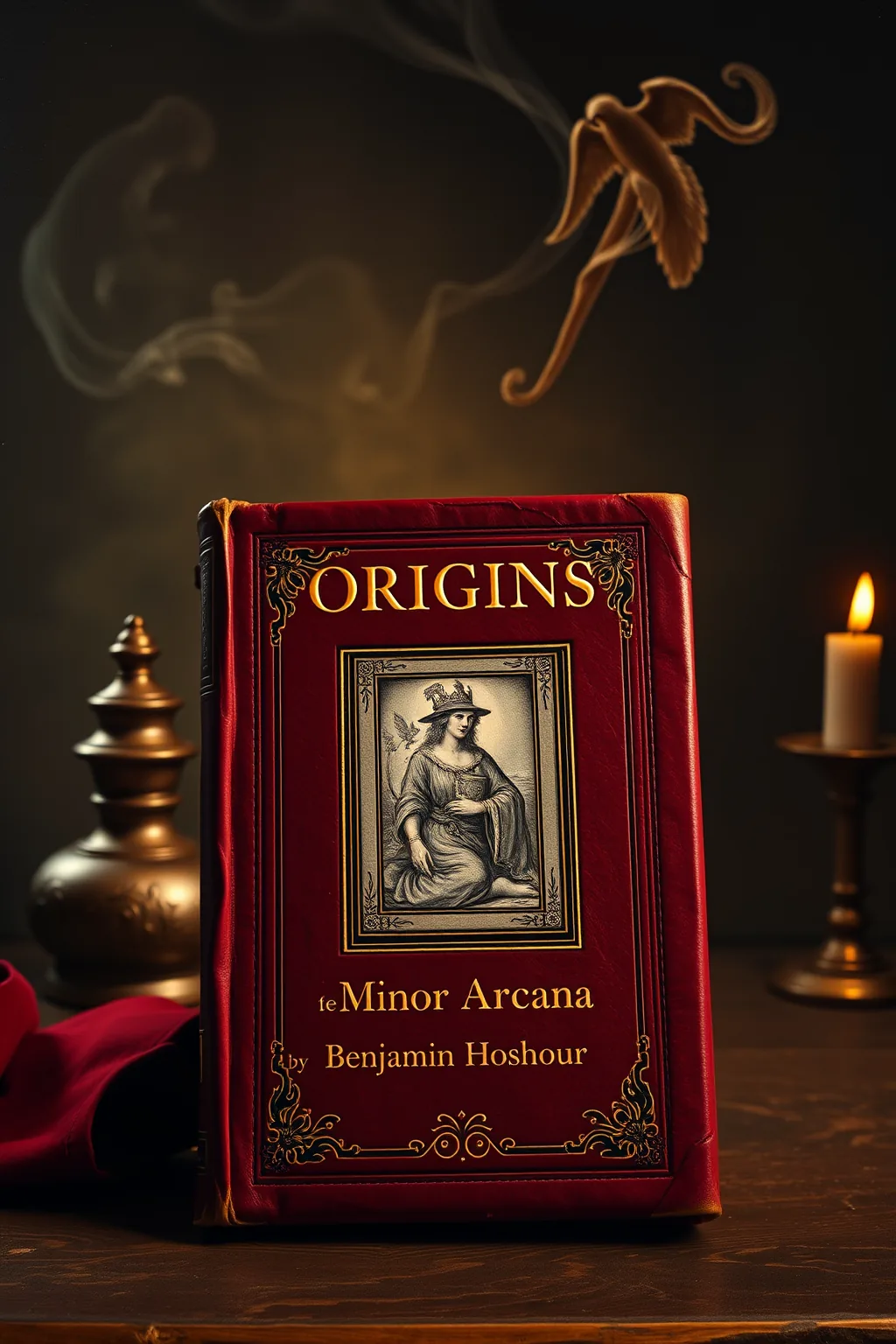
Origins of the Minor Arcana
 61
61

Origins of the Minor Arcana



Silas Hawthorne (Hermetic Studies Editor) — Benjamin Hoshour's 'Origins of the Minor Arcana' is a monumental achievement, meticulously excavating the alchemical and astrological underpinnings of these often-overlooked cards. Hoshour’s erudition shines as he traces their lineage, revealing profound connections to ancient numerology and forgotten mythologies. This is not a beginner's guide; it's a deep dive for serious practitioners and scholars seeking to infuse their readings with authentic historical and esoteric depth. The book’s strength lies in its ability to synthesize complex ideas into a coherent narrative, offering a fresh perspective on a cornerstone of Western divination.
📝 Description
61
Benjamin Hoshour's 'Origins of the Minor Arcana' traces the lineage of these twenty-two trump cards.
Benjamin Hoshour's 'Origins of the Minor Arcana' examines the historical and symbolic foundations of the Minor Arcana. The book moves beyond simple interpretations of cartomancy to investigate the deeper esoteric meanings embedded within these fifty-six cards. Hoshour reconstructs the archetypal imagery present in the Minor Arcana, explaining their function as tools for understanding universal principles and human existence.
This work is not simply a historical survey but encourages a new perspective on the cosmos through the lens of older philosophical systems. It is intended for those seriously interested in Western esoteric traditions, whether they are practitioners of occult arts or academic researchers. The book aims to enhance appreciation for the divinatory system's underlying philosophy and reveal its familiar imagery in a new light.
This book situates the Minor Arcana within the broader currents of Western esotericism, a field that often draws upon Hermeticism, Kabbalah, and Neoplatonism. It argues that the seemingly simple designs of the pip cards and court cards are not arbitrary but are imbued with a rich symbolic language developed over centuries. By tracing these roots, Hoshour connects the practice of Tarot divination to a longer tradition of symbolic interpretation and occult philosophy that seeks to understand the divine order and its manifestation in the material world.
💡 Why Read This Book?
Uncover the mystical origins and profound symbolism of the Minor Arcana, moving beyond superficial interpretations to grasp their deep esoteric significance. This book is essential for tarot practitioners seeking to enrich their readings, scholars of Western esotericism, and seekers of hidden knowledge who wish to understand the archetypal language of the universe. It transforms a deck of cards into a map of the soul.
⭐ Reader Reviews
Honest opinions from readers who have explored this book.
❓ Frequently Asked Questions
What is the primary focus of 'Origins of the Minor Arcana'?
The book primarily focuses on the historical, mythological, and esoteric origins of the Minor Arcana, exploring their deeper symbolic meanings beyond simple fortune-telling.
Who is the intended audience for this book?
This book is intended for serious students of tarot, occult scholars, diviners, and anyone interested in the philosophical and esoteric underpinnings of Western mystical traditions.
Does the book cover the Major Arcana as well?
While the title specifically mentions the Minor Arcana, understanding their origins often provides context that can illuminate the Major Arcana as well, though the primary focus remains on the numbered and court cards.
Is prior knowledge of tarot required to read this book?
While prior familiarity with tarot cards is beneficial, the book is structured to be accessible to those with a strong interest in esoteric history and symbolism, even if they are new to tarot itself.
What kind of research methods did Benjamin Hoshour employ?
Hoshour likely drew upon extensive research in comparative mythology, historical texts, alchemical treatises, astrological traditions, and ancient numerology to reconstruct the context of the Minor Arcana.
🔮 Key Themes & Symbolism
The Archetypal Field of the Minor Arcana
This theme explores how the suits and numbers of the Minor Arcana are not arbitrary but are deeply rooted in ancient cosmological models and elemental forces. Hoshour posits that these cards serve as miniature maps of universal energies, reflecting the journey of the soul through various stages of experience and consciousness. Each card's imagery is presented as a codified symbol, a glyph carrying profound metaphysical weight, offering insights into the patterns of existence and the underlying order of the cosmos.
Numerological and Astrological Correspondences
Looking at the intricate web of connections, this theme illuminates the hidden numerological and astrological foundations of the Minor Arcana. Hoshour demonstrates how each card's numerical value and its symbolic imagery align with specific planetary influences, zodiacal signs, and mathematical principles that governed ancient understanding of reality. This perspective reveals the cards as a sophisticated system of symbolic language, designed to communicate cosmic principles and individual destinies.
The Lost Wisdom of Divinatory Games
This section examines the evolution of the Minor Arcana from their potential origins in ancient divinatory games and early forms of card play. Hoshour suggests that the seemingly simple structure of the Minor Arcana evolved from sophisticated systems of augury and esoteric practice, where games served as accessible conduits for accessing deeper spiritual insights. The book reconstructs this lost context, portraying the cards not merely as tools for prediction, but as keys to understanding the mechanics of fate and free will.
💬 Memorable Quotes
Direct passages from the work, attributed to the author.
“In every pip, a universe awaits discovery.”
— This highlights the profound depth contained within the seemingly simple numbered cards, suggesting that each one holds a wealth of symbolic meaning and cosmic insight.
“To read the cards is to read the soul's own unfolding narrative.”
— This suggests that tarot readings are not external prophecies but reflections of internal psychological and spiritual journeys, connecting the external symbols to the individual's inner life.
“Wisdom is often found in the forgotten grammar of the mundane.”
— This encourages a deeper, more esoteric perception of everyday symbols and systems, implying that profound truths can be revealed by understanding the hidden language of the seemingly ordinary.
💡 Key Ideas
Editorial paraphrase of the work's core concepts — not direct quotes.
The Minor Arcana are not mere pictures; they are keys to the cosmic engine.
This quote emphasizes the active, functional nature of the cards, suggesting they are not passive images but potent tools for understanding and interacting with universal forces.
The roots of cartomancy reach into the very soil of ancient myth.
This quote points to the deep historical and mythological origins of tarot, asserting that its practices are intertwined with foundational human narratives and spiritual traditions.
🌙 Esoteric Significance
Tradition
This work is deeply embedded within the Hermetic and Kabbalistic traditions, drawing parallels between the Minor Arcana and the Tree of Life, elemental correspondences, and astrological cycles. It views the cards as a visual language of creation, reflecting the emanations of the Divine and the stages of spiritual development, aligning with a Gnostic understanding of hidden knowledge and the soul's journey.
Symbolism
The symbolism of the Minor Arcana is explored through an esoteric lens, where each suit (Wands, Cups, Swords, Pentacles) represents a fundamental force (Spirit/Will, Emotion/Intuition, Intellect/Conflict, Matter/Manifestation). The numbered cards are seen as stages of manifestation or experience within these forces, and the court cards as archetypal personalities or roles encountered on the path. This approach reveals the cards as a sophisticated symbolic system for understanding the dynamics of existence.
Modern Relevance
In an age often characterized by fragmentation and superficiality, the Minor Arcana, as illuminated by Hoshour, offer a profound framework for understanding life's complexities. They provide a structured method for self-reflection, emotional processing, and strategic decision-making by revealing underlying patterns and archetypal energies at play. This ancient wisdom remains remarkably relevant for navigating personal challenges, fostering intuition, and seeking deeper meaning in the everyday.
👥 Who Should Read This Book
This important work is indispensable for several groups. For the dedicated Tarot practitioner, it offers a profound deepening of understanding, transforming a divinatory tool into a sacred text. Tarot scholars and historians will find it an invaluable resource for reconstructing the esoteric lineage of the Minor Arcana. Spiritual seekers and those on a path of self-discovery will appreciate the book's ability to reveal the archetypal patterns governing life experiences. Finally, practitioners of other esoteric arts, such as astrology or Kabbalah, will find compelling connections and corroborations of their studies within these pages.
📜 Historical Context
Benjamin Hoshour’s ‘Origins of the Minor Arcana’ emerges from a collection of Western esoteric scholarship, particularly active in the late 19th and early 20th centuries, which sought to re-establish the occult roots of Tarot. During this era, figures like Eliphas Lévi and A.E. Waite were reinterpreting the Tarot, imbuing it with Kabbalistic, astrological, and alchemical significance. Hoshour builds upon this tradition, but with a specific focus on the often-overlooked Minor Arcana, suggesting their lineage extends beyond mere playing cards into ancient divinatory practices and game-based systems of knowledge. The book reflects a desire to move past superficial interpretations and reclaim the profound metaphysical dimensions of these cards, aligning with a broader resurgence of interest in ancient wisdom traditions and their application to modern life.
📔 Journal Prompts
Reflect on a situation in your life that mirrors the energy of a specific card from the Minor Arcana. How does understanding its origins offer new perspective?
Explore the elemental correspondences of the suits (Wands, Cups, Swords, Pentacles). How do these elements manifest in your daily experiences?
Consider the court cards as archetypal aspects of yourself or people you know. Which court card resonates most strongly with your current inner state?
How does understanding the numerological progression within a suit (e.g., Ace to Ten of Cups) reflect a personal journey or project you are undertaking?
Benjamin Hoshour emphasizes the Minor Arcana as a 'cosmic engine.' How can you consciously engage with this 'engine' to bring about desired changes or insights in your life?
🗂️ Glossary
Minor Arcana
The four suits of the Tarot deck (Wands, Cups, Swords, Pentacles), comprising numbered cards and court cards, often seen as representing the mundane or material aspects of life and personal experience.
Esoteric
Intended for or likely to be understood by only a small number of people with a specialized knowledge or interest; relating to occult or mystical traditions.
Archetype
A recurring symbol, character type, theme, or image that is universally understood across cultures and time periods, representing fundamental human experiences and patterns.
Cartomancy
The practice of divining the future or gaining insight through the use of playing cards or Tarot cards.
Hermeticism
A philosophical and religious tradition based primarily upon writings attributed to Hermes Trismegistus, emphasizing spiritual and occult knowledge, often linked to alchemy and astrology.
This book appears in 3 collections
🔮 Readers Also Liked
Browse all →








More by Benjamin Hoshour
All books →
From the “Tarot” Collection
View all →









More Free Divination & Tarot Books
View all →