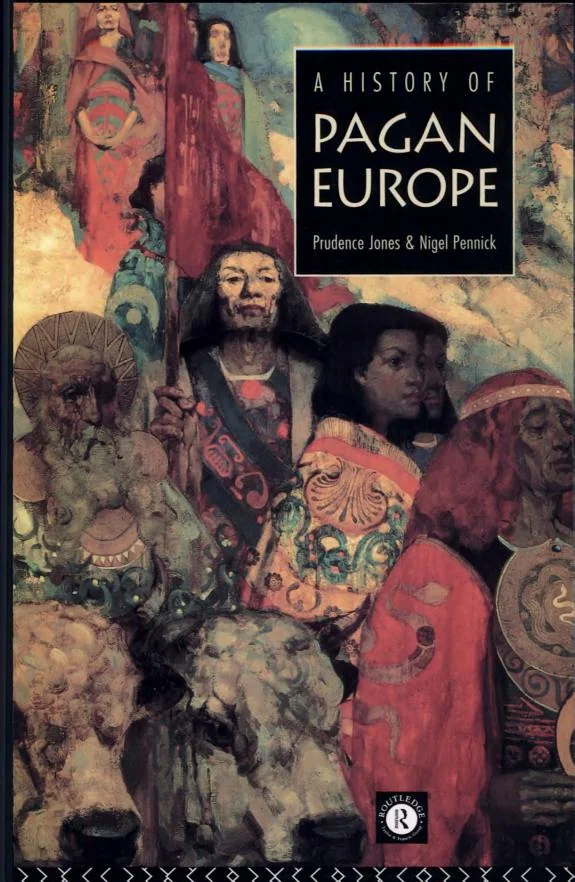
A History of Pagan Europe
 75
75

A History of Pagan Europe
Prudence Jones and Nigel Pennick’s A History of Pagan Europe provides a broad, accessible survey of indigenous European religious traditions. Its strength lies in its extensive scope, moving from the Bronze Age Aegean to the post-Soviet revivals. The inclusion of illustrations enhances the visual understanding of artifacts and symbols. However, the sheer breadth sometimes leads to a lack of depth in specific regional analyses. A particularly rewarding section examines the surviving evidence for pre-Christian Slavic and Baltic practices, showcasing the authors' meticulous research into fragmented sources. While the book successfully argues for Paganism's persistent force, its focus on historical continuity might occasionally overlook the radical reconstructions inherent in modern Paganism. It is a foundational text for understanding the historical underpinnings of European indigenous spirituality.
📝 Description
75
Published in 1997, A History of Pagan Europe surveys European Pagan traditions from antiquity to modern revivals.
Prudence Jones and Nigel Pennick's 1997 book traces the historical presence of Paganism across Europe. It argues against viewing Paganism as a mere relic, instead highlighting its continuous influence on culture and thought from ancient animistic beliefs and serpent goddesses in Crete to the re-emergence of indigenous religions in Eastern Europe in the late 20th century.
The book is intended for readers interested in European spirituality outside dominant monotheistic frameworks. It will appeal to historians of religion, cultural anthropologists, and those studying pre-Christian European beliefs and their connections to contemporary Pagan practice. Jones and Pennick offer a detailed historical perspective on Paganism, moving beyond generalized theories to specific regional and temporal analyses, providing a counter-narrative to a perceived monolithic history of Christianity in Europe.
It examines the persistence of animism, the significance of sacred landscapes and natural cycles in worship, and the reconstruction of fragmented religious practices. The authors also explore the relationship between Paganism and later dominant religions, noting instances of cultural syncretism and the endurance of specific symbols and ritual forms across different eras.
This work situates itself within the study of European indigenous religions, often termed Paganism, which experienced a global resurgence in the late 20th century. Jones and Pennick's historical approach provides a scholarly grounding for understanding the diverse expressions of nature-based spiritualities that predate and, in some cases, coexist with monotheistic traditions. Their focus on historical lineage and specific regional practices offers a counterpoint to more generalized or mythopoetic interpretations of ancient European faiths, aiming to provide a factual basis for understanding these traditions.
💡 Why Read This Book?
• Gain a historical perspective on European Paganism, tracing its influence from ancient serpent goddesses of Crete to the late 20th-century restoration of indigenous religions in Eastern Europe, understanding its historical persistence. • Discover the diverse forms of pre-Christian European worship, moving beyond generalized notions to explore specific regional practices and their evolution over centuries. • Understand the scholarly context of Pagan studies in the 1990s, recognizing how this book offered a comprehensive historical framework that informed contemporary Neopagan movements and academic discourse.
⭐ Reader Reviews
Honest opinions from readers who have explored this book.
❓ Frequently Asked Questions
What is the earliest historical period covered in A History of Pagan Europe?
The book begins by exploring evidence from the Neolithic and Bronze Age periods, referencing ancient sites and early religious expressions like those associated with serpent goddesses in Minoan Crete.
Do Jones and Pennick discuss modern Pagan revivals?
Yes, the work extends its historical overview to the late 20th century, examining the restoration and re-emergence of indigenous religions in Eastern Europe.
Is A History of Pagan Europe illustrated?
The book is described as fully illustrated, featuring images that aid in understanding the historical artifacts, symbols, and archaeological evidence presented.
What regions of Europe does the book focus on?
It offers a wide-ranging study encompassing various regions of Europe, from the Mediterranean (ancient Crete) to Northern and Eastern Europe, detailing diverse indigenous traditions.
What is the significance of the book's 1997 publication date?
Published in 1997, it arrived during a period of increased interest in Neopaganism, providing a comprehensive historical grounding for both practitioners and academics.
Does the book present Paganism as a unified religion?
No, it emphasizes Paganism as a persistent force with diverse manifestations across different historical periods and geographical locations in Europe, rather than a single, unified doctrine.
🔮 Key Themes & Symbolism
Continuity of Indigenous Beliefs
The central thesis posits that Paganism represents a persistent spiritual force throughout European history, not merely isolated incidents. Jones and Pennick trace this continuity through archaeological findings, folklore, and linguistic evidence, suggesting an underlying current of nature-based spirituality that predates and coexists with later dominant religions. This perspective challenges narratives of a complete break with pre-Christian traditions, highlighting enduring motifs and practices.
Regional Diversity of Pagan Practices
Rather than presenting a monolithic 'Paganism,' the book meticulously details the varied expressions across different European cultures. From the Mediterranean serpent cults to the practices of Northern Germanic tribes and the Slavic peoples, it illustrates how local ecologies, social structures, and historical encounters shaped distinct religious landscapes. This regional focus is crucial for understanding the complexity of indigenous European spirituality.
Paganism and Modern Identity
The work implicitly and explicitly connects historical Paganism to its modern revivals. By establishing a deep historical lineage, Jones and Pennick provide a framework for contemporary Pagans seeking to understand their roots. The book’s exploration of reconstructed indigenous religions in Eastern Europe directly addresses the practical and ideological underpinnings of modern spiritual movements.
Symbolism in Pagan Cultures
Throughout its historical survey, the book examines recurring symbols and motifs that appear across various European Pagan traditions. These include representations of the divine feminine, animal symbolism (such as the serpent and boar), and cosmic diagrams. The interpretation of these symbols offers insights into the worldview, cosmology, and spiritual concerns of ancient and historical European peoples.
💬 Memorable Quotes
Direct passages from the work, attributed to the author.
“The serpent goddess of ancient Crete represents a powerful early manifestation of the divine feminine in European religious history.”
— This highlights the book's focus on tracing ancient matriarchal or goddess-centric spiritualities as foundational elements within the broader spectrum of European Paganism.
“Indigenous religions of Eastern Europe show remarkable resilience and restoration efforts in the late 20th century.”
— This points to the book's engagement with contemporary Pagan movements, demonstrating the historical continuity and active revival of pre-Christian spiritual traditions.
“The work draws together fragmented sources to establish Paganism as a persistent force.”
— This emphasizes the authors' methodological approach, synthesizing diverse and often incomplete historical and archaeological evidence to build a comprehensive narrative.
“European history reveals a profound influence of Pagan traditions on modern thinking.”
— This underscores the book's argument for the enduring legacy of Paganism, suggesting its impact extends beyond religious practice into broader cultural and philosophical spheres.
“From ancient Crete to modern nature-worship, the study offers a new perspective on European history.”
— This expresses the book's expansive scope and its aim to reframe historical understanding by foregrounding indigenous European spiritual traditions.
🌙 Esoteric Significance
Tradition
This work fits within the broader lineage of comparative mythology and religious history, particularly as it informs Western Esotericism and Neopagan studies. While not strictly an initiatory text, it provides the historical and cultural context that underpins many modern Pagan traditions, including various forms of Wicca, Germanic Heathenry, and Slavic Rodnovery. It aligns with the esoteric interest in uncovering suppressed or forgotten spiritual lineages.
Symbolism
Key symbols explored include the serpent, often associated with chthonic deities, earth fertility, and wisdom in ancient European contexts, and the concept of sacred groves and natural sites, which represent the immanent divinity found in the natural world. These motifs are central to understanding the animistic and earth-centered worldview prevalent in many historical Pagan traditions discussed.
Modern Relevance
Contemporary practitioners of various Neopagan paths, particularly those focused on European indigenous traditions (like Heathenry or Rodnovery), draw heavily on the historical research presented. Scholars studying the evolution of modern spiritual movements and cultural historians analyzing the persistence of pre-Christian motifs in European folklore and identity also find this work invaluable.
👥 Who Should Read This Book
• Students of comparative religion and European cultural history seeking a comprehensive overview of pre-Christian beliefs and their enduring legacy. • Contemporary Pagans and Heathens interested in understanding the historical roots and diverse expressions of their spiritual traditions across the continent. • Researchers of Western Esotericism looking to contextualize modern Pagan revivals within a broader historical and anthropological framework.
📜 Historical Context
Published in 1997, Prudence Jones and Nigel Pennick's A History of Pagan Europe emerged during a significant period of Neopagan revival and growing academic interest in pre-Christian European religions. It offered a substantial counterpoint to established historical narratives dominated by Christianity and classical Greco-Roman paganism. Unlike more generalized comparative mythology studies, Jones and Pennick focused specifically on the indigenous traditions of Europe. Their work provided a much-needed historical framework that resonated with contemporary Pagan practitioners seeking to connect with ancestral spiritualities. While authors like Mircea Eliade had explored shamanism and archaic religions, Jones and Pennick’s detailed, region-specific approach filled a gap in tracing the continuous, albeit often transformed, presence of Pagan beliefs across the continent.
📔 Journal Prompts
The persistence of serpent symbolism across European Pagan traditions: explore its potential meanings.
Reconstructing fragmented indigenous religions: what challenges and ethical considerations arise?
The influence of geography and ecology on specific regional Pagan practices discussed.
Connecting historical Paganism to modern nature-worship: identify key continuities.
The impact of the 1997 publication date on the reception of Pagan history.
🗂️ Glossary
Animism
The belief that natural objects, phenomena, and the universe itself possess souls or consciousness. It's a foundational concept in understanding many early European Pagan worldviews.
Indigenous Religions
Spiritual beliefs and practices native to a particular region or people, often deeply connected to the land and ancestral traditions, as opposed to introduced or colonial religions.
Neopaganism
A modern spiritual movement that seeks to revive or reinterpret pre-Christian European Pagan religions, often incorporating reconstructed practices and beliefs.
Syncretism
The merging or blending of different religious beliefs, myths, and practices, often occurring when cultures interact, leading to new religious forms.
Chthonic Deities
Gods and goddesses associated with the underworld, the earth, fertility, and the cyclical nature of life, death, and rebirth.
Minoan Civilization
A Bronze Age civilization centered on the island of Crete, known for its distinctive art, architecture, and religious iconography, including prominent depictions of goddesses.
Rodnovery
A contemporary revival of Slavic native (Pagan) faith, often referred to as Slavic Neopaganism or Slavic Native Faith.
This book appears in 1 collection
🔮 Readers Also Liked
Browse all →![D. [i. e., Doktor] Balthasar Bekkers reformierten Predigers in Amsterdam bezauberte Welt. ... 1781: Vol 1 Iss 81](/img/thumb/d-i-e-doktor-balthasar-bekkers-reformierten-predigers-in-amsterdam-bezauberte-welt-1781-vol-1-iss-81-bekker-balthasar-1634-1698.webp)




![The Tipperary (or Clonmel) witch case : [transcripts of newspaper reports &c. concerning Bridget Cleary, burned as a witch, and the trial of her husband and neighbours for murder, in 1895]](/img/thumb/the-tipperary-or-clonmel-witch-case-transcripts-of-newspaper-reports-c-concerning-bridget-cleary-burned-as-a-witch-and-the-trial-of-her-husband-and-neighbours-for-murder-in-1895.webp)



From the “Paganism” Collection
View all →








More Free Witchcraft & Paganism Books
View all →