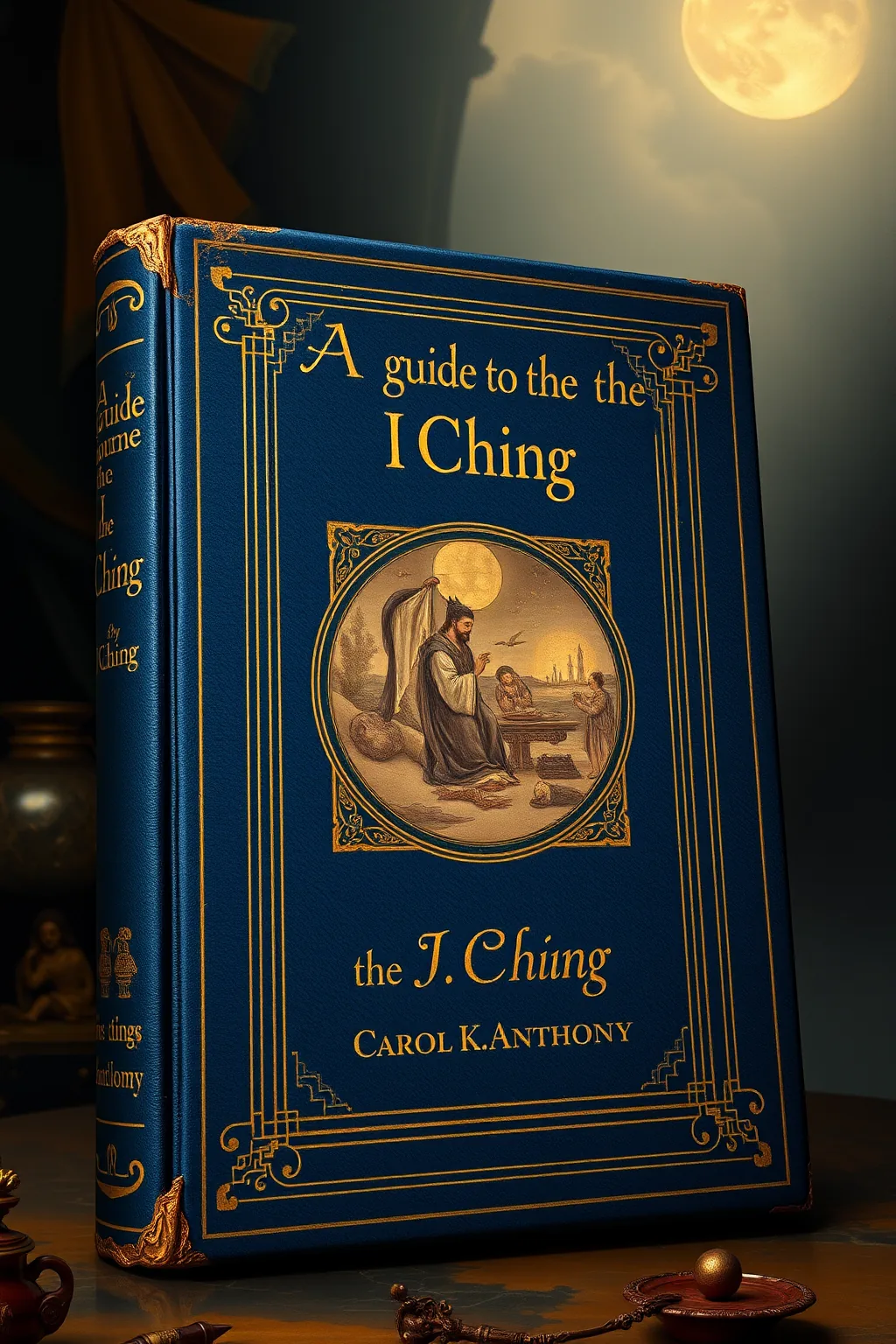
A guide to the I Ching
 81
81

A guide to the I Ching
Carol K. Anthony's "A Guide to the I Ching" tackles a notoriously dense text with commendable clarity. The strength of this 1980 publication lies in its systematic breakdown of the hexagrams and their evolving lines, offering a much-needed bridge for Western readers encountering this ancient oracle. Anthony avoids overly mystical jargon, presenting the I Ching as a practical tool for self-inquiry. However, the book occasionally feels overly didactic, sometimes sacrificing the poetic ambiguity that makes the I Ching so potent. A notable passage that highlights this is the detailed explanation of how to interpret changing lines, which, while useful, can feel prescriptive. Despite this tendency toward structure, the work remains a solid entry point for anyone seeking a grounded introduction to the wisdom of the Book of Changes.
📝 Description
81
Carol K. Anthony's 1980 guide offers a structured way to understand the I Ching.
Published in 1980, "A Guide to the I Ching" by Carol K. Anthony presents a systematic method for engaging with the ancient Chinese divination text. The book breaks down the 64 hexagrams, their constituent trigrams, and the significance of changing lines into clear, digestible parts. Anthony aims to make the I Ching's principles accessible, particularly for Western readers who might find the original text challenging.
This guide is useful for anyone curious about divination, especially those new to the I Ching. It provides step-by-step explanations that simplify the oracle's complex structure. Experienced practitioners may also appreciate the book's methodical approach to interpreting the hexagrams' messages. It is a resource for those interested in Chinese philosophy, traditional divination, or seeking a tool for introspection and guidance.
Anthony's work emerged in the 1980s, a period when Western interest in Eastern philosophies was growing. The I Ching, a foundational text of Chinese thought, was among the traditions gaining attention. This guide contributed to demystifying the oracle, offering a framework for its study and application distinct from purely academic or traditional Chinese approaches. It positioned the I Ching as a tool for personal insight within a broader context of esoteric and philosophical inquiry.
💡 Why Read This Book?
• Learn a methodical approach to interpreting the 64 hexagrams and their changing lines, moving beyond simple memorization to understand the dynamic shifts within the I Ching, a core concept detailed in the book. • Gain practical skills for using the I Ching as a tool for introspection and decision-making, focusing on the specific methods of consultation and interpretation presented by Carol K. Anthony. • Understand the philosophical underpinnings of change and balance as expressed through the I Ching's trigrams and hexagrams, providing a foundational grasp of its Taoist roots as explained in the text.
⭐ Reader Reviews
Honest opinions from readers who have explored this book.
❓ Frequently Asked Questions
When was "A Guide to the I Ching" first published?
"A Guide to the I Ching" by Carol K. Anthony was first published in 1980, making it a significant resource from that era of Western engagement with Eastern philosophies.
What is the I Ching?
The I Ching, also known as the Book of Changes, is an ancient Chinese divination text and a foundational text of Taoism, composed of 64 hexagrams used for wisdom and guidance.
Is this book suitable for absolute beginners to the I Ching?
Yes, "A Guide to the I Ching" is designed to be accessible to beginners, breaking down the complex system of hexagrams and lines into manageable parts.
What are hexagrams in the I Ching?
Hexagrams are the 64 symbolic figures in the I Ching, each formed by six stacked horizontal lines, which can be either solid (yang) or broken (yin), representing fundamental cosmic principles.
Does the book explain how to cast the I Ching?
While the book focuses on interpretation, it guides readers through understanding the results of I Ching consultations, assuming a method of casting (like yarrow stalks or coins) has been used.
What is the main purpose of consulting the I Ching according to this guide?
According to "A Guide to the I Ching," the primary purpose is to gain insight for self-reflection, understand changing circumstances, and make decisions aligned with natural principles.
🔮 Key Themes & Symbolism
Systematic Hexagram Interpretation
The guide meticulously dissects each of the 64 hexagrams, presenting them not as static symbols but as dynamic configurations of yin and yang lines. It emphasizes understanding the component trigrams and the significance of changing lines, which indicate the flow of events and potential transformations. This structured approach aims to explain the oracle, providing readers with a clear framework for deciphering the I Ching's counsel on specific queries, moving beyond rote memorization to intuitive comprehension.
The Philosophy of Change
Fundamentally, the I Ching is a manual for understanding the nature of change. Anthony's work highlights this central tenet, explaining how the hexagrams reflect the constant flux of the universe and human experience. It introduces concepts such as balance, dynamism, and the interplay of opposing forces (yin and yang) as fundamental principles for navigating life's challenges and opportunities. The book encourages readers to see change not as something to be feared, but as an inherent, cyclical process.
Practical Divination and Self-Reflection
Beyond its philosophical depth, "A Guide to the I Ching" positions the oracle as a practical tool for personal guidance. It outlines methods for posing questions and interpreting the resulting hexagrams, fostering a practice of introspection. The book guides users to engage with the I Ching's wisdom to gain clarity on personal dilemmas, relationships, and decisions, promoting a mindful approach to consulting the oracle for self-awareness and informed action.
Bridging East and West
Published in 1980, this guide represents an effort to translate the profound wisdom of the I Ching into a format accessible to a Western audience unfamiliar with its deep cultural and philosophical roots. Anthony's approach filters traditional Chinese concepts through a lens that speaks to modern psychological and self-help paradigms, making the ancient oracle approachable without oversimplification, thereby serving as a bridge between Eastern esoteric traditions and Western seekers.
💬 Memorable Quotes
Direct passages from the work, attributed to the author.
“Each hexagram is a picture of a situation and its potential development.”
— This highlights the visual and narrative nature of the I Ching's 64 hexagrams. It frames them as symbolic representations that not only describe a current circumstance but also suggest its trajectory and possible evolution.
“Understanding the changing lines is key to grasping the movement within a hexagram.”
— This interpretation underscores the dynamic aspect of I Ching consultations. It points to the importance of analyzing the specific lines that shift within a hexagram to comprehend the unfolding of events or the nuances of a situation.
“Balance and change are the fundamental principles governing all phenomena.”
— This statement captures a core Taoist philosophy embedded in the I Ching. It posits that the constant interplay between stability (balance) and transformation (change) is the underlying mechanism of existence.
💡 Key Ideas
Editorial paraphrase of the work's core concepts — not direct quotes.
The I Ching offers guidance not by dictating the future, but by revealing the forces at play.
This paraphrased concept emphasizes the I Ching's role as an oracle of insight rather than prophecy. It suggests the text illuminates the present dynamics and potential outcomes, empowering the user to make informed choices.
The oracle encourages a mindful approach, urging reflection before action.
This paraphrased idea stresses the contemplative purpose of consulting the I Ching. It suggests the text serves as a catalyst for inner consideration, promoting thoughtful deliberation over impulsive responses.
🌙 Esoteric Significance
Tradition
While rooted in the ancient Chinese Taoist tradition, "A Guide to the I Ching" adapts its presentation for a Western esoteric context. It functions less as a direct transmission of lineage and more as a bridge, translating the I Ching's complex philosophical and divinatory system into a framework understandable through Western psychological and self-help lenses. It draws on the I Ching's function as a universal oracle, a concept that has permeated various esoteric circles globally, including Hermetic and Jungian-influenced groups.
Symbolism
The primary symbolism lies in the 64 hexagrams, each a compound of two trigrams. These trigrams (e.g., Heaven, Earth, Water, Fire) represent fundamental forces and elements. The book explains how the stacking of these trigrams and the nature of their lines (solid yang, broken yin) create symbolic imagery for specific situations and archetypal patterns of change. Changing lines within a hexagram further symbolize dynamic transitions and the unfolding of events, offering nuanced layers of meaning.
Modern Relevance
Contemporary seekers engaging with divination, personal development, and comparative spirituality often find "A Guide to the I Ching" a valuable starting point. Its clear methodology appeals to those interested in practical application, including practitioners of modern witchcraft, Western ceremonial magic, and those exploring Jungian archetypes. The book's enduring relevance lies in its ability to make the profound wisdom of the I Ching accessible for self-discovery and ethical guidance in a rapidly changing world.
👥 Who Should Read This Book
['• Individuals new to the I Ching seeking a structured, step-by-step introduction to its hexagrams and interpretation methods.', '• Students of comparative religion and philosophy interested in understanding foundational texts of Taoism and Chinese divination.', "• Seekers of personal guidance and self-reflection tools looking for a practical oracle to aid in decision-making and understanding life's changes."]
📜 Historical Context
Carol K. Anthony's "A Guide to the I Ching," released in 1980, emerged during a period of significant Western interest in Eastern esoteric traditions, spurred by figures like Alan Watts and the broader counterculture movement. The 1970s saw a surge in translations and popularizations of texts like the Tao Te Ching and the I Ching itself. Anthony's work provided a structured, accessible entry point, contrasting with more academic or purely Taoist interpretations prevalent at the time. While not a direct engagement, her work shared the intellectual space with contemporary explorations of Jungian psychology, which also found resonance in archetypal symbolism found in the I Ching. The book's practical, almost pedagogical approach distinguished it from more mystical or purely philosophical treatises on the subject, aiming to integrate the oracle into daily Western life.
📔 Journal Prompts
The meaning of Hexagram 1 (Ch'ien / The Creative) in relation to your current aspirations.
Reflect on a recent situation where changing lines in an I Ching reading offered a crucial insight.
How can the principle of 'balance' as presented in the guide inform your approach to conflict?
Consider the symbolic representation of a specific trigram (e.g., K'an / The Abysmal) in your personal challenges.
Map the process of change described by the I Ching to a significant transition you have experienced.
🗂️ Glossary
Hexagram
A symbol composed of six stacked lines, each either solid (yang) or broken (yin). There are 64 unique hexagrams in the I Ching, each representing a specific situation or archetype.
Trigram
A symbol composed of three lines, either solid (yang) or broken (yin). The eight trigrams (Heaven, Earth, Fire, Water, etc.) are the building blocks of the 64 hexagrams.
Yang Line
Represented by a solid line (—), symbolizing strength, activity, light, and the masculine principle.
Yin Line
Represented by a broken line (-- --), symbolizing receptivity, passivity, darkness, and the feminine principle.
Changing Lines
Specific lines within a hexagram that are in the process of transforming from yin to yang or vice versa. These lines indicate movement and the transition to a new hexagram.
Oracle
A source of wisdom or prophecy, in this context referring to the I Ching as a tool for gaining insight and guidance.
Taoism
An ancient Chinese philosophy and religion emphasizing living in harmony with the Tao (the Way), characterized by principles of balance, nature, and non-interference.
🔮 Readers Also Liked
Browse all →







More by Carol K. Anthony
All books →




More Free Divination & Tarot Books
View all →