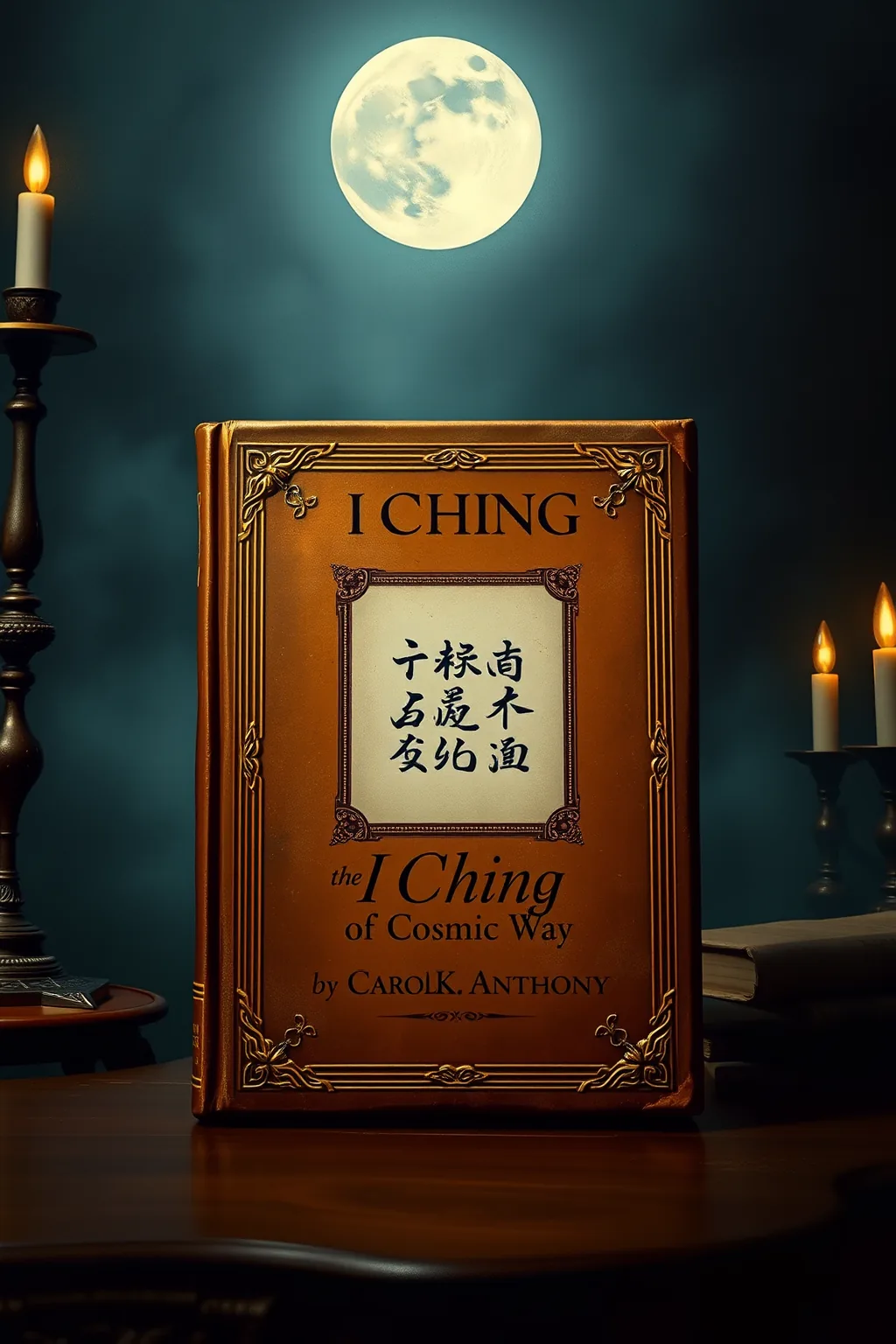
I Ching, the Oracle of the Cosmic Way
 61
61

I Ching, the Oracle of the Cosmic Way



Marcus Thorne (Esoteric Sciences Reviewer) — Carol K. Anthony's 'I Ching, the Oracle of the Cosmic Way' stands as a beacon for those seeking genuine esoteric insight into this ancient Chinese oracle. Anthony's profound understanding transcends mere translation, delving into the philosophical and spiritual underpinnings that make the I Ching a timeless guide. She illuminates the hexagrams with a clarity that resonates deeply, revealing their potent symbolism and application to the complexities of modern life. This work is particularly valuable for its ability to bridge the gap between academic study and practical application, offering practitioners a robust framework for self-discovery and conscious living. An indispensable resource for serious students of divination and Eastern mysticism.
📝 Description
61
Carol K. Anthony's 1988 book explains the I Ching as a guide to cosmic and personal balance.
Carol K. Anthony's 'I Ching, the Oracle of the Cosmic Way' interprets the ancient Chinese divination system. Published in 1988, the book focuses on the I Ching's hexagrams not just as prediction tools, but as symbolic representations of universal forces and human fate. Anthony aims to clarify the complex symbolism, showing how it mirrors the interaction between cosmic energies and individual destinies.
The author's approach emphasizes the interconnectedness of all things and offers a way to find clarity. The text guides readers toward aligning their lives with natural universal rhythms. It is intended for those seeking a deeper comprehension of life's processes.
This work engages with the I Ching, a classic Chinese text used for divination and philosophical insight for over two millennia. Its esoteric tradition connects the trigrams and hexagrams to fundamental principles of change and balance in the cosmos and human affairs. The book places itself within this lineage, interpreting the I Ching's imagery as a mirror to the dynamic interplay of universal forces and individual life paths, moving beyond simple fortune-telling to a system of understanding life's unfolding patterns.
💡 Why Read This Book?
Discover the ancient wisdom of the I Ching, a profound system for navigating life's challenges and opportunities. Carol K. Anthony's insightful interpretation unlocks the symbolic language of the hexagrams, revealing their deep connection to cosmic principles and personal destiny. Ideal for seekers of wisdom, practitioners of divination, and scholars of esoteric traditions yearning for clarity and guidance.
⭐ Reader Reviews
Honest opinions from readers who have explored this book.
❓ Frequently Asked Questions
What is the I Ching?
The I Ching, or 'Book of Changes,' is an ancient Chinese divination text and philosophical classic. It comprises 64 hexagrams, each representing a fundamental situation or state of being, offering profound insights into the flow of life and offering guidance for decision-making.
How does Carol K. Anthony's approach differ?
Anthony's approach emphasizes the philosophical and spiritual dimensions of the I Ching, presenting it as a 'Cosmic Way' rather than solely a fortune-telling device. She deciphers the symbolic language to reveal universal principles of change and balance.
Can beginners use this book?
Yes, while rich in depth, the book is structured to be accessible to beginners. Anthony's clear explanations and evocative prose guide newcomers through the foundational concepts and practical application of the I Ching.
What kind of guidance does the I Ching offer?
The I Ching offers guidance on a wide spectrum of human experience, from personal relationships and career decisions to understanding larger cosmic cycles. It encourages introspection, adaptability, and alignment with the natural order.
Is this book suitable for experienced practitioners?
Absolutely. Experienced practitioners will find Anthony's nuanced interpretations and philosophical depth enriching, offering new perspectives and deeper understanding of the I Ching's multidimensional wisdom.
🔮 Key Themes & Symbolism
The Dynamics of Change
Fundamentally, the I Ching is a profound exploration of the ceaseless nature of change. Anthony illuminates how the 64 hexagrams represent the constant flux and transformation inherent in the universe and in human experience. This theme encourages readers to embrace impermanence, understand the cyclical nature of events, and develop the wisdom to adapt and flow with life's ever-shifting currents. It's about recognizing that challenges are temporary and opportunities arise from periods of transition, fostering resilience and a deep trust in the unfolding cosmic order.
Cosmic Harmony and Alignment
This theme studies the intricate interconnectedness of all things, positing that human lives are interwoven with the grand range of the cosmos. Anthony reveals how the I Ching serves as a map to align oneself with these universal principles, fostering a state of harmony and balance. By understanding the archetypal patterns within the hexagrams, individuals can discern the 'Cosmic Way' and make choices that resonate with the natural flow of existence, leading to greater peace, clarity, and purposeful living. It's about finding one's place within the greater order.
Symbolism and Archetypal Wisdom
The I Ching's power lies in its rich and layered symbolism, where each hexagram and its constituent lines are potent archetypes. Anthony masterfully deciphers these visual and conceptual symbols, unveiling their profound psychological and spiritual significance. This theme encourages readers to engage with the archetypal energies that shape our lives, fostering self-awareness and a deeper understanding of universal human experiences. It's a journey into the collective unconscious, guided by the ancient imagery that speaks directly to the soul, offering timeless truths.
💬 Memorable Quotes
Direct passages from the work, attributed to the author.
“Seek clarity not in stillness, but in the flow.”
— Highlights that true understanding and peace are found not by resisting change, but by actively engaging with and understanding its currents.
“Each hexagram is a mirror to your soul's journey.”
— Suggests the I Ching's profound role in introspection and self-discovery, acting as a symbolic reflection of one's inner landscape and life path.
“Wisdom is found in aligning with the natural Way.”
— Emphasizes the importance of living in accordance with universal principles, promoting harmony and a sense of purpose by understanding cosmic rhythms.
“The past informs, the present guides, the future unfolds.”
— A concise statement on the temporal perspective of the I Ching, acknowledging the influence of history, the importance of mindful action now, and the inevitable unfolding of what is to come.
💡 Key Ideas
Editorial paraphrase of the work's core concepts — not direct quotes.
The universe is a ceaseless dance of transformation.
This quote captures the core philosophy of the I Ching, emphasizing that change is the only constant and is fundamental to the cosmic order. It encourages acceptance and adaptation.
🌙 Esoteric Significance
Tradition
The I Ching is a central to Chinese esoteric traditions, particularly Taoism and its various branches, as well as a significant text within the broader spectrum of East Asian mysticism. It is viewed as a profound cosmological map, offering insights into the Tao (the Way) and the interplay of Yin and Yang. Its principles are seen as universal laws governing the universe, making it a key text for practitioners seeking to understand and align with these fundamental forces, thus achieving spiritual growth and inner harmony.
Symbolism
The I Ching's symbolism is rich and many-sided, centered on the 64 hexagrams formed by combinations of six lines, each being either solid (Yang) or broken (Yin). These lines represent fundamental forces, while the hexagrams symbolize archetypal situations and transformations. Key symbols include the trigrams (eight fundamental combinations of three lines, representing elements like Heaven, Earth, Water, Fire), the Yin-Yang duality, and the concept of the 'Great Ultimate' (Taiji). The dynamic interplay of these symbols offers a profound language for understanding the universe's processes.
Modern Relevance
In the modern era, the I Ching continues to offer profound relevance as a tool for self-awareness, decision-making, and spiritual guidance. Its emphasis on adaptability, understanding cyclical patterns, and seeking balance resonates deeply with contemporary challenges. For those navigating a rapidly changing world, the I Ching provides a framework for introspection, helping individuals to make conscious choices, understand underlying dynamics, and foster a sense of purpose and resilience. It serves as a bridge between ancient wisdom and the complexities of modern life, offering timeless guidance.
👥 Who Should Read This Book
This profound exploration of the I Ching is an invaluable resource for a diverse audience. Beginners seeking an accessible yet deep introduction to this ancient oracle will find Carol K. Anthony's explanations clear and clear. Scholars of Eastern philosophy and comparative religion will appreciate the nuanced interpretations and historical context. Spiritual seekers and practitioners of divination will discover a powerful tool for self-reflection, guidance, and the cultivation of inner wisdom. Anyone feeling adrift in the currents of modern life and yearning for a deeper understanding of cosmic principles and personal destiny will find solace and direction within its pages.
📜 Historical Context
The I Ching, or 'Book of Changes,' boasts a lineage stretching back over three millennia, originating in ancient China. Its roots are deeply entwined with shamanistic practices, early philosophical thought, and astronomical observation. Initially used for divination, it evolved into a complex philosophical text that profoundly influenced Confucianism and Taoism. During the Zhou Dynasty (c. 1046–256 BCE), its compilation and interpretation began to take shape, with figures like King Wen and the Duke of Zhou contributing significantly to its structure and commentary. Its influence permeated East Asian culture, impacting everything from governance and military strategy to art and personal ethics. The I Ching's journey through centuries of scholarly debate, esoteric study, and popular use makes it one of the world's most enduring and influential texts, a evidence of its timeless wisdom and adaptability across diverse eras and cultures.
📔 Journal Prompts
Reflect on a recent situation where change felt overwhelming. How might the principles of the I Ching offer a new perspective?
Consider the interplay of Yin and Yang in your daily life. Where do you see imbalance, and how can you foster greater harmony?
Choose a hexagram that speaks to you today. What archetypal energy does it represent, and how does it speak to your current circumstances?
How can understanding the cyclical nature of events help you approach challenges with greater equanimity?
What does it mean to you to 'align with the Cosmic Way' in your personal or professional life?
🗂️ Glossary
Hexagram
A symbol composed of six stacked lines, each either solid (Yang) or broken (Yin). There are 64 unique hexagrams in the I Ching, representing fundamental archetypes and situations.
Trigram
A symbol composed of three stacked lines, representing eight fundamental elements or forces (e.g., Heaven, Earth, Water, Fire, Mountain, Lake, Wind, Thunder).
Yin
In Taoist philosophy, Yin represents the feminine, passive, dark, and receptive principle. It is often associated with the moon, earth, and water.
Yang
In Taoist philosophy, Yang represents the masculine, active, light, and assertive principle. It is often associated with the sun, heaven, and fire.
The Way (Tao)
The fundamental, ineffable principle that underlies and governs all existence in Taoist philosophy. It represents the natural order of the universe.
This book appears in 1 collection
🔮 Readers Also Liked
Browse all →








More by Carol K. Anthony
All books →



From the “Divination” Collection
View all →
![EBOOK COLLECTION ( PART 8) [ CSI][h 33t]](/img/thumb/ebook-collection-part-8-csi-h-33t.webp)







More Free Divination & Tarot Books
View all →