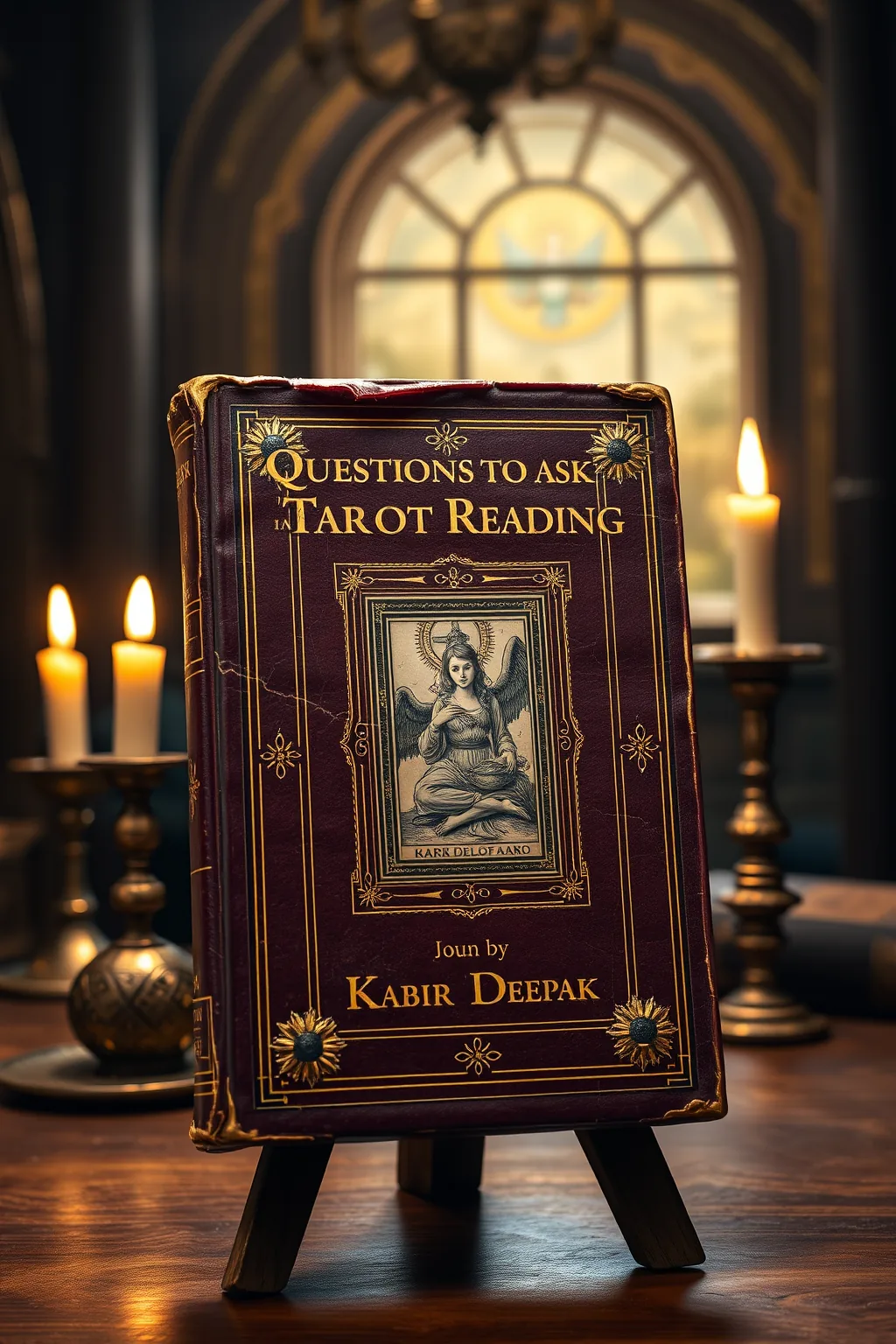
Questions to Ask in a Tarot Reading
 62
62

Questions to Ask in a Tarot Reading



Sophia Crane, Associate Editor — Kabir Deepak's 'Questions to Ask in a Tarot Reading' is a masterful exposition on the art of esoteric inquiry. Deepak elevates the practice of Tarot from mere fortune-telling to a profound dialogue with the subconscious and the divine. He masterfully illustrates how the framing of a question can unlock layers of symbolic meaning previously obscured. This work is indispensable for any serious practitioner seeking to deepen their connection with the Tarot and to elicit truly transformative insights from their readings. It's a guiding light for those ready to move beyond surface-level interpretations and engage with the archetypal forces at play, offering a path to profound self-awareness and spiritual growth. An essential addition to any occult library.
📝 Description
62
Kabir Deepak's 2023 book, 'Questions to Ask in a Tarot Reading,' argues that question formulation is central to Tarot's utility.
Kabir Deepak's book argues that the effectiveness of a Tarot reading hinges on the quality of the questions asked. Instead of viewing Tarot as solely a predictive system, Deepak positions it as a reflective tool for self-understanding and spiritual insight. The text guides readers in crafting specific inquiries designed to access deeper wisdom and foster personal change.
Each question is presented as a means to uncover hidden knowledge and facilitate self-discovery. The book aims to create a space for contemplative practice, encouraging users to move past surface-level interpretations and connect with the archetypal symbolism of the Tarot. It is intended for those interested in the occult, introspection, and using Tarot for personal growth and alignment.
This work fits within the Western esoteric tradition that views Tarot not just as a card game or fortune-telling device, but as a symbolic system with psychological and spiritual depth. It aligns with practices that use divination tools for introspection and personal development, emphasizing conscious engagement with symbolic language. The focus on question crafting echoes hermetic principles of correspondence and the power of focused intent in manifesting understanding.
💡 Why Read This Book?
Unveil the hidden potential of your Tarot practice by learning to formulate questions that resonate with cosmic wisdom. 'Questions to Ask in a Tarot Reading' empowers seekers, scholars, and practitioners to move beyond generic queries and unlock profound, personalized insights. Discover how to engage the Tarot as a sacred dialogue, fostering deeper self-awareness, spiritual growth, and conscious co-creation with the universe. This book is your key to transformative readings.
⭐ Reader Reviews
Honest opinions from readers who have explored this book.
❓ Frequently Asked Questions
What makes a 'good' question in Tarot?
A good Tarot question is open-ended, focused, and framed with intention. It seeks understanding rather than a simple yes/no answer, inviting the cards to reveal underlying dynamics, potential pathways, and deeper wisdom for personal growth and conscious decision-making. It taps into the symbolic language of the deck to explore hidden truths.
Can this book help beginners with Tarot?
Absolutely. This book is designed to guide beginners in understanding the foundational principles of framing effective questions, demystifying the initial stages of Tarot inquiry and setting them on a path for more meaningful and insightful readings from the outset.
How does asking better questions improve a Tarot reading?
Asking precise, intention-driven questions transforms a Tarot reading from a passive observation into an active, empowering dialogue. It directs the archetypal energies of the cards toward specific areas of inquiry, yielding more relevant, actionable, and profound insights that illuminate the path forward.
Is this book suitable for advanced Tarot practitioners?
Yes, advanced practitioners will find value in refining their inquiry skills, exploring nuanced question archetypes, and deepening their understanding of how specific phrasing can unlock more profound symbolic interpretations and esoteric wisdom within their readings.
What is the philosophical underpinning of effective Tarot questioning?
The philosophy centers on the belief that the universe responds to intention and focused inquiry. By asking well-crafted questions, we align ourselves with the subtle energies and archetypal patterns of existence, facilitating a conscious co-creation of our reality and a deeper understanding of our soul's journey.
🔮 Key Themes & Symbolism
The Art of Esoteric Inquiry
This theme studies the profound practice of formulating questions that resonate with the subtle energies of the cosmos. It explores how the precise articulation of intent acts as a conduit for divine guidance, transforming the Tarot reader into an active participant in the unfolding of destiny. Deepak illuminates the difference between superficial curiosity and genuine spiritual seeking, emphasizing how well-crafted questions can pierce through illusion and reveal the underlying truths of existence, fostering a deeper connection with the archetypal realms and the wisdom of the Tarot.
Tarot as a Mirror of the Soul
Beyond mere prediction, this theme positions the Tarot as a sacred mirror reflecting the intricate field of the individual psyche and the collective unconscious. The book emphasizes how questions serve to polish this mirror, enabling the seeker to confront their shadow aspects, illuminate their highest potentials, and gain profound self-awareness. It highlights the archetypal symbolism within the cards as a language of the soul, and how targeted questions unlock these symbols to foster personal transformation and spiritual alignment, fostering a deeper understanding of one's life path and purpose.
Conscious Co-Creation and Destiny
This important theme explores the dynamic interplay between free will and fate, positing that the right questions empower the individual to become an active co-creator of their destiny. Instead of passively accepting what the cards reveal, the reader is guided to use the insights gained to make conscious choices that steer their life's journey. The book underscores the idea that by understanding the energetic currents at play, facilitated by insightful questioning, individuals can consciously manifest their highest aspirations and navigate life's challenges with wisdom and grace, aligning with their soul's true calling.
💬 Memorable Quotes
Direct passages from the work, attributed to the author.
“A question well-posed is half the answer revealed.”
— This aphorism underscores the power of intention and clarity in seeking knowledge. It suggests that the act of formulating a precise question primes the mind and the universe for revelation, making the subsequent discovery of truth more accessible and direct.
“Seek not the 'what,' but the 'why' and 'how.'”
— This encourages a deeper dive into the underlying causes and processes behind events. It shifts the focus from simple outcomes to understanding the dynamics at play, fostering greater self-awareness and enabling more effective navigation of life's complexities.
“Your deepest truths lie within the questions you dare to ask.”
— This highlights the introspective nature of Tarot and the courage required to confront one's inner world. It suggests that the most profound self-discoveries are unlocked when we bravely probe our own motivations, fears, and desires through intentional inquiry.
“The Tarot is a conversation, not a decree.”
— This metaphor emphasizes the interactive and dynamic nature of a Tarot reading. It frames the experience as a collaborative dialogue between the querent, the reader, and the archetypal wisdom of the cards, fostering agency and co-creation.
💡 Key Ideas
Editorial paraphrase of the work's core concepts — not direct quotes.
The cards do not dictate; they illuminate.
This quote distinguishes Tarot as a tool for insight and guidance, not absolute pronouncements. It emphasizes that the Tarot reveals potentials and influences, empowering the querent to make informed choices rather than passively accepting a predetermined fate.
🌙 Esoteric Significance
Tradition
This work draws heavily from the Western Esoteric Tradition, particularly its branches focused on divination, hermeneutics, and self-transformation. It aligns with Kabbalistic principles of symbolic interpretation, Hermetic wisdom regarding the correspondence between macrocosm and microcosm, and Jungian archetypal psychology. The emphasis on crafting precise questions reflects the alchemical process of refinement and the magician's art of focused intent, positioning Tarot as a sacred technology for accessing higher consciousness and understanding the subtle energetic currents of existence.
Symbolism
The book leverages the inherent symbolic language of the Tarot archetypes – from the Fool's journey of initiation to the Hierophant's wisdom and the Empress's abundance. It teaches how to frame questions that specifically engage these symbols, unlocking their layered meanings related to spiritual growth, psychological states, and the unfolding of destiny. Each card becomes a focal point for introspection, and a well-posed question acts as a key to deciphering its unique energetic signature and its relevance to the querent's life path, revealing profound truths about the self and the universe.
Modern Relevance
In an age saturated with information yet often lacking in profound meaning, 'Questions to Ask in a Tarot Reading' offers a vital pathway to curated wisdom. It empowers individuals to read through the complexities of modern life with greater clarity and intention, transforming passive consumption into active discernment. The book provides practical tools for self-reflection, ethical decision-making, and spiritual alignment, making ancient esoteric practices directly applicable to contemporary challenges and aspirations for personal growth and conscious living.
👥 Who Should Read This Book
This useful guide is a treasure for a diverse spectrum of seekers. Beginners will find a clear, empowering introduction to the art of Tarot inquiry, laying a solid foundation for meaningful readings. Tarot practitioners seeking to deepen their practice will discover advanced techniques for eliciting useful insights and moving beyond superficial interpretations. Scholars of esotericism will appreciate the sophisticated philosophical underpinnings and the exploration of Tarot as a tool for psychological and spiritual development. Ultimately, anyone yearning for greater self-awareness, clarity on their life path, and a more conscious engagement with the subtle energies of the universe will find immense value within these pages.
📜 Historical Context
While the specific historical context of Kabir Deepak's 'Questions to Ask in a Tarot Reading' isn't detailed in its title, its subject matter places it within the body of modern esoteric revivalism. The late 19th and 20th centuries saw a resurgence of interest in occultism, divination, and ancient wisdom traditions, influenced by movements like Theosophy, Hermeticism, and various forms of spiritualism. Tarot, with its deep roots in Renaissance symbolism and later association with occultists like Eliphas Levi and the Hermetic Order of the Golden Dawn, became a central tool for personal exploration and spiritual development. Books like Deepak's emerge from this lineage, seeking to explain and elevate Tarot practice beyond parlor tricks, grounding it in philosophical inquiry and psychological insight, reflecting a contemporary desire for deeper meaning and practical application of esoteric knowledge in an increasingly complex world.
📔 Journal Prompts
Reflect on a significant life decision you recently made. What question, if asked at the time, would have provided the most crucial insight?
Choose a Tarot card that appeals to you this week. Formulate three distinct questions about its meaning and relevance to your current life situation.
Consider an area of your life where you feel stuck. How can you reframe your current understanding of this situation into a potent, open-ended question for a Tarot reading?
Explore the difference between asking a question for prediction versus a question for guidance. How does this distinction impact the potential insights gained from the Tarot?
Imagine you are teaching someone how to ask a powerful Tarot question. What are the three most important principles you would convey?
🗂️ Glossary
Archetype
Universal, archaic patterns and images that derive from the collective unconscious and are the psychic counterpart of a biological instinct. In Tarot, archetypes are represented by the Major Arcana cards, embodying fundamental human experiences and spiritual forces.
Divination
The practice of seeking knowledge of the future or the unknown by supernatural means. In the context of Tarot, it involves interpreting the symbolic language of the cards to gain insight into present circumstances, potential outcomes, and underlying spiritual influences.
Esoteric
Intended for or likely to be understood by only a small number of people with a specialized knowledge or interest. Esoteric literature often deals with hidden meanings, spiritual mysteries, and inner transformation.
Hermeneutics
The theory of interpretation, especially of texts or symbols. In Tarot, hermeneutics is crucial for understanding how to derive meaning from the visual and symbolic language of the cards in response to specific questions.
Querent
The person for whom a Tarot reading is being conducted. The querent is the individual seeking insight and answers through the Tarot cards, and the quality of their questions significantly influences the depth of the reading.
This book appears in 3 collections
🔮 Readers Also Liked
Browse all →








More by Kabir Deepak
All books →
From the “Tarot” Collection
View all →







More Free Divination & Tarot Books
View all →