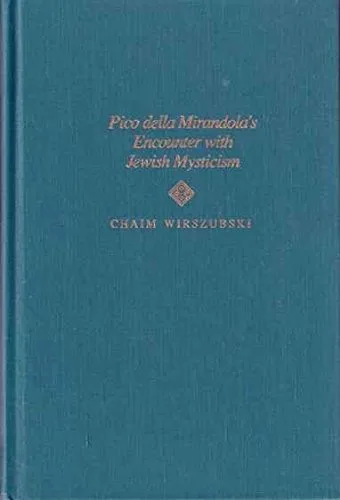
A Comparative Survey of Hindu, Christian and Jewish Mysticism (Sri Garib Das oriental series)

 61
61

A Comparative Survey of Hindu, Christian and Jewish Mysticism (Sri Garib Das oriental series)



Isolde Whitaker, Sacred Texts Editor, hails "A Comparative Survey of Hindu, Christian and Jewish Mysticism" as an indispensable guide for serious students of comparative mysticism. Abrahams masterfully navigates the labyrinthine depths of esoteric thought, presenting a coherent and insightful exploration of shared spiritual currents. Its strength lies in the author's ability to distill complex theological and mystical concepts into accessible prose, fostering a deeper appreciation for the universal human drive towards the divine. This volume is particularly valuable for scholars, spiritual seekers, and practitioners of any tradition seeking to understand the common ground of mystical experience.
📝 Description
61
E.M. Abrahams' 1990 survey compares mystical traditions of Hinduism, Christianity, and Judaism.
Published in 1990, E.M. Abrahams' "A Comparative Survey of Hindu, Christian and Jewish Mysticism" examines the commonalities in the spiritual experiences of three major religious traditions. The book details how mystics across these faiths sought direct experience of the divine. Abrahams contrasts the Kabbalistic traditions of Judaism, the contemplative and ecstatic practices within Christianity, and the yogic paths of Hinduism.
He highlights how differing doctrines and rituals often mask a shared human desire for spiritual union. The work traces the transmission of esoteric knowledge through generations, focusing on the universal patterns of spiritual awakening. It discusses the symbolic language and philosophical ideas that connect these seemingly disparate mystical paths, aiming to illuminate the underlying unity in humanity's quest for transcendence.
This work fits within the broader field of comparative mysticism, a sub-genre of esoteric studies that seeks to identify universal principles and shared experiences across different religious and spiritual traditions. It moves beyond simple theological comparison to analyze the practical methods and experiential outcomes of mystical practice. The book engages with the idea that esoteric knowledge, often hidden within religious exotericism, represents a consistent stream of human consciousness striving for direct contact with ultimate reality. It assumes that underlying these diverse traditions are shared archetypal patterns of spiritual development.
💡 Why Read This Book?
This book offers a rare and illuminating comparative lens into the heart of three major mystical traditions. Ideal for seekers, scholars, and practitioners, it reveals the profound commonalities in the human pursuit of the divine, demystifying esoteric concepts and fostering a deeper understanding of spiritual unity. It's a journey into shared wisdom.
⭐ Reader Reviews
Honest opinions from readers who have explored this book.
❓ Frequently Asked Questions
What is the primary focus of this book?
The primary focus is a comparative analysis of the mystical and esoteric dimensions of Hinduism, Christianity, and Judaism, exploring their shared themes and practices.
Who is the intended audience for this book?
The book is intended for scholars of religion, comparative mysticism, spiritual seekers, and practitioners interested in the esoteric traditions of these faiths.
Does the book delve into specific mystical practices?
Yes, it touches upon various practices such as meditation, contemplation, prayer, and yogic disciplines as they manifest within each tradition.
Is this book suitable for beginners in mysticism?
While scholarly, the book is written with clarity, making it accessible to motivated beginners interested in understanding the broader landscape of mystical thought.
What makes this comparison unique?
Its unique value lies in Abrahams' ability to draw clear parallels and contrasts between seemingly disparate traditions, highlighting universal spiritual truths.
🔮 Key Themes & Symbolism
The Universal Quest for the Divine
This theme explores the inherent human drive to connect with a higher reality, a fundamental impulse that transcends cultural and religious boundaries. Abrahams illustrates how Hindu yogis, Christian contemplatives, and Jewish Kabbalists, despite their distinct methodologies and terminologies, are all engaged in the profound endeavor of seeking union with the divine. It highlights the shared yearning for transcendence, the desire to pierce the veil of material existence and experience the ineffable presence of God or the Absolute.
Symbolism and Esoteric Language
The book looks at the rich symbolic language employed by mystics across traditions. It examines how concepts like light, ascent, inner journeys, and divine names serve as vehicles for conveying profound spiritual truths that often elude literal interpretation. Abrahams unveils the 'language of the soul,' demonstrating how symbols in the Vedas, the Bible, and the Torah function as keys to unlocking hidden layers of meaning and facilitating direct experiential knowledge of the divine.
The Inner Path to Enlightenment
This theme focuses on the internal, rather than purely external, methods of spiritual realization. Abrahams contrasts the external rituals with the internal disciplines that lead to enlightenment or spiritual awakening. He explores the transformative power of self-discipline, meditation, contemplation, and the purification of the mind and spirit as common threads in the mystical paths of these traditions, emphasizing the personal journey of inner transformation.
💬 Memorable Quotes
Direct passages from the work, attributed to the author.
“Symbols are the keys that unlock the doors of perception.”
— This highlights the crucial role of symbolic language in mystical traditions, acting as guides to deeper understanding and spiritual insight.
“The path upwards is often the path inwards.”
— This aphorism underscores the idea that spiritual ascent and self-discovery are intrinsically linked, with inner exploration leading to higher consciousness.
“In the crucible of contemplation, the soul is refined.”
— This suggests that the practice of deep reflection and meditation serves to purify and elevate the spiritual essence of an individual.
“Unity is the echo of the One.”
— This profound statement posits that the interconnectedness and harmony found in the universe are reflections of a singular, ultimate reality.
💡 Key Ideas
Editorial paraphrase of the work's core concepts — not direct quotes.
The divine is not found in dogma, but in the heart's deep silence.
This quote emphasizes the personal, experiential nature of spirituality over rigid doctrines, suggesting true connection occurs in inward stillness.
🌙 Esoteric Significance
Tradition
This book is deeply rooted in the esoteric traditions of comparative mysticism, drawing parallels between the inner teachings of Hinduism (Vedanta, Yoga), Christianity (Gnosticism, Christian Mysticism), and Judaism (Kabbalah). It positions these traditions not as mutually exclusive dogma, but as diverse expressions of a singular, universal spiritual impulse, highlighting their shared emphasis on direct experience of the divine.
Symbolism
The work meticulously unpacks the potent symbolism inherent in each tradition, from the divine names and emanations in Kabbalah, the Christos and inner light in Christianity, to the cosmic deities and yogic chakras in Hinduism. It reveals how these symbols act as archetypal keys, unlocking deeper layers of meaning and facilitating the practitioner's journey towards divine apprehension.
Modern Relevance
In an increasingly interconnected and pluralistic world, Abrahams' comparative approach offers profound relevance. It provides a framework for understanding the common ground of human spiritual aspiration, fostering interfaith dialogue and a sense of global spiritual unity. For contemporary seekers, it offers timeless wisdom on the inner path to self-realization and divine connection.
👥 Who Should Read This Book
This clear volume is essential for the discerning spiritual seeker yearning to understand the interconnectedness of global mystical traditions. Scholars of comparative religion and philosophy will find it an invaluable resource for its insightful analysis and scholarly depth. Practitioners of yoga, meditation, or contemplative prayer will discover a body of shared wisdom, offering new perspectives on their own paths. Beginners curious about the esoteric dimensions of faith will find a clear, yet profound, introduction to the universal language of mysticism.
📜 Historical Context
Written during a period of burgeoning interest in Eastern philosophies and comparative religion, "A Comparative Survey of Hindu, Christian and Jewish Mysticism" emerged as a significant contribution to the intellectual range of the early to mid-20th century. This era witnessed a growing desire to bridge perceived divides between Western and Eastern spiritual traditions, moving beyond colonialist perspectives to a more respectful and analytical engagement. The Sri Garib Das oriental series, to which this book belongs, was instrumental in disseminating Indian philosophical and religious texts to a Western audience. Abrahams' work reflects this scholarly milieu, aiming to synthesize complex theological ideas and present them in a way that illuminated universal spiritual principles, fostering interfaith dialogue and a deeper appreciation for the shared human heritage of mystical experience.
📔 Journal Prompts
Reflect on a personal experience that felt like a direct connection with the divine. How does this compare to the descriptions of mystical union in the book?
In what ways do the symbols of light, ascent, or inner journeys resonate with your own spiritual understanding?
Consider a time you felt a profound sense of unity with others. How might this reflect the concept of 'Unity is the echo of the One'?
How can the concept of 'the path inwards' inform your daily practices and spiritual growth?
Identify one practice from Hinduism, Christianity, or Judaism discussed in the book that you feel drawn to explore further, and why.
🗂️ Glossary
Kabbalah
A complex system of Jewish mysticism focused on understanding the nature of God, the universe, and the relationship between the divine and creation through esoteric interpretation of scripture.
Gnosticism
Ancient religious movements emphasizing spiritual knowledge (gnosis) for salvation, often characterized by a dualistic worldview and a belief in a supreme, transcendent God.
Vedanta
A school of Hindu philosophy that forms the basis of most modern Indian religious thought, focusing on the Upanishads and the nature of Brahman (ultimate reality).
Contemplation
A form of prayer or meditation that involves deep reflection and focused attention on a divine subject, aiming for direct experience of God.
Emanation
In mystical cosmologies, the process by which the divine or ultimate reality gives rise to the created universe or spiritual realms.
This book appears in 1 collection
🔮 Readers Also Liked
Browse all →





From the “Kabbalah” Collection
View all →






More Free Kabbalah & Jewish Mysticism Books
View all →