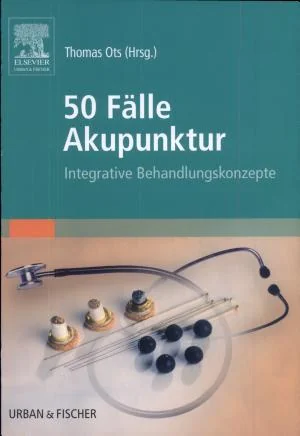
50 Fälle Akupunktur
 80
80

50 Fälle Akupunktur
Thomas Ots’s "50 Fälle Akupunktur" offers a refreshing departure from purely theoretical texts, grounding TCM principles in fifty concrete clinical scenarios. The strength lies in its unvarnished presentation of anamnesis, diagnosis, and therapy, crucially including an analysis of treatment failures. This honesty is invaluable for learning. One area where the work could be expanded is in providing more detailed diagnostic reasoning for each case, particularly for complex presentations. For instance, the discussion surrounding Case 17, concerning chronic fatigue, could benefit from a more explicit breakdown of differential diagnoses within the TCM framework. Despite this, the book’s practical focus makes it a solid resource for practitioners.
Ots’s pragmatic approach provides a valuable counterpoint to more esoteric interpretations of acupuncture.
📝 Description
80
Published in 2004, Thomas Ots's '50 Fälle Akupunktur' details fifty real patient encounters in acupuncture.
Thomas Ots's 2004 book, '50 Fälle Akupunktur,' presents fifty clinical case studies in acupuncture and Traditional Chinese Medicine (TCM). Each case covers patient history, diagnosis, and treatment, moving beyond theory to show TCM in practice. The book is for acupuncturists and advanced students wanting to learn from real examples, especially for exam preparation. It covers diagnostic reasoning and treatment planning.
Ots's work contrasts with broader introductions to TCM, like Ted J. Kaptchuk's popular works. While Kaptchuk explained TCM concepts, Ots focuses on the minute details of patient cases. This book examines both successful treatments and difficult situations. It reflects a practical approach to clinical work, acknowledging the complexities of patient care in the early 2000s.
This book grounds the esoteric principles of Traditional Chinese Medicine in concrete clinical practice. It applies theoretical concepts like the Eight Principles, Zang-Fu organ systems, and the balance of Qi, Blood, Yin, and Yang to actual patient problems. The focus on detailed case analysis shows how these ancient frameworks are used to understand and treat illness in individuals, emphasizing the practitioner's role in interpreting symptoms and tailoring treatments.
💡 Why Read This Book?
• Gain practical diagnostic skills by analyzing fifty detailed patient histories and their corresponding TCM diagnoses, as presented in the "Anamnese" sections of each case study. • Learn from therapeutic successes and failures by examining the outcomes described in each of the fifty cases, understanding how treatment plans were adjusted based on patient response. • Enhance exam preparation and daily practice integration by studying expert approaches to acupuncture and TCM, as demonstrated through the structured case analyses from the 2004 publication.
⭐ Reader Reviews
Honest opinions from readers who have explored this book.
❓ Frequently Asked Questions
What is the primary focus of "50 Fälle Akupunktur"?
The book focuses on practical application of acupuncture and Traditional Chinese Medicine (TCM) through fifty detailed case studies. It covers patient history (anamnesis), diagnosis, and therapy, including analyses of both successful and unsuccessful treatments.
Who would benefit most from reading Thomas Ots's "50 Fälle Akupunktur"?
Practitioners and advanced students of acupuncture and TCM will benefit most. It is especially useful for those preparing for professional examinations or seeking to integrate TCM principles more effectively into their daily clinical work.
What distinguishes this book from other TCM literature?
Its strength lies in its detailed case-study format, offering real-world examples of diagnostic and therapeutic processes. Crucially, it analyzes not only successes but also treatment failures, providing a more realistic and instructive perspective.
When was "50 Fälle Akupunktur" first published?
The book was first published in 2004, reflecting a period of increasing integration of TCM into Western medical contexts.
Does the book cover specific acupuncture point prescriptions?
While the blurb focuses on anamnesis, diagnosis, and therapy, the detailed case studies implicitly involve specific treatment strategies, which typically include acupuncture point selections within the TCM framework.
Can "50 Fälle Akupunktur" help with exam preparation?
Yes, the book explicitly states it helps with exam preparation by demonstrating diagnostic reasoning and therapeutic approaches used by experts in real clinical scenarios.
🔮 Key Themes & Symbolism
Clinical Case Analysis
The core of "50 Fälle Akupunktur" lies in its rigorous examination of fifty distinct clinical cases. Each case unfolds with patient history (anamnesis), detailing symptoms and background, followed by the diagnostic process grounded in Traditional Chinese Medicine (TCM) principles. The subsequent therapy section outlines the treatment applied. Importantly, the work doesn't shy away from analyzing therapeutic outcomes, including instances where initial treatments were unsuccessful, offering profound learning opportunities about the dynamic nature of healing and the art of adjusting treatment strategies.
Diagnostic Reasoning in TCM
Ots emphasizes the systematic application of TCM diagnostic methods. Readers are guided through interpreting patient complaints through the lens of concepts like Qi, Blood, Yin, Yang, and the Zang-Fu organ systems. The book demonstrates how to synthesize disparate symptoms into a coherent diagnostic pattern, a crucial skill for any practitioner. The fifty cases serve as practical exercises in differential diagnosis within the TCM framework, showing how subtle nuances in presentation can lead to distinct therapeutic pathways.
Therapeutic Strategy and Adjustment
Beyond diagnosis, the book highlights the practical implementation of therapeutic strategies. It showcases how acupuncture and potentially other TCM modalities are employed to address identified imbalances. A significant aspect is the analysis of treatment efficacy, including when and why a therapy might falter. This focus on adaptive treatment planning underscores a key tenet of TCM: the need for continuous patient assessment and the flexibility to modify interventions based on evolving conditions and responses.
Bridging Theory and Practice
Published in 2004, this work serves as a vital bridge between the theoretical underpinnings of TCM and its actual application in clinical settings. By presenting fifty real-world scenarios, Ots makes abstract concepts tangible and demonstrates how to work through the complexities of patient care. The inclusion of both successes and failures offers a realistic portrayal of practice, equipping readers with the knowledge to anticipate challenges and refine their own approaches, thereby fostering more competent and adaptable practitioners.
💬 Memorable Quotes
Direct passages from the work, attributed to the author.
“Anamnese, Diagnose und Therapie werden beschrieben.”
— This concise statement from the blurb captures the book's foundational structure. It highlights the methodical approach Ots takes, presenting a complete clinical picture from initial patient contact through to the treatment plan and its outcome.
“Dabei werden nicht nur die Erfolge, sondern auch die Misserfolge einer Therapie analysiert.”
— This phrase points to the book's critical strength: the honest evaluation of therapeutic results. Analyzing failures is as important as celebrating successes for genuine learning and skill development in clinical practice.
“Sie lernen von Experten verschiedene diagnostische und therapeutische Herangehensweisen.”
— This indicates that the book functions as a learning tool, offering readers exposure to the methods and decision-making processes of experienced practitioners in the field of acupuncture and TCM.
“Sie lernen, wie Sie sich am besten auf Ihre Prüfung vorbereiten.”
— This directly addresses students and those seeking certification, suggesting the case studies are structured to prepare individuals for the diagnostic and treatment-planning challenges they might face in professional examinations.
“Sie erfahren, wie Sie Akupunktur und TCM in Ihre tägliche Praxisarbeit integrieren können.”
— This promises practical utility, showing readers how to apply the knowledge gained from the case studies to their ongoing professional work, making the learning immediately applicable.
🌙 Esoteric Significance
Tradition
While acupuncture is rooted in the empirical and philosophical traditions of Traditional Chinese Medicine, its practice often intersects with broader esoteric currents when viewed through a Western lens. Ots's work, focusing on clinical application, doesn't explicitly align with a specific Western esoteric lineage like Hermeticism or Kabbalah. However, the underlying principles of balancing vital energies (Qi) and harmonizing opposing forces (Yin/Yang) can be seen as parallel to concepts found in various holistic and energetic healing traditions that often fall under the esoteric umbrella.
Symbolism
The core symbolism in acupuncture lies in the meridians, channels through which Qi flows, and the specific acupoints that act as gateways to influence this flow. The concept of Yin and Yang represents the fundamental duality and interdependence of all phenomena, a potent symbol of balance. The Zang-Fu organ theory employs symbolic relationships between physical organs and their associated energetic, emotional, and spiritual functions, creating a symbolic map of the body's energetic landscape that informs diagnosis and treatment.
Modern Relevance
Contemporary practitioners of acupuncture and TCM, whether in Asia or the West, continue to draw upon case-based learning. Ots's methodology, emphasizing detailed patient histories and the critical analysis of treatment outcomes, remains relevant. Thinkers and practitioners focused on integrative medicine, personalized healthcare, and evidence-informed complementary therapies find value in such grounded clinical examples. The book's approach contributes to the ongoing effort to refine and validate TCM practices within diverse healthcare settings.
👥 Who Should Read This Book
• Acupuncture and TCM students seeking to bridge theoretical knowledge with practical application through real-world case examples. • Licensed acupuncturists and TCM practitioners aiming to enhance their diagnostic acumen and refine their therapeutic strategies by studying expert approaches. • Healthcare professionals interested in understanding the clinical reasoning behind acupuncture treatments, particularly those seeking to integrate complementary therapies into patient care.
📜 Historical Context
Thomas Ots's "50 Fälle Akupunktur" emerged in 2004, a period marked by the growing institutionalization of Traditional Chinese Medicine (TCM) within Western healthcare systems. While pioneers like Dr. John K. Chen had already established foundational texts in English, the need for detailed, practical case studies in German-language literature was significant. The book's publication coincided with academic discourse surrounding the evidence base for acupuncture, often debated against the backdrop of Western biomedical models. Unlike works focusing on historical TCM development or philosophical underpinnings, Ots’s approach centered on empirical clinical application. The book’s critical analysis of treatment failures, rather than presenting a uniformly successful narrative, offered a mature perspective that resonated with practitioners seeking realistic guidance, diverging from earlier, more didactic approaches to TCM education.
📔 Journal Prompts
The diagnostic process for Case 12, detailing the interpretation of the patient's pulse and tongue.
Therapeutic adjustments described in Case 31 following an initial treatment setback.
The anamnesis in Case 45 and its specific relevance to the final diagnosis.
Comparing the treatment approaches presented in Case 8 and Case 22 for similar presenting symptoms.
Reflecting on the analysis of treatment failures across multiple cases.
🗂️ Glossary
Anamnese
The patient's medical history, including past illnesses, symptoms, lifestyle, and other relevant information gathered by a practitioner.
Diagnose
The identification of the nature of an illness or other problem by examination of the symptoms, a core component of TCM practice.
Therapie
The treatment of disease or disorders by medicinal agents or procedures, in this context, primarily acupuncture and TCM modalities.
TCM
Traditional Chinese Medicine, a comprehensive system of healthcare developed over thousands of years in China, including acupuncture, herbal medicine, and other therapies.
Qi (Chi)
The fundamental concept in TCM representing vital energy or life force that flows through the body and animates all living things.
Yin und Yang
The Taoist concept of dual, complementary, and interdependent forces that govern the universe and the human body; their balance is crucial for health.
Zang-Fu
A system within TCM that classifies the internal organs (Zang: solid, Fu: hollow) and describes their physiological functions, relationships, and pathological changes.
This book appears in 1 collection
🔮 Readers Also Liked
Browse all →









From the “Acupuncture” Collection
View all →






More Free Occult Philosophy Books
View all →