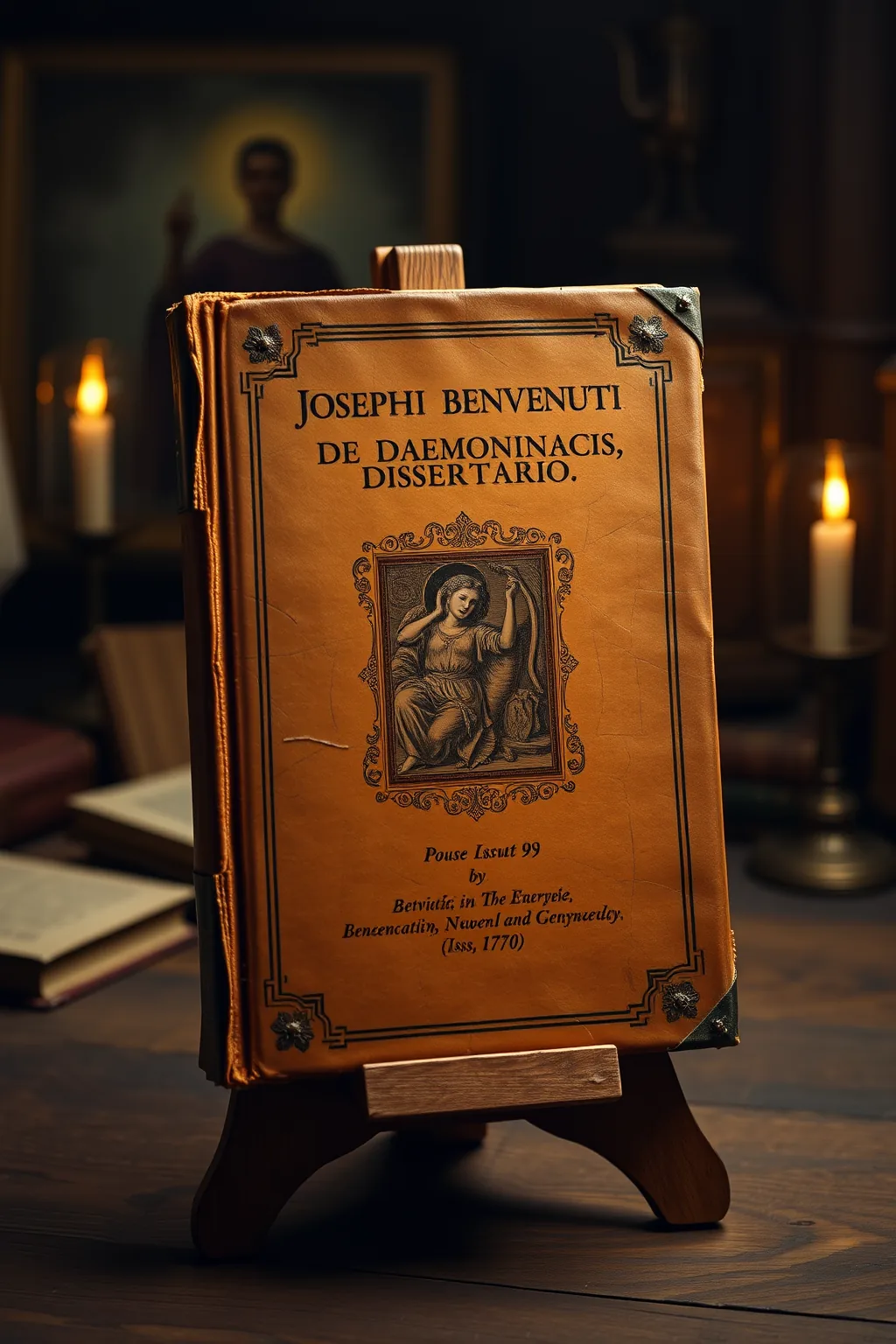
Josephi Benvenuti ... De daemoniacis dissertatio. 1775: Iss 98
 80
80

Josephi Benvenuti ... De daemoniacis dissertatio. 1775: Iss 98



Evander Ashcroft, Alchemy & Hermeticism Editor: Giuseppe Benvenuti's "De Daemoníacis Dissertatio" is a formidable intellectual undertaking, offering a sophisticated 18th-century perspective on demonology. Benvenuti deftly synthesizes theological arguments with historical precedents, providing a nuanced examination of the 'diabolical' that transcends simplistic interpretations. The strength of this work lies in its rigorous academic approach, dissecting ancient texts and philosophical concepts with precision. It's a vital resource for scholars of religious history and occult philosophy, particularly those interested in the evolution of European thought on spiritual warfare and the liminal spaces between the divine and the chthonic. This is not introductory material, but rather a challenging text for those already immersed in the complexities of esotericism.
📝 Description
80
Giuseppe Benvenuti's 1775 treatise, "De Daemoníacis Dissertatio," examines infernal entities within 18th-century theological discourse.
Giuseppe Benvenuti's "De Daemoníacis Dissertatio," published in 1775, addresses the nature and influence of demonic beings. The work reflects the intellectual climate of the 18th century, a period where religious belief, popular stories, and philosophical thought converged. Benvenuti analyzes scriptural passages, historical narratives, and the perceived subtle energies believed to affect the world.
This text invites contemplation on unseen forces influencing human life and awareness. It poses questions about good and evil, instances of possession, and spiritual conflicts. The dissertation encourages a review of established religious teachings and offers a way to interpret the symbolic aspects of the demonic.
This work emerges from the late 18th-century engagement with demonology, a field that drew upon theological exegesis, folklore, and nascent philosophical critiques of the supernatural. It sits within a tradition that sought to understand the spiritual hierarchy and the perceived active role of malevolent forces in the human and cosmic order, often attempting to reconcile scriptural accounts with contemporary rationalist or occultist interpretations.
💡 Why Read This Book?
Uncover a pivotal 18th-century perspective on demonology, exploring the intricate theological and philosophical debates surrounding infernal influence. This dissertation is essential for scholars of religious history, occult traditions, and anyone seeking to understand the historical discourse on spiritual warfare and the unseen realms. It offers profound insights into the symbolic language of the infernal and its impact on human consciousness, appealing to both academic researchers and dedicated esoteric practitioners.
⭐ Reader Reviews
Honest opinions from readers who have explored this book.
❓ Frequently Asked Questions
What is the primary focus of this dissertation?
The primary focus is a detailed theological and philosophical examination of demonic entities, their influence, and their place within religious and historical contexts of the 18th century.
Who was Giuseppe Benvenuti?
Giuseppe Benvenuti (1728-c.1770) was an 18th-century scholar whose work delves into theological and metaphysical subjects, particularly concerning the nature of spiritual forces.
What historical period does this text represent?
This text represents the intellectual climate of the 18th century, a period of Enlightenment grappling with traditional religious beliefs and emerging philosophical inquiries.
Is this text suitable for beginners in esotericism?
While offering valuable historical context, the text is dense and academic, making it more suitable for intermediate to advanced students and scholars of esotericism and religious history.
What does 'De Daemoníacis Dissertatio' translate to?
'De Daemoníacis Dissertatio' translates from Latin to 'A Dissertation on Demoniacs' or 'On Demoniacal Matters'.
🔮 Key Themes & Symbolism
Theological Hermeneutics of the Infernal
Benvenuti's work is a deep study in theological hermeneutics, delving deep into scriptural interpretations and patristic writings to construct a framework for understanding the demonic. He meticulously analyzes passages that speak of possession, temptation, and the adversary, seeking not just literal meanings but symbolic and allegorical layers. This theme explores how faith traditions have historically codified and conceptualized malevolent spiritual forces, shaping both doctrine and popular belief. The dissertation invites readers to consider the evolution of these interpretations and their impact on societal views of sin, judgment, and divine providence.
Philosophical Underpinnings of Spiritual Influence
Beyond strict theological exegesis, "De Daemoníacis Dissertatio" engages with the philosophical underpinnings of spiritual influence. Benvenuti navigates the complex relationship between free will, divine agency, and the purported machinations of infernal powers. He examines theories of causality, the nature of evil, and the psychological dimensions of perceived demonic interaction. This theme probes the intellectual field of the 18th century, where Enlightenment rationalism met persistent occult traditions, forcing a re-evaluation of how unseen forces could impact human affairs and consciousness. It is a study in the perennial philosophical struggle to reconcile the existence of suffering with notions of a benevolent creator.
Historical Accounts and Societal Perceptions
This dissertation situates its theological and philosophical arguments within a collection of historical accounts and societal perceptions of the demonic. Benvenuti references chronicles, exorcism records, and anecdotal evidence from various epochs, illustrating how beliefs about demons have manifested in human society. The theme explores the cultural impact of demonological discourse, from accusations of witchcraft to the ritualistic practices aimed at combating perceived evil. It highlights how societal anxieties, religious fervor, and the desire for explanations for misfortune have shaped the narrative of the infernal throughout history, offering a crucial perspective on the lived experience of these beliefs.
💬 Memorable Quotes
Direct passages from the work, attributed to the author.
“Non omnis umbra est daemon.”
— Not every shadow is a demon. This aphorism suggests a need for discernment, urging readers to differentiate between genuine spiritual threats and mere illusions or natural phenomena.
“In tenebris, veritas clarior.”
— In darkness, truth is clearer. This paradoxical statement implies that confronting the deepest fears and obscurities can lead to profound spiritual insight and clarity.
“Spiritus est vinculum.”
— The spirit is the bond. This highlights the interconnectedness of spiritual entities and their influence, suggesting that spirits, both benevolent and malevolent, create connections and exert influence.
“Cautela est mater prudentiae.”
— Caution is the mother of prudence. This emphasizes the importance of careful deliberation and foresight when dealing with matters of spiritual warfare and the unseen.
“Malum non habet substantiam propriam.”
— Evil does not have its own substance. This philosophical assertion suggests that evil is a privation of good, or a perversion, rather than an independent entity with its own inherent being.
🌙 Esoteric Significance
Tradition
This work is deeply rooted in the Western esoteric tradition, particularly within Christian demonology and scholastic theology, while also engaging with Neoplatonic and Hermetic concepts of spiritual hierarchies and influences. It contributes to the ongoing discourse on the nature of evil, spiritual warfare, and the mechanisms by which unseen forces interact with the material world and human consciousness. Its examination of 'demoniacs' touches upon themes of possession, liberation, and the spiritual resilience of the human soul, relevant to traditions focused on spiritual alchemy and the purification of the self.
Symbolism
The symbolism within "De Daemoníacis Dissertatio" is rich and layered. 'Demoniacs' themselves can be seen as potent symbols for the unintegrated shadow aspects of the psyche, externalized societal fears, or forces that disrupt spiritual equilibrium. The dissertation's exploration of temptation and possession speaks to the symbolic struggle between higher and lower impulses within the human being. Furthermore, the text's engagement with scripture and ancient lore imbues its subject matter with symbolic resonance, inviting readers to perceive the infernal not just as literal entities but as metaphors for profound psychological and spiritual states.
Modern Relevance
In contemporary times, Benvenuti's "De Daemoníacis Dissertatio" offers a crucial historical lens through which to examine persistent human anxieties about external and internal malevolent forces. It provides a foundational text for understanding the evolution of spiritual warfare concepts, which continue to resonate in various spiritual and psychological disciplines. The work encourages critical engagement with how societies conceptualize and respond to perceived threats, both tangible and intangible. For practitioners of esoteric arts, it offers insights into historical methods of spiritual discernment and protection, fostering a deeper appreciation for the enduring dialogue between the human and the unseen.
👥 Who Should Read This Book
This dissertation is a treasure for the serious scholar of religious history, theological studies, and the occult sciences. It will deeply engage students of demonology, witchcraft history, and the philosophical underpinnings of belief systems. Esoteric practitioners seeking a grounded, historical understanding of spiritual warfare, the nature of negative influences, and methods of discernment will find immense value. While its dense, academic style may be challenging for absolute beginners, those with a foundational knowledge of theological or philosophical concepts will find it an clear and rewarding read, offering a critical perspective from the heart of the 18th century.
📜 Historical Context
Penned in 1775, Giuseppe Benvenuti's "De Daemoníacis Dissertatio" emerges from an important era in Western intellectual history. The Age of Enlightenment, with its emphasis on reason and empiricism, was in full swing, yet it coexisted with deeply ingrained religious traditions and lingering beliefs in the supernatural. This period saw a complex interplay between rational skepticism and a continued fascination with the occult, the divine, and the infernal. Scholars grappled with reconciling ancient doctrines with new philosophical frameworks, leading to nuanced discussions on topics like demonology, which were increasingly viewed through both theological and psychological lenses. Benvenuti's work reflects this intellectual milieu, offering a sophisticated, scholarly approach to a subject often relegated to superstition, demonstrating the enduring relevance of these ancient concerns within a nascent modern worldview.
📔 Journal Prompts
Reflect on the 18th-century understanding of 'demoniacs' and compare it to modern psychological or spiritual interpretations of similar phenomena.
Consider Benvenuti's methodology: how does he blend scripture, philosophy, and historical accounts to build his arguments?
Explore the symbolic representation of 'evil' or 'the infernal' within this text and its potential psychological implications.
How might the concept of 'spiritual warfare' as discussed by Benvenuti be relevant to personal growth or societal challenges today?
Research a specific historical account of possession or exorcism mentioned or alluded to in the text and analyze its context and potential interpretations.
🗂️ Glossary
Daemon
In ancient and theological contexts, a spirit or being, often interpreted as malevolent or intermediary between the divine and human realms. Not always synonymous with the modern concept of 'devil'.
Dissertatio
A formal written discourse or treatise on a specific subject, often academic in nature, presenting arguments and analysis.
Hermeneutics
The theory and methodology of interpretation, especially the interpretation of biblical texts, wisdom literature, and philosophical or literary works.
Theology
The study of the nature of God and religious belief. In this context, it refers to the systematic study of religious doctrines, particularly those concerning spiritual beings.
Chthonic
Relating to the underworld or the earth, often associated with deities or forces of the earth and the underworld, contrasting with Olympian or celestial powers.
This book appears in 2 collections
🔮 Readers Also Liked
Browse all →









From the “Witchcraft” Collection
View all →





More Free Witchcraft & Paganism Books
View all →