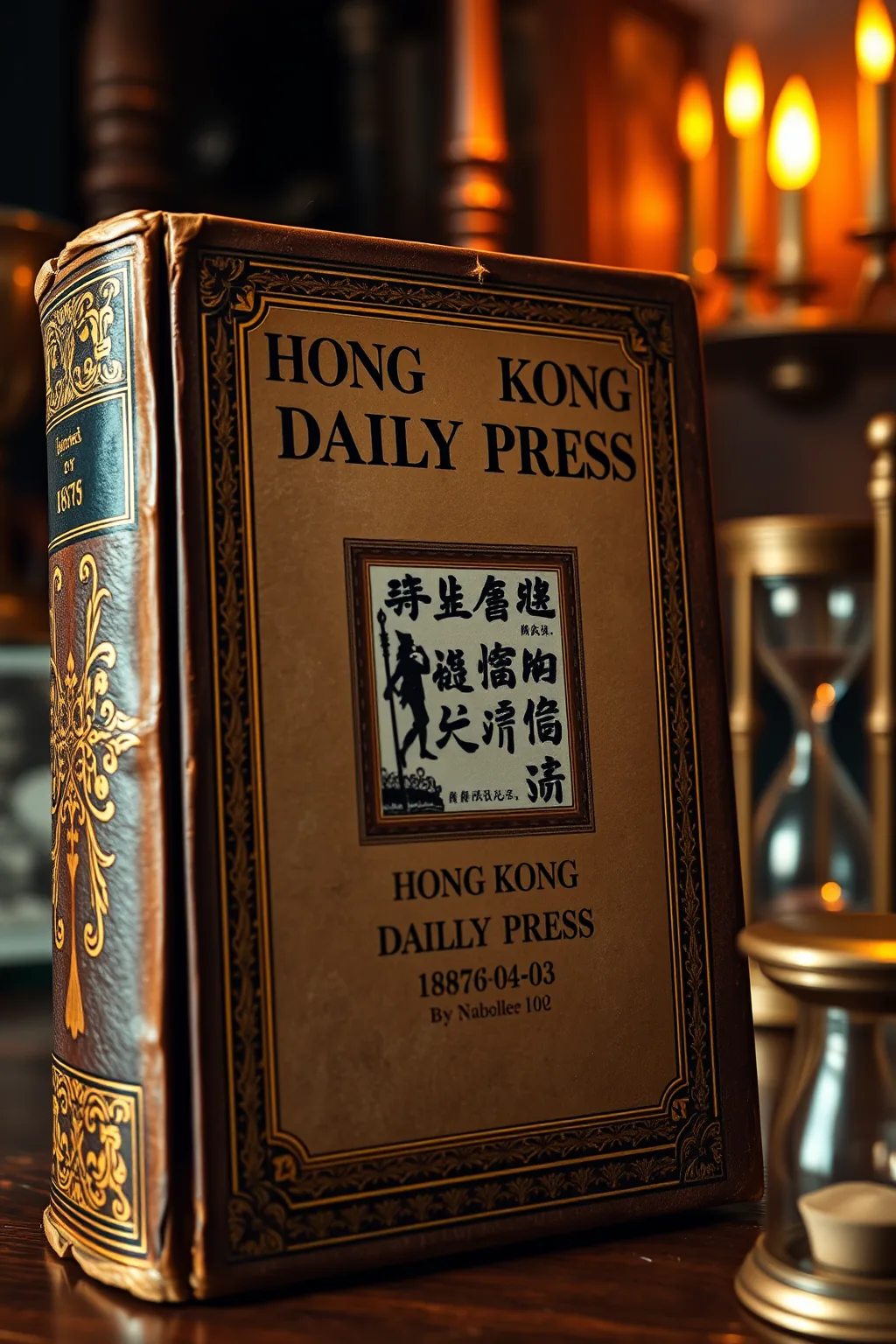
Hong Kong Daily Press 1876-04-03
 79
79

Hong Kong Daily Press 1876-04-03



Aurelia Blackwood (Occult Philosophy Critic) — This issue of the *Hong Kong Daily Press* is a fascinating artifact, offering a rare window into the psychic atmosphere of Victorian Hong Kong. While ostensibly a daily newspaper, its curated selection of reports—from 'Witchcraft and Blasphemy' to 'Contagious Disease' and 'Eccentric Robbery by Chinese'—reveals a society wrestling with primal fears and burgeoning occult interests. The juxtaposition of mundane news with whispers of the supernatural is particularly striking, suggesting a permeable boundary between the known and the unknown. This edition is invaluable for scholars of historical occultism and those interested in the socio-cultural impact of esoteric beliefs in colonial settings. Its strengths lie in its unvarnished portrayal of societal anxieties, making it a compelling read for anyone seeking to understand the deeper narratives of the past.
📝 Description
79
The April 3, 1876, Hong Kong Daily Press issue contains reports on witchcraft and blasphemy.
This 1876 edition of the Hong Kong Daily Press goes beyond typical colonial reporting. While it covers commerce, crime, and diplomatic affairs, it also reveals underlying societal concerns. The paper presents a society where anxieties about unseen forces coexist with material progress. Articles on 'Witchcraft and Blasphemy' appear alongside financial news and royal movements, illustrating a population confronting both the visible world and its mysterious aspects.
The inclusion of such topics suggests a society aware of beliefs and fears that persist despite modernization. The newspaper captures a moment where the everyday narrative intersects with deeper, perhaps more ancient, concerns. It serves as a record of a colonial port city's collective state of mind, reflecting a human tendency to seek understanding in both the rational and the unknown.
This newspaper issue touches upon themes that resonate with occult and esoteric traditions, particularly those concerned with the hidden influences on human affairs and society. The explicit mention of 'Witchcraft and Blasphemy' alongside diplomatic and financial news highlights a societal consciousness that acknowledges forces beyond conventional understanding. Such content reflects a historical period where the boundaries between rationalism and superstition were often blurred, a common area of interest for those studying the history of belief systems and their impact on collective psychology.
💡 Why Read This Book?
Unearth the hidden narratives of a colonial past where the mundane and the mystical intertwine. This edition of the *Hong Kong Daily Press* offers a rare glimpse into societal anxieties and the pervasive influence of esoteric thought amidst daily life. It's essential for seekers of historical occultism, scholars of cultural undercurrents, and practitioners interested in the tangible manifestations of belief.
⭐ Reader Reviews
Honest opinions from readers who have explored this book.
❓ Frequently Asked Questions
What is the primary esoteric theme explored in this edition?
The primary esoteric theme is the pervasive societal anxiety and fascination with the unseen, manifesting through discussions of witchcraft, blasphemy, and other alleged supernatural or unexplained occurrences that were present even in the midst of colonial modernity.
Who is the intended audience for this historical newspaper edition?
The intended audience includes historians of occultism, cultural anthropologists, students of colonial history, and anyone intrigued by the intersection of societal norms and esoteric beliefs in the late 19th century.
Are there any specific occult practices mentioned?
While specific practices are not detailed, the mention of 'Witchcraft and Blasphemy' suggests an awareness and, likely, a fear or suspicion of occult practices circulating within the society.
How does this edition connect to the broader Esoteric Library collection?
This edition connects by demonstrating how esoteric beliefs and anxieties were woven into the fabric of everyday life in historical periods, offering a grounded perspective on often abstract metaphysical concepts.
Can this newspaper edition be considered a primary source for occult studies?
Absolutely. It serves as a primary source for understanding public discourse, anxieties, and the perceived presence of occult phenomena within a specific historical and geographical context.
🔮 Key Themes & Symbolism
The Shadow Beneath Colonial Order
This edition reveals the persistent presence of ancient fears and beliefs lurking beneath the veneer of Victorian colonial order. Reports on 'Witchcraft and Blasphemy,' 'Contagious Disease,' and 'Eccentric Robbery' suggest a society deeply concerned with unseen forces, moral decay, and the potential for chaos. It highlights how even in a rapidly modernizing port city, the primal anxieties about the unknown continued to shape public consciousness and discourse, offering a compelling counterpoint to the prevailing narratives of progress and rationality.
Elements of the Unseen in Daily Discourse
The juxtaposition of mundane news – 'The Queen's Movements,' 'Panics in Foreign Funds,' 'Divorce' – with topics like 'Witchcraft and Blasphemy' and 'Contagious Disease' underscores the permeable boundary between the rational and the mystical in the collective psyche. This newspaper serves as a evidence of how esoteric concerns and supernatural interpretations could permeate everyday conversations and shape perceptions of events, demonstrating that the search for deeper meaning and explanation was a constant undercurrent in human experience, regardless of technological advancement.
Societal Anxieties and Esoteric Fascination
This historical snapshot captures a society grappling with a multitude of anxieties, from political unrest in Turkey to economic panics and personal transgressions. The inclusion of 'Witchcraft and Blasphemy' alongside more conventional news indicates a public fascination with, and perhaps fear of, forces that defied easy explanation. It suggests that during this era, the esoteric was not confined to cloistered circles but was a visible, albeit often sensationalized, aspect of public awareness, reflecting a complex interplay between rational thought and enduring spiritual or superstitious inclinations.
💬 Memorable Quotes
Direct passages from the work, attributed to the author.
“WITCHCRAFT AND BLASPHEMY.”
— This stark headline points to the societal fear and condemnation of practices perceived as deviating from accepted religious and moral norms, hinting at the power and perceived threat of the occult.
“ALLEGED LARCENY.”
— A seemingly mundane report, yet 'alleged' suggests the precariousness of truth and the potential for hidden motives or unseen circumstances surrounding criminal acts.
“CONTAGIOUS DISEASE.”
— Beyond the medical aspect, this evokes ancient fears of unseen contagions, a metaphor for societal ills and the pervasive sense of vulnerability to forces beyond human control.
“ECCENTRIC ROBBERY BY CHINESE.”
— This phrasing suggests a perception of the 'other' as potentially possessing unusual or irrational methods, reflecting colonial biases and the mystique surrounding foreign cultures.
“PANIC IN FOREIGN FUNDS.”
— A reflection of the interconnectedness of the world and the anxieties generated by forces that can destabilize economies, mirroring a collective unease about external influences.
🌙 Esoteric Significance
Tradition
This artifact speaks to the broad undercurrents of esoteric thought prevalent in the late Victorian era, a period marked by a resurgence of interest in spiritualism, occultism, and folklore. While not tied to a single codified tradition, it reflects a societal awareness of and reaction to what was perceived as the 'other' – be it through witchcraft, blasphemy, or perceived 'eccentric' criminal acts. It represents a societal engagement with the liminal spaces between the known and the unknown, a fertile ground for both fear and fascination.
Symbolism
The juxtaposition of disparate news items acts as a form of symbolic commentary. 'Witchcraft and Blasphemy' symbolizes the fear of transgression and the unknown, standing in contrast to the 'Queen's Movements' which represent order and established power. 'Contagious Disease' can be seen as a symbol of societal vulnerability, mirroring the 'Panic in Foreign Funds' as a symbol of economic fragility. These elements, when read together, create a symbolic narrative of a world grappling with both visible structures and invisible threats.
Modern Relevance
In our increasingly interconnected yet often fragmented world, the anxieties and fascinations reflected in this 1876 newspaper resonate deeply. The fear of unseen forces (whether disease, economic collapse, or ideological 'blasphemy') and the search for meaning beyond material reality remain pertinent. This edition serves as a reminder that the human psyche has always sought to understand and work through the mysteries of existence, a quest that continues to drive spiritual and philosophical inquiry today.
👥 Who Should Read This Book
This edition is essential for **historians of the occult** and **cultural anthropologists** seeking primary source material on societal beliefs and anxieties in colonial Hong Kong. **Scholars of Victorian studies** will find it important for understanding the interplay between progress and superstition. **Spiritual seekers** and **practitioners of esoteric arts** can gain insights into the historical context of occult fears and fascinations, understanding how these themes manifested in public consciousness. **Anyone interested in the hidden narratives of the past**, beyond the official records, will find this a compelling and thought-provoking read.
📜 Historical Context
This edition of the *Hong Kong Daily Press* emerges from the vibrant, complex milieu of late 19th-century Hong Kong, a key hub of global trade and cultural exchange. The Victorian era was a period of profound paradox: rapid industrialization and scientific advancement coexisted with a deep-seated fascination for spiritualism, occultism, and the unexplained. Colonial societies, like Hong Kong, were melting pots of diverse beliefs and anxieties, where traditional Eastern philosophies met Western rationalism and religious dogma. This newspaper reflects that dynamic, reporting on international affairs, colonial administration, and local events, while also hinting at the undercurrents of superstition, fear, and spiritual searching that were prevalent across the British Empire and beyond. The mention of 'Witchcraft and Blasphemy' alongside 'Panics in Foreign Funds' expresses the era's dual focus on material progress and the enduring human preoccupation with the mystical and the unknown.
📔 Journal Prompts
Reflect on a time when you felt a sense of unease or mystery in your everyday life. How did you interpret it?
Consider the societal anxieties mentioned (disease, crime, foreign influence). How do these echo in contemporary society?
Imagine you are a resident of 1876 Hong Kong reading this paper. What story would most capture your attention and why?
How does the concept of 'blasphemy' or 'witchcraft' function as a societal control mechanism, then and now?
Explore the idea of 'hidden knowledge' in this context. What might the 'esoteric' signify for the average reader of this newspaper?
🗂️ Glossary
孖剌西報 (Mālà Xībào)
The Chinese transliteration and name for the *Hong Kong Daily Press*, indicating its readership and circulation among Chinese communities as well as expatriates.
Larceny
Theft of personal property. In a legal context, it implies a wrongful taking of another's goods, often with the intent to permanently deprive the owner.
Reprobate
A person who is wicked and unprincipled; a scoundrel or villain. It carries religious connotations of being damned or condemned.
Insurrection
A violent uprising against an established government or authority. In this context, it refers to political or social unrest.
Spurious
Not being what it purports to be; false or fake. Often used to describe counterfeit items like coins or documents.
This book appears in 2 collections
🔮 Readers Also Liked
Browse all →





From the “Witchcraft” Collection
View all →





![John Todd [Illuminati And Witchcraft Exposed].pdf (PDFy mirror)](/img/thumb/john-todd-illuminati-and-witchcraft-exposed-pdf-pdfy-mirror.webp)

More Free Witchcraft & Paganism Books
View all →