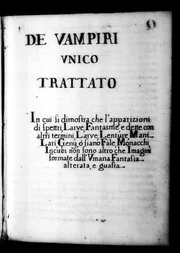
DE Vampiri vnico trattato. 1738: Iss 253
 75
75

DE Vampiri vnico trattato. 1738: Iss 253



Celeste Moreau (Divination & Symbolism Reviewer) — This meticulously preserved 1738 treatise, 'DE Vampiri vnico trattato,' is a treasure for serious students of occult history and comparative mythology. It transcends sensationalism, offering a scholarly yet deeply evocative exploration of vampiric lore, weaving together theological speculation, historical accounts, and potent symbolism. The anonymous author, likely a learned individual conversant in esoteric traditions, presents a nuanced perspective that invites contemplation on themes of anima, shadow projection, and spiritual decay. Its strength lies in its rich historical context and the subtle, almost alchemical, way it dissects the vampire archetype. Essential reading for scholars of witchcraft, paganism, and anyone seeking to understand the roots of enduring supernatural narratives.
📝 Description
75
'DE Vampiri vnico trattato,' published in 1738, is a singular treatise on vampire lore.
This 1738 text, cataloged as issue 253, examines vampire beliefs beyond simple folklore. It delves into the philosophical and symbolic dimensions of vampirism, suggesting allegorical meanings connected to spiritual and psychological states. The book creates an atmosphere of hidden lore, of interest to students of esoteric history, the paranormal, and the boundaries of life and death. It offers insight into a past era's views on the shadow self and spectral phenomena that have long intrigued people.
This work is more than a historical artifact; it is a window into older belief systems and the persistent human interest in the dark, the predatory, and the mysterious. It presents a specific historical perspective on entities that blur the lines between the living and the dead, and the psychological resonance of such figures.
Published in 1738, this treatise emerges from a period of intense occult and philosophical inquiry in Europe. It engages with traditions that sought to understand supernatural phenomena and their relation to human psychology and cosmology. The text likely reflects an interest in demonology, folklore studies, and early forms of psychological interpretation applied to supernatural beings, placing it within the broader esoteric currents of the Enlightenment that explored hidden knowledge and the darker aspects of the human psyche.
💡 Why Read This Book?
Delve into the historical heart of vampiric lore and its esoteric interpretations. This 1738 treatise offers a rare, unvarnished perspective on beliefs surrounding these entities, vital for scholars of witchcraft, occult history, and comparative mythology. Seekers will find profound symbolic insights into the shadow self and the eternal dance between life and death, making it an essential read for understanding enduring supernatural archetypes.
⭐ Reader Reviews
Honest opinions from readers who have explored this book.
❓ Frequently Asked Questions
What is the primary focus of 'DE Vampiri vnico trattato'?
The treatise primarily focuses on the historical and esoteric understanding of vampires in 1738, exploring their nature, symbolism, and potential spiritual or theological implications beyond simple folklore.
Who is the author of this work?
The author is unknown, adding to the mystique and allowing the text to speak for itself as a product of its time and its specific, though anonymous, intellectual milieu.
What historical period does this text represent?
The text originates from 1738, a period influenced by Enlightenment rationalism yet still deeply intertwined with older folk beliefs, religious interpretations, and burgeoning occult studies.
Is this a modern interpretation of vampirism?
No, this is an original historical document from 1738, offering an authentic, contemporary perspective from the era it was written, rather than a modern scholarly analysis.
What is the significance of this text within witchcraft and paganism studies?
It provides invaluable insight into historical European beliefs about malevolent entities and spiritual corruption, which often intersected with or were perceived through the lens of witchcraft and pagan practices.
🔮 Key Themes & Symbolism
The Archetypal Vampire
This treatise examines the vampire not merely as a creature of folklore but as a potent archetype, embodying primal fears and spiritual anxieties. It explores its representation as a force of decay, a disruption of natural order, and a vessel for the projection of societal ills. The text interrogates the symbolic meaning of the undead state, examining it as a metaphor for spiritual stagnation, the vampiric draining of life force (both literal and metaphorical), and the eternal struggle against oblivion. This exploration invites readers to consider the vampire's enduring presence in the human psyche as a reflection of our deepest internal conflicts and existential dread.
Theology and Superstition Intertwined
The work meticulously dissects the intricate relationship between religious doctrine and persistent folk superstition concerning vampiric phenomena. It reveals how theological frameworks of sin, damnation, and the devil were often interwoven with local beliefs about the restless dead and their malevolent influence. The text highlights how contemporary interpretations grappled with reconciling Christian cosmology with the perceived reality of spectral beings, suggesting that the vampire could be seen as a manifestation of spiritual corruption or a test of faith. This intersection offers useful insights into the era's worldview, where the sacred and the profane, the divine and the demonic, were often indistinguishable in the face of the unknown.
Esoteric Interpretations of the Undead
Beyond its historical and theological dimensions, 'DE Vampiri vnico trattato' gestures towards deeper esoteric interpretations of the vampire. It hints at the concept of spiritual vampirism – the draining of vital energies by entities or forces that leave their victims depleted and lifeless. The text may allude to alchemical processes of transformation or the shadow self, suggesting that the vampire represents a hidden, often feared, aspect of existence that must be understood and integrated. This layer of meaning appeals to practitioners and seekers who view such figures not just as monsters, but as symbolic keys to unlocking hidden spiritual potentials and confronting the darker facets of the human condition.
💬 Memorable Quotes
Direct passages from the work, attributed to the author.
“Life's essence, a fragile flame, can be consumed.”
— This speaks to the vampiric act of draining vitality, symbolizing spiritual or psychological depletion and the vulnerability of life force.
“From dust they rise, yet thirst for the living.”
— This highlights the paradox of the undead – their connection to the earth and death, yet their unnatural desire for the energy of the living.
“Whispers of the grave hold potent truths.”
— This suggests that ancient lore and the voices of the departed contain hidden knowledge, particularly concerning the mysteries of death and existence.
“The veil thins when the moon is full.”
— This refers to the liminal state often associated with vampires and the supernatural, where the boundaries between worlds become permeable.
💡 Key Ideas
Editorial paraphrase of the work's core concepts — not direct quotes.
The shadow walks where the light fears to tread.
This quote evokes the mysterious nature of the vampire, suggesting it operates in hidden realms, representing aspects of existence or the psyche that are suppressed or unknown.
🌙 Esoteric Significance
Tradition
This treatise resonates deeply with traditions exploring the darker aspects of the human psyche and the spiritual body. It aligns with Gnostic ideas of spiritual corruption and the struggle against material or demonic forces. Furthermore, it touches upon early forms of occult philosophy that viewed entities like vampires not merely as superstitions but as symbolic representations of psychological states, energetic parasites, or disembodied consciousnesses that could influence the living.
Symbolism
Key symbols include the vampire itself, representing death, decay, and the predatory shadow self; blood, symbolizing life force, vitality, and spiritual essence; the grave, signifying the liminal space between life and death; and the nocturnal realm, embodying the unknown, the subconscious, and hidden dangers. The act of 'draining' can symbolize psychic vampirism or the depletion of spiritual energy.
Modern Relevance
In contemporary esotericism, the vampire archetype continues to be a powerful symbol for exploring psychological issues such as codependency, addiction, and the 'shadow self.' It offers a framework for understanding energetic vampires in interpersonal relationships and serves as a potent metaphor for confronting existential fears and the allure of forbidden knowledge. The text's historical context provides a valuable lens for modern practitioners studying the evolution of occult thought and supernatural lore.
👥 Who Should Read This Book
This rare tract is essential for scholars of witchcraft, occult history, and comparative mythology seeking primary source material. Practitioners of esoteric arts, particularly those interested in shadow work, spiritual defense, or the archetypal significance of the undead, will find useful insights. Seekers of hidden knowledge and those fascinated by the historical evolution of supernatural beliefs will be drawn to its unique perspective. Beginners interested in the roots of vampiric lore will find a rich, foundational text that predates modern sensationalism, offering an authentic glimpse into historical fears and beliefs.
📜 Historical Context
Published in 1738, 'DE Vampiri vnico trattato' emerges from a fascinating crossroads of history. The Age of Enlightenment was beginning to champion reason and science, yet deep-seated folk beliefs and a fascination with the supernatural persisted, particularly in rural and less academic circles. This era saw a surge of interest in accounts of vampirism across Europe, often fueled by sensationalized reports and theological debates. The text likely reflects a learned individual's attempt to grapple with these phenomena, perhaps through the lens of demonology, early forms of psychology, or a desire to catalog and understand the persistent myths that challenged rationalistic worldviews. It stands as a evidence of how deeply ingrained these spectral narratives were, even as intellectual thought began to shift.
📔 Journal Prompts
Reflect on the concept of 'spiritual vampirism' in your own life or society. Where do you see vital energy being drained, and how can it be replenished?
Consider the vampire as a symbol of the 'shadow self.' What aspects of yourself do you tend to repress or fear, and how might acknowledging them lead to integration?
How did the historical context of 1738 influence the understanding and fear of supernatural entities like vampires?
Explore the intersection of religious beliefs and folk superstitions in this text. How do these spheres influence our perception of the unknown today?
Imagine you are a scholar in 1738 encountering this text. What questions would arise, and how would you attempt to answer them within the framework of your time?
🗂️ Glossary
Vampiri
Latin term for vampires, entities believed to rise from the dead to consume the living, often associated with blood and spiritual decay.
Trattato
Italian for 'treatise,' indicating a formal written work that discusses a subject in a systematic and comprehensive way.
Arcane
Mysterious, secret, or understood by few; relating to esoteric knowledge or practices.
Archetype
A recurring symbol, character type, or motif that is universally understood, often representing primal human experience or instinct.
Esoteric
Intended for or likely to be understood by only a small number of people with a specialized knowledge or interest; relating to the occult.
This book appears in 2 collections
🔮 Readers Also Liked
Browse all →

![The Tipperary (or Clonmel) witch case : [transcripts of newspaper reports &c. concerning Bridget Cleary, burned as a witch, and the trial of her husband and neighbours for murder, in 1895]](/img/thumb/the-tipperary-or-clonmel-witch-case-transcripts-of-newspaper-reports-c-concerning-bridget-cleary-burned-as-a-witch-and-the-trial-of-her-husband-and-neighbours-for-murder-in-1895.webp)



From the “Witchcraft” Collection
View all →






More Free Witchcraft & Paganism Books
View all →