De la demonomanie des sorciers ... 1582: Iss 125
 75
75

De la demonomanie des sorciers ... 1582: Iss 125



Isolde Whitaker, Sacred Texts Editor, hails Bodin's "De la demonomanie des sorciers" as a cornerstone of early modern demonological discourse. "Bodin's comprehensive treatise, penned with legalistic precision and theological conviction, remains a vital, if unsettling, window into the mechanics of witch-belief. Its detailed cataloging of alleged demonic practices and the rationale behind accusations offers invaluable insights into the period's collective consciousness and the construction of 'the witch.' This digitized edition is indispensable for scholars and practitioners seeking to understand the roots of Western occultism and the historical forces that shaped perceptions of the arcane. It is a testament to the enduring, if often dark, fascination with the hidden powers that were believed to govern the world."
📝 Description
75
Jean Bodin's 1582 treatise, "De la demonomanie des sorciers," details the legal and theological justifications for prosecuting witchcraft.
Jean Bodin, a jurist and philosopher, wrote "De la demonomanie des sorciers" in 1582. The book examines beliefs about witchcraft prevalent in the late Renaissance. Bodin analyzes the perceived pacts between individuals and demonic forces, and the concept of maleficium, or harmful magic. He approaches the subject with the structured thinking of a legal scholar, but his writing reflects the intense fear and fascination with the supernatural common in his time.
This work is not simply a historical account. It considers the human mind's struggle with concepts of the hidden, the forbidden, and the perceived influence of those accused of dealing with dark powers. The book lays out the intellectual basis for witch hunts, including theological arguments and the kinds of evidence accepted. It is a key text for understanding how belief, authority, and fear shaped historical persecutions.
Published in 1582, Bodin's work is a significant document within the history of Western esotericism, specifically concerning the demonological tradition. It reflects a period where the perceived reality of witchcraft and demonic influence was deeply integrated into both religious and legal frameworks. The book's detailed examination of sorcery aligns with a broader late medieval and Renaissance interest in classifying and understanding supernatural phenomena, often linking them to theological doctrines and popular beliefs about the Devil's activity in the world.
💡 Why Read This Book?
Uncover the historical genesis of Western demonology and understand the societal fears that fueled witch trials. This foundational text reveals the intellectual and theological frameworks used to define and condemn alleged sorcerers. Essential for scholars of occult history, theology, and the sociology of belief, and for practitioners seeking to comprehend the historical roots of magic and its persecution.
⭐ Reader Reviews
Honest opinions from readers who have explored this book.
❓ Frequently Asked Questions
What is the primary focus of Bodin's "De la demonomanie des sorciers"?
The book's primary focus is a comprehensive legal and theological examination of witchcraft, aiming to define demonic pacts, identify sorcerers, and justify their prosecution based on contemporary beliefs and perceived evidence of their pacts with the devil.
Who was Jean Bodin, and what was his role?
Jean Bodin (1530-1596) was a prominent French jurist, philosopher, and political theorist. In "De la demonomanie," he applied his legal and intellectual acumen to the subject of witchcraft, attempting to establish a systematic approach to its understanding and suppression.
Is this book an academic text or a practitioner's guide?
While it details alleged practices, "De la demonomanie" is primarily an academic and legalistic text from its era, designed to inform authorities and justify the legal framework for prosecuting witches. It is not a guide for practitioners of magic.
What historical period does this book represent?
The book represents the late Renaissance, specifically 1582, a period marked by intense religious upheaval, fear of heresy, and widespread belief in and persecution of witchcraft across Europe.
What is the significance of this digitized edition?
This digitized edition makes a rare and historically significant text accessible, preserving Bodin's original arguments and providing scholars and enthusiasts with direct access to a foundational work in the study of demonology and witch trials.
🔮 Key Themes & Symbolism
Theological Framework of Demonic Influence
Bodin meticulously constructs a theological edifice to explain the pervasive influence of demons in human affairs. He details the nature of Satan, the hierarchy of infernal spirits, and the mechanisms by which they are believed to corrupt mortals. The text studies the concept of the diabolical pact, the supposed covenant between a sorcerer and the devil, outlining the perceived signs and consequences of such an unholy alliance. This theme explores how prevailing religious doctrines and eschatological fears were interwoven to create a worldview where supernatural malevolence was not only possible but actively present, shaping societal responses to perceived threats.
The Legal and Judicial Construction of Witchcraft
As a jurist, Bodin applies a legalistic lens to the phenomenon of witchcraft, attempting to define its characteristics and establish criteria for its identification and prosecution. The book serves as a quasi-legal handbook, detailing procedures, types of evidence (often spectral or circumstantial), and the justification for severe punishments. This theme highlights the convergence of legal systems with theological dogma, illustrating how societal fears were codified into law, leading to systematic persecution. It examines the intellectual struggle to reconcile divine justice with earthly law in the face of perceived supernatural transgressions.
Perception and Manifestation of Maleficium
Central to Bodin's work is the concept of 'maleficium'—the harmful magic attributed to witches. The text enumerates a vast array of alleged sorcerous acts, from causing illness and crop failure to curses and pacts with animals. This theme explores how the fear of hidden malevolence manifested in tangible accusations and beliefs about the tangible, destructive power of those accused of witchcraft. It offers insight into the collective imagination, where unexplained misfortunes were readily attributed to the deliberate machinations of individuals deemed to be in league with dark forces.
💬 Memorable Quotes
Direct passages from the work, attributed to the author.
“To deny witchcraft is to deny God's justice.”
— This highlights the religious imperative behind combating witchcraft, suggesting that acknowledging and punishing it is a divine duty and a validation of God's righteous order.
“Signs of a pact with the Devil are manifold.”
— This points to Bodin's systematic approach, emphasizing that the supposed evidence of a witch's pact is not singular but a collection of specific, identifiable indicators.
“Malefices are the instruments of infernal rage.”
— This phrase underscores the perceived destructive intent behind witchcraft, portraying the harmful acts as direct expressions of demonic fury unleashed upon humanity.
“Justice must strike with severity against such abominations.”
— This reveals Bodin's conviction regarding the necessity of harsh legal retribution, framing the persecution of witches as an act of purifying society from grave moral and spiritual contamination.
💡 Key Ideas
Editorial paraphrase of the work's core concepts — not direct quotes.
The Devil is the true author of witchcraft.
This quote expresses Bodin's core theological assertion: that all sorcery originates from Satan, framing witchcraft not as human agency but as a diabolical imposition upon the world.
🌙 Esoteric Significance
Tradition
While Bodin's text is a product of mainstream theological and legal thought of its time, its deep dive into demonology and the perceived mechanics of diabolical pacts places it at the fringes of what could be considered historical esoteric discourse. It illuminates the intellectual underpinnings that informed popular occult beliefs and fears, providing a crucial historical lens for understanding the historical context of various Western magical traditions that often engaged with or reacted against such demonological frameworks.
Symbolism
The symbolism within Bodin's work is largely tied to Christian demonology. The Devil is the ultimate symbol of evil and opposition to the divine order. Witches, through their pacts, become symbols of betrayal, corruption, and the inversion of natural law. The 'signs' of witchcraft—such as familiars (animal spirits), marks on the body, or nocturnal gatherings—function as symbolic indicators of this infernal allegiance. The text is rich with symbolic interpretations of biblical passages and theological concepts used to identify and condemn those perceived as agents of darkness.
Modern Relevance
In the modern era, Bodin's "De la demonomanie" serves as a critical historical document. It offers invaluable insight into the psychological and societal mechanisms that drive mass hysteria, scapegoating, and the persecution of marginalized groups. For those studying the history of religion, law, and social control, it provides a stark example of how belief systems can be weaponized. Esoterically, it helps understand the historical evolution of ideas about magic, spirit alliances, and the adversarial forces that have been conceptualized within various magical traditions.
👥 Who Should Read This Book
This key work is essential for a diverse audience. **Scholars of history, theology, and legal studies** will find it an indispensable primary source for understanding the intellectual climate of the late Renaissance and the judicial prosecution of witchcraft. **Students of occult history and demonology** will gain a foundational understanding of the era's prevailing beliefs about the Devil and his influence. **Practitioners of Western esoteric traditions** may find value in comprehending the historical context and the adversarial forces that have been conceptualized and feared within their lineage. **General readers interested in the darker aspects of human history and the sociology of belief** will find a compelling, albeit disturbing, account of how fear and faith can shape societal actions.
📜 Historical Context
Published in 1582, "De la demonomanie des sorciers" emerged during a period of profound societal upheaval in Europe. The late Renaissance was characterized by religious schisms, the Protestant Reformation, and the Catholic Counter-Reformation, fueling an atmosphere of intense theological debate and suspicion. Belief in the active, malevolent presence of the Devil and his agents was widespread across all strata of society, from peasantry to royalty. This era saw a dramatic escalation in witch trials, driven by a confluence of factors including newfound legal frameworks for prosecution, evolving theological interpretations of demonic influence, and widespread anxieties about social disorder, famine, and disease. Bodin's work was a significant contribution to this discourse, codifying beliefs and legal precedents that would influence witch-hunting practices for decades, reflecting a society grappling with fear, faith, and the perceived presence of the supernatural.
📔 Journal Prompts
How did Bodin's legalistic approach to witchcraft reflect or challenge the prevailing theological views of his time?
Analyze the societal anxieties that likely contributed to the widespread acceptance of Bodin's claims about demonic influence.
In what ways does Bodin's definition of 'maleficium' reveal the fears and superstitions of 16th-century Europe?
Consider the ethical implications of Bodin's work from a modern perspective. How do his arguments about evidence and justice differ from contemporary standards?
Explore the concept of the 'diabolical pact' as presented by Bodin. What does this concept reveal about the perceived relationship between humanity and the supernatural?
🗂️ Glossary
Demonomanie
From the Greek 'daimon' (demon) and 'mania' (madness or frenzy), referring to a belief in or obsession with demons and their influence, particularly as it pertains to witchcraft.
Maleficium
Latin for 'evil deed' or 'harmful magic.' In the context of witchcraft, it refers to the malevolent acts attributed to sorcerers, such as causing illness, crop failure, or misfortune.
Diabolical Pact
A purported agreement between an individual and the Devil, often involving the renunciation of one's faith in exchange for supernatural powers or protection.
Familiars
Supernatural entities, often depicted as animals (cats, dogs, toads), believed to be in service to witches, acting as their assistants or conduits to demonic power.
Witch-Mark
A physical blemish or insensitive spot on the body of an accused witch, believed to be a physical manifestation of their pact with the Devil, where he would suck blood.
This book appears in 2 collections
🔮 Readers Also Liked
Browse all →







More by BODIN, Jean, 1530-1596.
All books →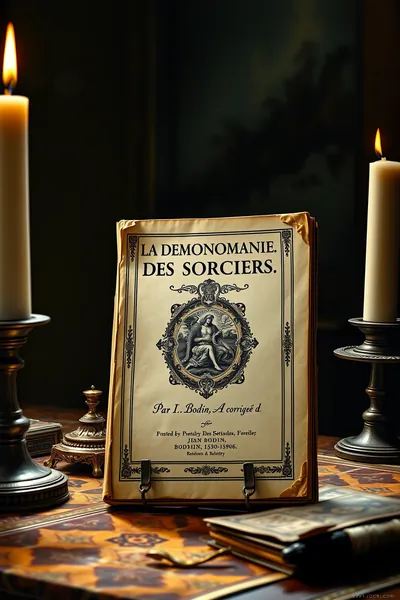



From the “Witchcraft” Collection
View all →








More Free Witchcraft & Paganism Books
View all →