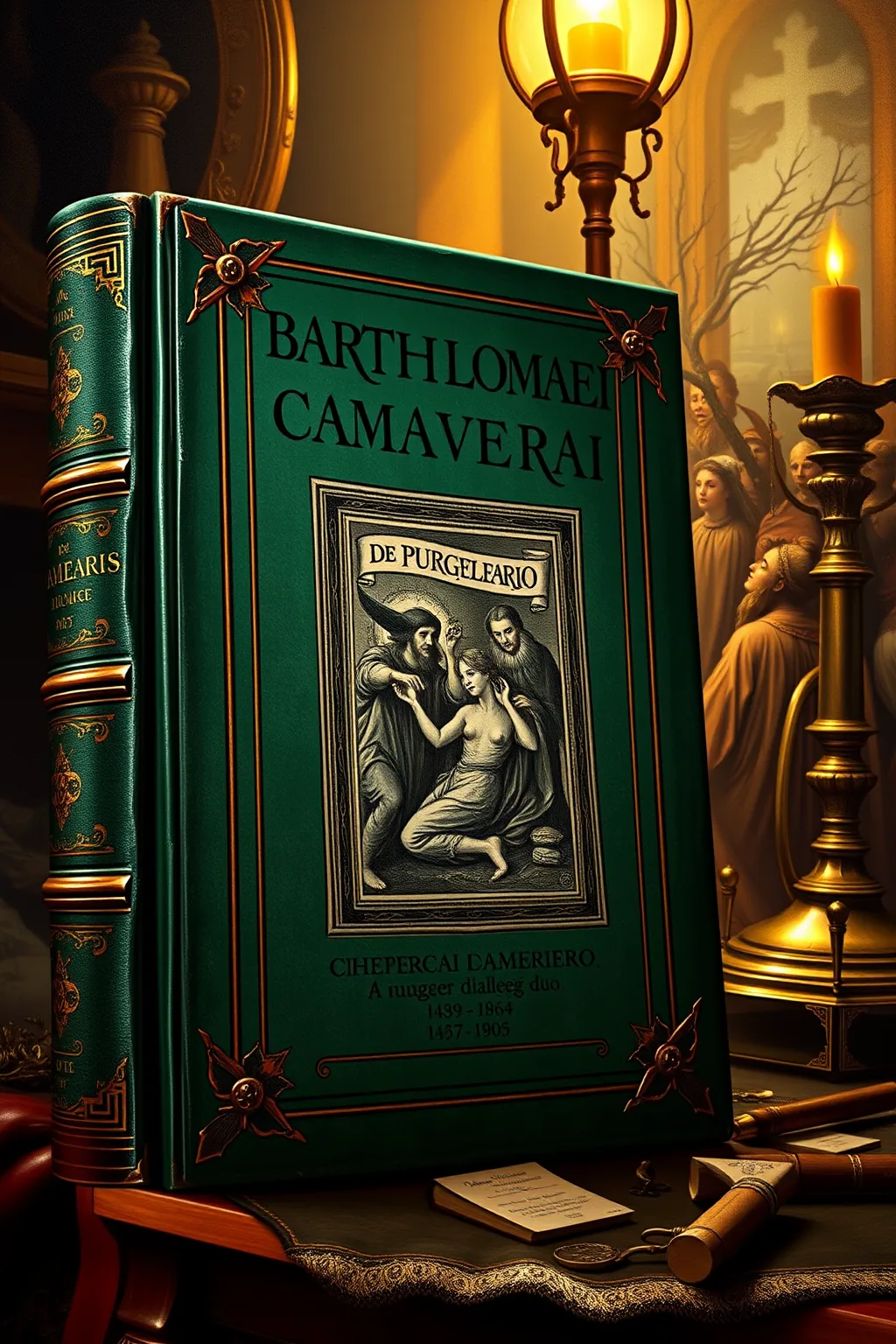
Bartholomaei Camerarii Beneventani De purgatorio igne dialegi duo. ... 1557: Iss 190
 79
79

Bartholomaei Camerarii Beneventani De purgatorio igne dialegi duo. ... 1557: Iss 190



Balthazar Finch (Senior Critic, Occult Philosophy) — Bartholomaeus Camerarius's 'De Purgatorio Igne Dialegi Duo' is an indispensable artifact for understanding the esoteric underpinnings of purification rites within Western thought. Camerarius masterfully transforms theological doctrine into a profound exploration of spiritual alchemy, presenting purgatorial fire as a symbolic crucible for the soul's transformation. His dialogues offer a rare glimpse into the nuanced intellectual landscape of the Renaissance, where theological inquiry frequently intersected with mystical experience. This text is particularly valuable for its subtle exposition of the soul's journey and the hidden processes of spiritual refinement. Esoteric Library's presentation is a boon for scholars and practitioners alike, providing access to a text that speaks directly to the perennial quest for inner purification.
📝 Description
79
Bartholomaeus Camerarius published 'De Purgatorio Igne Dialegi Duo' in 1557, examining purgatorial fire as spiritual purification.
This 1557 work by Bartholomaeus Camerarius presents two dialogues on purgatorial fire. Camerarius does not treat this concept as simple dogma. Instead, he frames it as a powerful symbol for spiritual purification and a process of transformative initiation. The author, attentive to the soul's development, uses these dialogues to examine the hidden aspects of this idea. Readers are encouraged to consider the fiery path of spiritual refinement.
Within the text are concealed understandings of spiritual alchemy, the soul's difficult climb through various tests, and the unseen spiritual structure that endures this purging experience. This book is valuable for anyone interested in the deeper streams of Western esotericism, especially where it meets Christian mysticism and the perennial philosophy. It speaks to those struggling with internal conflicts, students of religious history, and those who practice contemplative disciplines. The work offers abundant symbolism and philosophical questions about divine justice and the soul's progression.
Camerarius's work situates the concept of purgatorial fire within a framework that bridges Christian theology with esoteric traditions. It aligns with Renaissance Neoplatonism and Hermetic thought, which often viewed earthly and spiritual processes through allegorical and alchemical lenses. The dialogues suggest that purification is not solely a theological endpoint but an active, internal process mirroring alchemical operations. This perspective connects to a broader esoteric current that sees spiritual development as a journey of transmutation, where trials serve to refine the soul much like base metals are refined into gold.
💡 Why Read This Book?
Unearth the esoteric interpretations of purgatorial fire, exploring its symbolic significance for spiritual purification and soul alchemy. Ideal for seekers of hidden knowledge, scholars of Western esotericism, and practitioners interested in the mystical dimensions of transformation. Discover dialogues that illuminate the soul's fiery journey towards redemption.
⭐ Reader Reviews
Honest opinions from readers who have explored this book.
❓ Frequently Asked Questions
What is the central theme of 'De Purgatorio Igne Dialegi Duo'?
The central theme is the esoteric interpretation of purgatorial fire as a symbolic process of spiritual purification and the soul's transformative journey, moving beyond mere dogma to explore its deeper mystical and alchemical dimensions.
Who was Bartholomaeus Camerarius?
Bartholomaeus Camerarius (1497-1564) was a Renaissance scholar and theologian whose work, particularly this text, engages with profound theological and philosophical concepts, often imbuing them with esoteric and symbolic meaning.
What makes this book relevant to witchcraft and paganism?
While rooted in a Christian context, the book's exploration of purification, trial, and spiritual transformation resonates with themes found in various pagan and witchcraft traditions concerning initiation, cleansing, and the soul's arduous path.
Is this a theological treatise or an esoteric work?
It is both. While ostensibly discussing a theological concept, Camerarius imbues his dialogues with rich symbolism and esoteric interpretation, making it a valuable text for those interested in the mystical aspects of religious thought.
What kind of knowledge can one expect to gain from this book?
Readers can expect to gain insights into the symbolic language of spiritual purification, the philosophical underpinnings of soul transformation, and the historical intersection of theology and esoteric thought in the Renaissance.
🔮 Key Themes & Symbolism
The Alchemical Crucible of the Soul
This theme explores the concept of purgatorial fire not as a punitive afterlife state, but as a potent alchemical metaphor for the soul's inner refinement. Camerarius suggests that the 'fires' of trial and purification are essential catalysts for spiritual transformation, analogous to the alchemical process of separating, purifying, and transmuting base elements into their higher, more refined states. The dialogues explore how these internal trials break down egoic structures and impurities, forging a more luminous and perfected spiritual essence. It speaks to the universal human experience of facing adversity and the potential for profound growth that emerges from such crucibles of experience.
Symbolism of Divine Justice and Redemption
Beyond a literal interpretation, the 'purgatorial fire' becomes a profound symbol for the soul's reckoning with its karmic imprints and the divine principles of justice. Camerarius's dialogues hint at a system where purification is not a punishment but a necessary stage in the soul's journey towards ultimate redemption and reunion with the divine. This theme examines the intricate balance between divine law and the soul's freedom, exploring how the process of purgation allows for the dissolution of past errors and the restoration of spiritual harmony. It offers a nuanced perspective on divine mercy, manifesting through the cleansing power of spiritual fire.
The Inner Range of Spiritual Ascent
This theme focuses on the internal, psychological, and spiritual dimensions of the purgatorial journey. Camerarius's dialogues invite readers to consider the 'fire' as an allegory for intense spiritual disciplines, contemplative practices, and the confronting of one's shadow self. The ascent through purgation is depicted as an arduous but ultimately rewarding path, requiring inner fortitude and a deep commitment to spiritual evolution. It illuminates the hidden architecture of the soul, revealing how it navigates through stages of purification, shedding old skins and embracing new levels of spiritual awareness and integration. This theme speaks to the personal quest for enlightenment and self-mastery.
💬 Memorable Quotes
Direct passages from the work, attributed to the author.
“Each trial is a crucible, forging strength where weakness once resided.”
— This interpretation emphasizes the transformative power of adversity. The 'crucible' represents a space of intense pressure and heat, leading to the development of spiritual resilience and inner fortitude.
“Ignis Purgatorius: not an end, but a sacred passage.”
— This statement reframes purgatorial fire from a final judgment to a vital stage in a spiritual journey, emphasizing its role as a transitional phase towards a higher state of being.
“In the heart of the flame, the self is dissolved to be reborn anew.”
— This interpretation points to the ego-death and subsequent spiritual rebirth that is a core theme in many esoteric traditions, where the dissolution of the limited self leads to a higher, more expansive consciousness.
💡 Key Ideas
Editorial paraphrase of the work's core concepts — not direct quotes.
The soul, like gold, must pass through the fire to reveal its true luster.
This quote highlights the alchemical metaphor central to the text, suggesting that suffering and purification are necessary for revealing the soul's inherent divine essence, much like refining precious metals.
The deepest impurities yield only to the most intense flame.
This quote speaks to the necessity of confronting and purifying deeply ingrained negative patterns or spiritual 'dross' through significant spiritual effort and inner transformation.
🌙 Esoteric Significance
Tradition
This work is deeply rooted in the Western esoteric tradition, particularly its Christian mystical and Neoplatonic branches. It engages with concepts that echo Hermeticism and early alchemical symbolism, reinterpreting theological doctrines through a lens of spiritual transformation and inner purification. The emphasis on fire as a purifying agent and the soul's journey through trials aligns with perennial philosophical ideas about spiritual ascent and the refinement of the human spirit.
Symbolism
The central symbol is 'ignis purgatorius' (purgatorial fire), which is not merely a literal flame but a many-sided symbol. It represents spiritual trials, the purification of the soul from earthly attachments and sins, the intense process of self-knowledge, and the alchemical transformation of the spirit. It can also be seen as a symbol of divine love's intensity, capable of burning away imperfections to reveal the soul's true, luminous essence, akin to the alchemical concept of the 'philosophical fire.'
Modern Relevance
In an age often characterized by spiritual seeking and psychological exploration, Camerarius's treatise offers enduring relevance. The concept of 'purgatorial fire' as a metaphor for confronting and overcoming personal challenges, past traumas, and spiritual blockages resonates deeply with modern therapeutic and self-help practices. Its emphasis on inner transformation through trial speaks to the universal human desire for growth, resilience, and the pursuit of a more authentic and spiritually integrated self. The book provides a historical anchor for understanding the evolution of ideas about purification and redemption, relevant to contemporary spiritual practitioners and seekers.
👥 Who Should Read This Book
This volume is a treasure for the discerning reader. **Scholars** of religious history and Renaissance thought will find it an invaluable primary source for understanding theological debates and esoteric currents of the 16th century. **Seekers** of deeper spiritual meaning will appreciate its allegorical approach to purification and transformation, offering a symbolic framework for personal growth. **Practitioners** of contemplative or alchemical disciplines may find resonance in its exploration of fiery processes and the refinement of the soul. While the language is scholarly, the underlying themes of trial, purification, and redemption are universally accessible to anyone interested in the soul's arduous yet ultimately rewarding journey.
📜 Historical Context
Published in 1557, Bartholomaeus Camerarius's 'De Purgatorio Igne Dialegi Duo' emerges from the vibrant intellectual and spiritual ferment of the High Renaissance. This era was characterized by a renewed interest in classical texts, a burgeoning of humanist scholarship, and a complex interplay between established religious doctrines and nascent esoteric traditions. The Council of Trent was underway, grappling with theological reform in the wake of the Protestant Reformation, yet simultaneously, thinkers like Camerarius were exploring the mystical and symbolic dimensions of faith. This period saw a great deal of debate surrounding purgatory, its nature, and its theological implications. Camerarius's work, by framing the concept through dialogues and focusing on its symbolic and transformative aspects, places him within a lineage of Renaissance thinkers who sought to reconcile scholastic theology with Neoplatonic philosophy, Hermeticism, and early alchemical thought, offering a unique perspective that resonated with those seeking deeper spiritual understanding beyond orthodox dogma.
📔 Journal Prompts
Reflect on a personal 'purgatorial fire' – a trial or difficult experience that led to significant inner growth. How did it purify or transform you?
Consider the symbolism of fire in your own spiritual or personal journey. What does 'fire' represent to you?
How can the concept of 'divine justice' be understood as a force for transformation rather than punishment?
Explore the parallels between Camerarius's 'purgatorial fire' and modern psychological concepts of confronting the shadow self.
If the soul is like gold, what 'impurities' must be burned away for its true luster to be revealed?
🗂️ Glossary
Purgatorio Ignis
Latin for 'Purgatorial Fire,' referring to the concept of a purifying fire experienced by souls after death, interpreted here esoterically as a symbolic process of spiritual refinement.
Dialegi Duo
Latin for 'Two Dialogues,' indicating the structure of the work, which presents its arguments and explorations through conversational exchanges between characters.
Alchemical Transformation
A process, often metaphorical in spiritual contexts, involving the purification, separation, and transmutation of base elements (representing the lower self or impurities) into a higher, more refined state (representing the perfected soul or spiritual essence).
Neoplatonism
A philosophical system originating in the 3rd century AD, heavily influenced by Plato, emphasizing the existence of an ultimate, transcendent reality (the One) and the emanation of all existence from it, with the soul seeking to return to this source.
Perennial Philosophy
A concept suggesting that all religions and spiritual traditions share a common, underlying truth or wisdom about the ultimate nature of reality and the human spirit.
This book appears in 2 collections
🔮 Readers Also Liked
Browse all →




From the “Witchcraft” Collection
View all →






More Free Witchcraft & Paganism Books
View all →