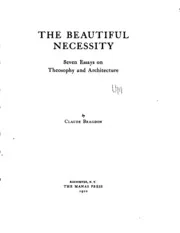
The Beautiful Necessity: Seven Essays on Theosophy and Architecture
 71
71

The Beautiful Necessity: Seven Essays on Theosophy and Architecture


Lorelei Sage (Contemplative Literature Editor) — Claude Fayette Bragdon’s ‘The Beautiful Necessity’ is a seminal work for those exploring the spiritual underpinnings of design. Bragdon masterfully weaves Theosophical principles with architectural theory, presenting a compelling argument for beauty as an inherent, almost divine, law. His essays delve into symbolism, revealing how structures echo cosmic truths and human aspiration. This book is particularly resonant for students of esoteric philosophy and architecture, offering profound insights into the interconnectedness of form, spirit, and universal order. It’s a deeply contemplative read that elevates the perception of the built environment, urging us to recognize the sacred in the mundane.
📝 Description
71
Claude Fayette Bragdon argued in 1910 that architecture reveals universal laws and spiritual aspirations.
Claude Fayette Bragdon's 'The Beautiful Necessity' presents seven essays that connect Theosophy and architecture. Bragdon, an architect and mystic, proposed that buildings are more than just functional structures. They are expressions of universal principles and divine geometry, channeling spiritual desires. He encouraged readers to find the sacred within structures, showing how form's necessity links to beauty and unseen forces.
Bragdon examines the symbolic meanings in various architectural styles, from Gothic spires to classical proportions. He saw these as reflections of cosmic order. This book appeals to anyone wanting to grasp the spiritual depth of our surroundings. It highlights the subtle links between the material and metaphysical worlds. The work offers a new perspective on the world, informed by ancient thought and artistic understanding.
Published in 1910, 'The Beautiful Necessity' emerged during a period of intense interest in Theosophy and related spiritual movements. Bragdon's work situates architecture within a broader metaphysical framework, aligning with the era's search for hidden order in the material world. It reflects the Theosophical emphasis on underlying spiritual truths manifesting in physical forms, connecting geometric principles to cosmic consciousness. The book engages with ideas prevalent in esoteric circles regarding the sacredness of proportion and the symbolic resonance of design.
💡 Why Read This Book?
Embark on a journey where architecture transcends mere structure to reveal its spiritual essence. 'The Beautiful Necessity' is essential for seekers of hidden knowledge, scholars of esoteric thought, and practitioners of art and design who wish to understand the profound, often mystical, relationship between form, beauty, and universal law. Discover the sacred geometry that underpins our world.
⭐ Reader Reviews
Honest opinions from readers who have explored this book.
❓ Frequently Asked Questions
What is Theosophy and how does it relate to architecture in this book?
Theosophy, as explored by Bragdon, is a philosophical and spiritual system that posits a universal divine wisdom. In this book, it’s presented as the unseen force and underlying principles that dictate the necessity and beauty of architectural forms, revealing them as expressions of cosmic order and human consciousness.
What kind of architectural styles does Bragdon discuss?
Bragdon examines various architectural styles, with a particular focus on the Gothic, discussing its spiritual resonance and symbolic language. He also touches upon classical proportions and the underlying geometric principles evident across different historical periods, linking them to universal laws.
Who is the intended audience for 'The Beautiful Necessity'?
The book is aimed at individuals interested in the intersection of spirituality, philosophy, art, and architecture. It appeals to thinkers, artists, architects, and anyone curious about the deeper, symbolic meanings embedded within the built environment and the laws of beauty.
Can someone with no prior knowledge of Theosophy read this book?
Yes, while familiarity with Theosophy enriches the experience, Bragdon’s clear and evocative prose makes his ideas accessible. He introduces concepts in a way that illuminates their relevance to architecture and everyday perception, inviting new readers into the esoteric landscape.
What is the 'beautiful necessity' Bragdon refers to?
The 'beautiful necessity' refers to the idea that true beauty in architecture, and indeed in all of existence, arises not from arbitrary whim but from adherence to fundamental, underlying laws – spiritual, geometric, and harmonic – that are inherently beautiful and necessary for cosmic order.
🔮 Key Themes & Symbolism
Theosophy as Architectural Blueprint
Bragdon posits that Theosophical principles are not abstract concepts but the very blueprints for creation, deeply influencing architectural design. He argues that the spiritual laws of harmony, proportion, and divine order, as understood through Theosophy, manifest physically in the structures humans build. This perspective elevates architecture from a craft to a sacred art, where buildings become tangible expressions of cosmic consciousness and human aspiration towards the divine. The necessity of certain forms, the inherent beauty in specific geometries, all find their root in this underlying spiritual framework, inviting a re-evaluation of our built environment as a reflection of unseen realities.
Symbolism in Structure and Form
This collection explores the profound symbolic language embedded within architectural elements. Bragdon deciphers how shapes, lines, and spatial arrangements can carry esoteric meanings, acting as visual representations of spiritual truths and universal forces. From the upward striving of Gothic cathedrals symbolizing humanity's yearning for the divine, to the harmonic ratios found in classical designs reflecting cosmic music, each element is viewed through a symbolic lens. Understanding this symbolism allows for a deeper appreciation of architecture not just as shelter, but as a profound communication of spiritual ideas and a guide for the soul's journey.
The Interplay of Law, Beauty, and Necessity
At the heart of Bragdon’s thesis is the inextricable link between law, beauty, and necessity. He contends that true beauty is not subjective but arises from an objective adherence to fundamental cosmic laws – the 'beautiful necessity.' This principle extends to architecture, where the most aesthetically pleasing and enduring designs are those that naturally align with these underlying principles of order and harmony. The book explores how recognizing and working with these laws allows architects to create spaces that are not only functional but also spiritually resonant and deeply satisfying to the human spirit, fostering a sense of universal connection.
💬 Memorable Quotes
Direct passages from the work, attributed to the author.
“Architecture is the art of the soul made manifest in space.”
— This highlights the spiritual dimension of architecture, suggesting buildings are physical expressions of our inner lives and aspirations.
“The universe is built upon necessity, and necessity is beautiful.”
— This profound statement links existence itself to a beautiful, inherent order, suggesting that what is fundamentally required is also aesthetically perfect.
“The Gothic cathedral is a prayer in stone.”
— A vivid metaphor illustrating how architectural forms can embody and communicate deep spiritual devotion and longing.
💡 Key Ideas
Editorial paraphrase of the work's core concepts — not direct quotes.
Beauty is the law of the universe made visible.
This quote captures Bragdon's core argument: beauty is not arbitrary but a divine manifestation of underlying cosmic principles, evident in both nature and art.
We build to express our ideas, and our ideas are the expression of the divine.
This quote traces the creative process back to a divine source, positioning human ingenuity as a conduit for spiritual revelation through built forms.
🌙 Esoteric Significance
Tradition
This work is deeply rooted in the Western esoteric tradition, particularly Theosophy as founded by Helena Blavatsky, and draws inspiration from related movements like Anthroposophy. Bragdon interprets these philosophies through the lens of architectural symbolism, viewing them as universal laws that govern not only spiritual realities but also the physical manifestations of human endeavor, such as buildings. It represents an attempt to bridge the gap between abstract spiritual teachings and concrete, everyday experience, demonstrating how esoteric wisdom can inform and elevate practical disciplines.
Symbolism
Bragdon employs architectural elements as a collection of esoteric symbolism. The height of spires in Gothic architecture, for example, symbolizes humanity's aspiration towards the divine, while geometric proportions represent cosmic harmony and order. He interprets various styles and forms as visual representations of spiritual principles, suggesting that buildings can serve as didactic tools, guiding the observer towards an understanding of universal laws. The book argues that the very 'necessity' of certain designs is a manifestation of this deeper symbolic language, inviting readers to perceive the spiritual in the structural.
Modern Relevance
In an age often characterized by secularism and rapid technological advancement, 'The Beautiful Necessity' offers a vital counterpoint, reminding us of the enduring power of spiritual principles and symbolic meaning. Its exploration of how beauty and necessity are intertwined through universal laws speaks to contemporary discussions on sustainable design, biomimicry, and the psychological impact of our built environments. Bragdon's work encourages a more mindful and intentional approach to creation, urging us to see architecture not just as functional spaces but as conduits for spiritual connection and well-being, making its insights profoundly relevant for today's designers and inhabitants.
👥 Who Should Read This Book
This informative text is a must-read for architects, designers, and artists seeking to imbue their work with deeper meaning and spiritual resonance. Esoteric scholars and students of Theosophy will find a unique application of their studies to the tangible world. Seekers of hidden knowledge and those interested in the philosophical underpinnings of beauty and form will discover clear insights. Even those new to metaphysical concepts will find Bragdon's prose accessible and his arguments compelling, offering a fresh perspective on the sacredness inherent in our constructed environments.
📜 Historical Context
Published in 1913, 'The Beautiful Necessity' emerged during a period of intense intellectual and spiritual ferment in the Western world. The burgeoning interest in Theosophy, Anthroposophy, and Eastern philosophies challenged prevailing materialist and rationalist viewpoints. This era saw artists, writers, and thinkers exploring the subconscious, symbolism, and the interconnectedness of all things. Bragdon, a prominent architect and a disciple of these esoteric movements, was at the forefront of articulating how these mystical insights could illuminate the practice of architecture. The book reflects a desire to find deeper meaning and spiritual purpose in the modern world, particularly within the tangible area of urban design and building, offering a bridge between the material and the metaphysical at a time of significant cultural transition.
📔 Journal Prompts
Reflect on a building that evokes a strong spiritual or emotional response in you. What architectural elements contribute to this feeling, and how might they symbolize deeper truths?
Consider the concept of 'necessity' in your own life and creative pursuits. How does this necessity align with or diverge from what you perceive as 'beautiful' or 'true'?
Explore the idea of 'cosmic music' or divine geometry. How might the principles of harmony and proportion manifest in the natural world and in human-made structures?
Bragdon suggests architecture is 'the soul made manifest.' How do you see your own personal spaces (home, workspace) reflecting or influencing your inner state?
Contemplate the relationship between the visible and the invisible. How can the built environment serve as a bridge or a reminder of the unseen forces that shape our reality?
🗂️ Glossary
Theosophy
A philosophical and spiritual system that seeks to understand the divine essence underlying all religions and sciences, emphasizing universal brotherhood and the study of comparative religion and philosophy.
Gothic Architecture
A style of architecture prevalent in Europe from the 12th to the 16th century, characterized by pointed arches, ribbed vaults, and flying buttresses, often associated with spiritual aspiration and light.
Metaphysical
Relating to or based upon the nature of reality beyond the physical and empirical; dealing with abstract concepts such as being, knowing, substance, cause, identity, time, and space.
Symbolism
The use of symbols to represent ideas and qualities by giving them symbolic meanings that are different from their literal sense.
Esoteric
Intended for or likely to be understood by only a small number of people with a specialized knowledge or interest; secret or mysterious.
This book appears in 2 collections
🔮 Readers Also Liked
Browse all →





More by Claude Fayette Bragdon
All books →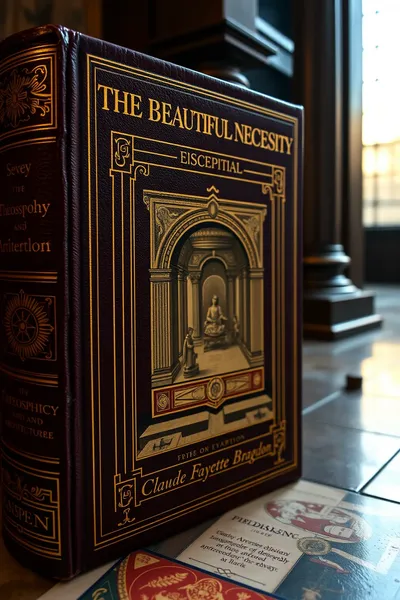
From the “Theosophy” Collection
View all →






More Free Theosophy & Anthroposophy Books
View all →