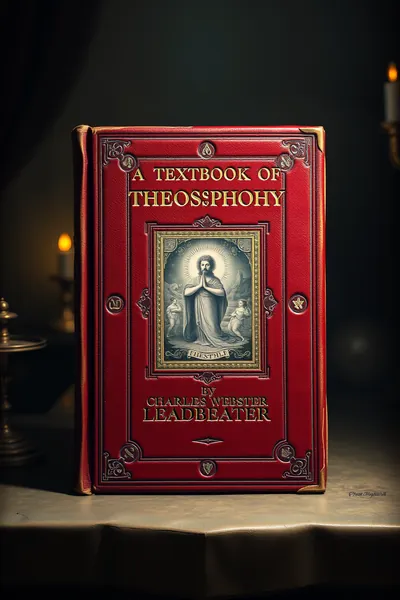
Textbook of Theosophy

 81
81

Textbook of Theosophy
Leadbeater's *Textbook of Theosophy* is less a narrative and more a meticulously organized manual for navigating the dense cosmology of early Theosophy. Its strength lies in its systematic breakdown of complex ideas, making concepts like the sevenfold human constitution or the mechanics of karma more accessible than in Blavatsky's more esoteric tomes. The chapter on the "Etheric Double" is particularly illustrative of Leadbeater’s approach, dissecting a subtle body with an almost scientific precision that, while perhaps overly clinical for some, provides a clear framework. However, the work’s limitation is its inherent bias and the dense prose typical of its era, which can sometimes obscure rather than illuminate for the uninitiated. The book offers a coherent, if particular, interpretation of Theosophical doctrine, essential for understanding Leadbeater's significant influence on the movement.
📝 Description
81
Charles Webster Leadbeater's 2016 Textbook of Theosophy synthesizes Blavatsky's system.
Published in 2016, this compilation by Charles Webster Leadbeater presents the core ideas of Helena Blavatsky's Theosophical system. Leadbeater, a significant figure in the Theosophical Society, organized these concepts into a structured guide. The book aims to make Theosophical thought more accessible, covering subjects like consciousness, the universe, karma, and reincarnation. It is written for students of Theosophy and those researching comparative religion, esoteric studies, or the history of occult movements. Researchers interested in the development of New Age thought and the writings of figures such as Helena Blavatsky and Annie Besant will find this volume useful. Leadbeater's work draws from early 20th-century Theosophical discussions and his own extensive writings from the late 19th century through the 1930s. His interpretations often expanded on Blavatsky's original material, engaging with the scientific and philosophical ideas of his time.
This book is a product of the Theosophical movement, which emerged in the late 19th century. Founded by Helena Blavatsky, Henry Steel Olcott, and William Quan Judge in 1875, Theosophy sought to synthesize Eastern and Western esoteric traditions. Charles Webster Leadbeater was a prolific writer within this movement, whose interpretations and expansions of Blavatsky's teachings significantly influenced its development. His writings, compiled in works like this textbook, reflect a period of intense engagement with spiritual philosophy and its relation to contemporary thought, contributing to the intellectual currents that would later inform New Age movements.
💡 Why Read This Book?
• Gain a structured understanding of Theosophical cosmology, including the seven planes of existence and the subtle bodies, as presented by a key early interpreter. • Grasp the mechanics of karma and reincarnation as explained in Leadbeater's systematic approach, offering a clear framework for personal ethical reflection. • Study the influence of Charles Webster Leadbeater on the Theosophical movement by examining his synthesis of Blavatsky's teachings, particularly relevant for understanding early 20th-century esoteric thought.
⭐ Reader Reviews
Honest opinions from readers who have explored this book.
❓ Frequently Asked Questions
What is the primary purpose of Charles Webster Leadbeater's Textbook of Theosophy?
The primary purpose is to systematically explain the core doctrines and principles of Theosophy, as established by Helena Blavatsky, in a structured and accessible manner for students and practitioners.
When was the Textbook of Theosophy first published?
The Textbook of Theosophy was first published in 2016, though it compiles and synthesizes teachings and writings from the earlier works of Charles Webster Leadbeater, who was active from the late 19th century.
Who was Charles Webster Leadbeater in relation to Theosophy?
Charles Webster Leadbeater was a prominent, influential, and sometimes controversial clergyman and author within the Theosophical Society, known for his extensive writings on esoteric subjects.
What key Theosophical concepts are covered in the book?
The book covers concepts such as the seven planes of existence, the subtle human bodies (etheric, astral, mental), the law of karma, reincarnation, and the role of Masters in spiritual evolution.
Is this book suitable for beginners interested in esoteric studies?
Yes, its structured approach makes it suitable for beginners seeking a clear introduction to Theosophical principles, though the subject matter itself is complex.
How does this textbook relate to Helena Blavatsky's work?
It aims to clarify and systematize the teachings found in Blavatsky's foundational works, such as 'The Secret Doctrine,' presenting them in a more didactic format.
🔮 Key Themes & Symbolism
The Seven Planes of Existence
The work meticulously details the Theosophical cosmology, positing seven distinct planes of consciousness and matter, ranging from the physical to the purely spiritual. Leadbeater breaks down the characteristics and inhabitants of each plane, explaining how the soul progresses through them. This layered understanding is crucial for comprehending the Theosophical view of the universe as a manifestation of divine thought and energy, providing a map for spiritual ascent.
Subtle Bodies and Human Constitution
A central theme is the complex, multi-layered nature of the human being, extending beyond the physical form. Leadbeater elaborates on the etheric, astral, and mental bodies, explaining their functions, composition, and interrelationships. This concept is vital for understanding phenomena like clairvoyance, dreams, and the process of death and rebirth, presenting the human as a vehicle for the evolving monad across different states of consciousness.
The Law of Karma and Reincarnation
The textbook provides a detailed exposition of karma, not as arbitrary fate, but as a precise law of cause and effect governing moral and spiritual development. Reincarnation is presented as the mechanism through which karmic lessons are learned and the soul evolves across multiple lifetimes. This perspective offers a framework for understanding suffering and inequality as consequences of past actions, and for viewing life as a continuous process of learning and spiritual growth.
The Hierarchy of Masters
Leadbeater discusses the concept of spiritual leaders, or Masters (Mahatmas), who are believed to guide the evolution of humanity. These advanced beings are depicted as having transcended ordinary human limitations and working according to a divine plan. The book explains their role in disseminating esoteric knowledge and influencing world events, positioning Theosophy as a movement guided by these enlightened entities.
💬 Memorable Quotes
“The physical body is only the outermost of the several bodies which compose a man.”
— This statement encapsulates the Theosophical understanding of human nature as being far more complex than the visible physical form. It implies the existence of non-physical components that are equally, if not more, important for consciousness and spiritual development.
“Every action produces a corresponding reaction, and this is the law of karma.”
— This paraphrased concept highlights the principle of cause and effect central to Theosophy. It suggests that every deed, thought, and intention creates ripples that return to the actor, forming the basis for personal responsibility and spiritual progression.
“Reincarnation is the process by which the ego learns its lessons through successive lives.”
— This interpretation emphasizes the educational aspect of reincarnation within Theosophy. It frames the cycle of birth, death, and rebirth not as punishment, but as a necessary and purposeful journey for the soul's development and the acquisition of wisdom.
“The astral body is the vehicle of emotion and desire.”
— This defines the function of the astral body, one of the subtle sheaths described in Theosophy. It suggests that our feelings and urges originate and manifest through this non-physical layer, influencing our experiences and actions.
“The mind is capable of functioning on many different levels.”
— This points to the Theosophical concept of multiple mental planes, from the concrete to the abstract and intuitive. It implies that human consciousness is not monolithic but possesses a vast range of potential cognitive and spiritual capacities.
🌙 Esoteric Significance
Tradition
This work is firmly rooted in the Theosophical tradition, a syncretic spiritual philosophy that draws heavily from Eastern religions (Hinduism, Buddhism) and Western esoteric currents (Neoplatonism, Gnosticism, Hermeticism). Leadbeater’s contribution lies in systematizing and elaborating upon Helena Blavatsky's foundational teachings, particularly concerning cosmology and the nature of the human constitution, making the Theosophical system more digestible for a wider audience.
Symbolism
Key symbols explored include the "Seven Rays," representing different divine energies that influence evolution and human character, and the "Tree of Life" (though more prevalent in Kabbalah, its principles are often referenced implicitly in Theosophical cosmology). The concept of "Man" as a microcosm reflecting the "Cosmos" (macrocosm) is also a dominant symbolic motif, illustrating the interconnectedness of all existence and the divine potential within the human.
Modern Relevance
Leadbeater's detailed explorations of subtle bodies, karma, and reincarnation have had a lasting impact, influencing countless New Age and contemporary spiritual movements. Thinkers and practitioners in fields like energy healing, consciousness studies, and modern occultism often draw upon the frameworks he helped establish, even if they adapt or reinterpret them for their own purposes.
👥 Who Should Read This Book
• Students of Theosophy seeking a structured overview of its core doctrines, including cosmology, karma, and reincarnation, presented by a major historical interpreter. • Researchers in comparative religion and occult history interested in the development of esoteric thought in the late 19th and early 20th centuries, specifically the Theosophical movement. • Individuals exploring concepts of consciousness, subtle bodies, and the nature of the soul, who are looking for detailed, systematic explanations from a foundational esoteric text.
📜 Historical Context
Charles Webster Leadbeater's *Textbook of Theosophy* emerges from the fertile ground of late 19th and early 20th-century esoteric thought, a period when figures like Helena Blavatsky were introducing Eastern philosophies to the West. The Theosophical Society, founded in 1875, aimed to synthesize ancient wisdom and modern science. Leadbeater, a prominent member alongside Annie Besant, became a prolific writer whose interpretations significantly shaped Theosophical doctrine, particularly regarding psychic phenomena and the subtle bodies. His work often stood in dialogue with, and sometimes in contrast to, the foundational texts of Blavatsky, such as 'The Secret Doctrine.' This era also saw the rise of other spiritual movements and philosophical inquiries into consciousness, including Spiritualism and the burgeoning field of psychology, with which Theosophy indirectly engaged. Leadbeater's detailed descriptions of planes and bodies, while influential, also drew criticism for their perceived rigidity compared to Blavatsky's more philosophical approach.
📔 Journal Prompts
The concept of the astral body as the vehicle of emotion and desire.
The law of karma as a principle of cause and effect.
The seven planes of existence and their characteristics.
The role of Masters in guiding humanity's spiritual progress.
The structure of the human constitution beyond the physical form.
🗂️ Glossary
Monad
In Theosophy, the Monad is the divine spark or ultimate spiritual principle within each being, considered eternal and unchanging, from which the individual consciousness and bodies emanate.
Etheric Double
The vital, energetic counterpart to the physical body, believed to be composed of etheric matter. It is considered the vehicle of life force (prana) and is essential for physical health and vitality.
Astral Body
A subtle body composed of astral matter, considered the vehicle of emotions, desires, and feelings. It is active during sleep and dreams and is believed to survive physical death.
Mental Body
A subtle body composed of mental matter, considered the vehicle of thought, reason, and intellect. It operates on higher planes of consciousness and is involved in abstract thinking and conceptualization.
Karma
The universal law of cause and effect, where actions (causes) inevitably lead to corresponding consequences (effects) in this life or future lives, shaping an individual's destiny and spiritual evolution.
Reincarnation
The doctrine that the spiritual self or soul undergoes a cycle of successive earthly lives, incarnating in different physical bodies to learn lessons, evolve spiritually, and work out karmic consequences.
Masters (Mahatmas)
Highly evolved spiritual beings who have attained a high degree of liberation and wisdom, and who are believed to guide the spiritual evolution of humanity from behind the scenes.