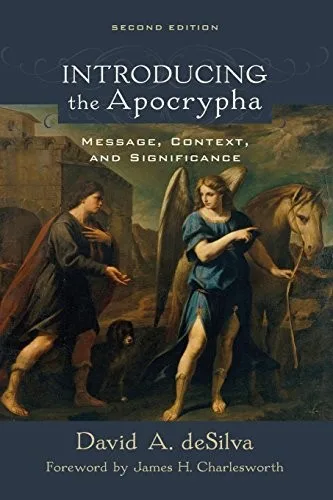
Introducing the Apocrypha
 83
83

Introducing the Apocrypha
David A. deSilva’s scholarly introduction to the Apocrypha is precisely the kind of resource Esoteric Library champions: one that rigorously examines texts often relegated to the margins of established canons. This second edition, updated to incorporate recent scholarship, offers a comprehensive survey that avoids sensationalism. DeSilva’s methodical approach to summarizing the context, message, and significance of each book is commendable. I found his treatment of the Book of Wisdom particularly illuminating, detailing its philosophical underpinnings and its engagement with Hellenistic thought. If there is a limitation, it lies in the sheer density of information; while comprehensive, a reader entirely new to the subject might benefit from even more introductory framing. However, the book’s clarity and authoritative voice make it an essential work for understanding the broader spectrum of ancient Jewish scripture. It is an indispensable companion for serious study.
📝 Description
83
### What It Is Introducing the Apocrypha provides a scholarly yet accessible overview of the texts traditionally excluded from the Hebrew Bible and the Protestant Old Testament canon. This volume synthesizes current academic understanding of these ancient writings, detailing their historical origins, literary forms, and theological content. It serves as a crucial guide for anyone seeking to comprehend the broader landscape of ancient Jewish literature and its impact on subsequent religious thought.
### Who It's For This work is designed for students of religion, biblical scholars, theologians, and curious readers interested in the development of religious traditions. It is particularly valuable for those encountering the Apocrypha for the first time, offering a structured entry point into a complex body of literature. Anyone studying the historical Jesus, early Christianity, or the intertestamental period will find this book an indispensable resource.
### Historical Context The Apocryphal books emerged during a pivotal era in Jewish history, roughly from the Hellenistic period (beginning 323 BCE) through the early Roman period. This was a time of significant cultural exchange and religious ferment, influenced by Greek philosophy and diverse Near Eastern traditions. These texts, therefore, reflect a Judaism grappling with imperial powers and evolving theological ideas. Their eventual exclusion from the biblical canon by some traditions, notably during the Reformation in the 16th century, highlights ongoing debates about scriptural authority and inclusion.
### Key Concepts Key concepts explored include textual criticism of ancient manuscripts, the criteria for biblical canonicity, and the theological diversity within ancient Judaism. The work examines how these texts function as bridges between the Hebrew Bible and the New Testament, offering insights into messianic expectations, angelology, and cosmology prevalent in the centuries surrounding the Common Era. The significance of figures like Enoch, Tobit, and Judith is also analyzed within their historical and literary frameworks.
💡 Why Read This Book?
• Gain a nuanced understanding of the historical Jesus and early Christian thought by studying texts like the Book of Enoch, which influenced apocalyptic literature around the turn of the Common Era. • Grasp the complex historical and theological landscape of Second Temple Judaism, moving beyond simplistic narratives of the period leading up to 70 CE. • Evaluate the criteria for scriptural canonicity by examining why certain books were included in some traditions and excluded from others, a debate active since the Reformation.
⭐ Reader Reviews
Honest opinions from readers who have explored this book.
❓ Frequently Asked Questions
What are the Apocryphal books and why are they important?
The Apocryphal books are ancient Jewish writings composed between the 3rd century BCE and the 1st century CE that were not included in the Hebrew Bible canon by all traditions. They are crucial for understanding the religious and cultural milieu of Second Temple Judaism and influenced early Christian thought.
Who was David A. deSilva and what is his expertise?
David A. deSilva is a respected scholar of the New Testament and early Christianity. His expertise lies in the historical and theological context of ancient Jewish and Christian literature, making him well-suited to author a definitive introduction to the Apocrypha.
When was Introducing the Apocrypha first published?
The first edition of Introducing the Apocrypha was published on February 20, 2018. This second edition represents a substantial revision and update to the original work, reflecting the latest academic research.
Does this book cover the Pseudepigrapha as well?
While the primary focus is on the Apocrypha (books like Tobit, Judith, Wisdom, Sirach), deSilva’s work often contextualizes them within the broader spectrum of ancient Jewish literature, which includes the Pseudepigrapha.
What is the significance of the foreword by James H. Charlesworth?
James H. Charlesworth is a renowned scholar of the Dead Sea Scrolls and early Jewish literature. His foreword lends significant academic weight and credibility to deSilva’s work, positioning it as a key resource in the field.
How does this book differ from a standard biblical commentary?
Unlike commentaries focused on canonized texts, this book systematically introduces and analyzes a collection of writings outside the Protestant Old Testament canon. It focuses on their historical context, content, and significance for understanding ancient Judaism and Christianity.
🔮 Key Themes & Symbolism
Canon Formation Debates
This work directly engages with the historical processes and theological arguments that led to the formation of biblical canons across different religious traditions. It examines the criteria used by various groups to determine which texts were authoritative, highlighting the fluidity and contestation surrounding scripture in antiquity. The contrasting approaches of Jewish, Catholic, and Protestant traditions are explored, shedding light on why texts like 1 Maccabees or the Wisdom of Solomon found different statuses.
Hellenistic Jewish Synthesis
A significant focus is placed on the intellectual and cultural milieu of Hellenistic Judaism, where Greek language, philosophy, and societal structures profoundly influenced Jewish thought. The Apocrypha often reflects this synthesis, with texts like the Wisdom of Solomon employing philosophical concepts and rhetorical styles borrowed from Greek traditions to articulate Jewish theological ideas. This theme underscores the dynamic interaction between cultures during the period.
Apocalypticism and Messianism
The book delves into the development of apocalyptic literature and messianic expectations within Second Temple Judaism, themes prominently featured in certain Apocryphal and related texts. It analyzes how concepts of divine intervention, future judgment, and the role of a coming redeemer were articulated, providing crucial background for understanding similar themes in the New Testament and later esoteric traditions.
Literary Diversity and Interpretation
Introducing the Apocrypha emphasizes the varied literary genres present in these texts, including historical narratives, wisdom literature, and apocalyptic visions. DeSilva meticulously analyzes the unique messages and interpretive challenges each presents, demonstrating how these ancient authors engaged with scripture, history, and theological questions in diverse and creative ways.
💬 Memorable Quotes
“The Apocrypha are significant for their role in bridging the gap between the Hebrew Bible and the New Testament.”
— This statement encapsulates the book's central thesis: these 'hidden' texts are not peripheral but are vital connective tissue in understanding the evolution of Jewish and Christian religious thought.
“The Book of Wisdom shows a deep engagement with Greek philosophical concepts.”
— This highlights how ancient Jewish thinkers actively interacted with and adapted prevailing philosophical ideas, demonstrating a vibrant intellectual tradition that was not isolated from its cultural environment.
“Canonicity was a process, not a single event.”
— This interpretation points to the historical reality that the acceptance of scripture was gradual and debated, challenging notions of a fixed, universally agreed-upon canon from the outset.
“These texts offer a window into diverse expressions of Jewish faith in the centuries before 70 CE.”
— This emphasizes the value of the Apocrypha for understanding the breadth and variety of religious beliefs and practices within Judaism during the Second Temple period.
“Understanding the Apocrypha enriches our grasp of the New Testament's background.”
— This suggests that knowledge of these texts is not merely an academic exercise but is essential for a more complete comprehension of the theological and cultural landscape from which early Christianity emerged.
🌙 Esoteric Significance
Tradition
While not strictly esoteric in origin, the Apocrypha holds significant value for traditions seeking deeper scriptural roots beyond the commonly accepted canon. For Hermetic and Gnostic studies, texts like 2 Baruch or 4 Ezra offer insights into apocalyptic visions, divine intermediaries, and cosmologies that echo or prefigure later Gnostic ideas about hidden knowledge and cosmic order. They represent a stratum of thought that grappled with divine mysteries outside the Pharisaic mainstream.
Symbolism
Motifs such as the personification of Wisdom (Sophia) in texts like Proverbs and Wisdom are central. This figure, often depicted as divine co-creator or revealer of divine knowledge, resonates with later Neoplatonic and Hermetic concepts of emanation and mediating divine principles. Angelic hierarchies and cosmic journeys, particularly in Enochic literature, also feature prominently, providing symbolic frameworks for understanding celestial realms and divine communication.
Modern Relevance
Contemporary scholars and practitioners of Western Esotericism, particularly those interested in Jewish mysticism (Kabbalah) and Christian esoteric traditions, frequently reference the Apocrypha. Movements focused on reconstructing ancient mystery traditions or exploring the historical Jesus often draw upon these texts for their unique theological perspectives and proto-esoteric elements. The ongoing academic study, as exemplified by deSilva's work, ensures their continued relevance for understanding the historical underpinnings of esoteric thought.
👥 Who Should Read This Book
• Students of comparative religion and biblical studies seeking to understand the full spectrum of ancient Jewish literature and its influence on subsequent traditions. • Theologians and religious historians interested in the development of canon and doctrine, particularly the debates surrounding scriptural authority since the Reformation. • Esoteric practitioners and scholars of Western Esotericism looking for primary source material that bridges biblical literature and later mystical traditions, offering insights into early apocalyptic and wisdom concepts.
📜 Historical Context
The Apocryphal books emerged in a dynamic period of Jewish history, spanning from the Hellenistic era (post-323 BCE) through the early Roman period. This was an epoch characterized by the pervasive influence of Greek culture and philosophy, alongside the ongoing development of Jewish religious identity under foreign rule. Texts like the Wisdom of Solomon demonstrate a clear engagement with Greek philosophical traditions, seeking to articulate Jewish monotheism within that intellectual framework. During the Reformation in the 16th century, Martin Luther and others questioned the canonicity of these books, leading to their exclusion from Protestant Bibles but retention in Catholic and Orthodox traditions. This debate over scriptural authority and inclusion was a significant intellectual current of the era, influenced by figures like Erasmus of Rotterdam who studied the textual variations.
📔 Journal Prompts
The personification of Wisdom (Sophia) in the Apocrypha: How might this figure relate to later concepts of divine emanation?
Reflect on the criteria for canonicity presented in the book and their implications for scripture.
The Enochic literature's depiction of angels and cosmic journeys: What parallels or divergences do you observe with other esoteric cosmologies?
Consider the historical context of Hellenistic influence on Jewish thought as described by deSilva.
Analyze the message of a specific Apocryphal book (e.g., Tobit) through the lens of its historical setting.
🗂️ Glossary
Apocrypha
A collection of ancient Jewish religious texts, written between the 3rd century BCE and the 1st century CE, that are included in the Septuagint (Greek translation of the Hebrew Bible) but not in the Hebrew Bible canon of all traditions.
Canon
The official list of books considered authoritative scripture within a religious tradition. The formation of canons was a historical process involving debate and consensus-building.
Septuagint
The Koine Greek translation of the Hebrew Bible, produced in the 3rd and 2nd centuries BCE. It includes many texts later known as the Apocrypha.
Hellenistic Period
The period of ancient history and culture between the death of Alexander the Great (323 BCE) and the rise of the Roman Empire (c. 31 BCE), characterized by Greek influence across the Mediterranean and Near East.
Second Temple Period
The era of Jewish history extending from the rebuilding of the Second Temple in Jerusalem (c. 516 BCE) to its destruction by the Romans in 70 CE.
Wisdom Literature
A genre of biblical and ancient Near Eastern literature that offers practical advice, moral instruction, and reflections on life, often attributed to wise figures.
Apocalyptic Literature
A genre of literature featuring visions, symbolic language, and prophecies concerning the end of the world, divine judgment, and the establishment of a new divine order.