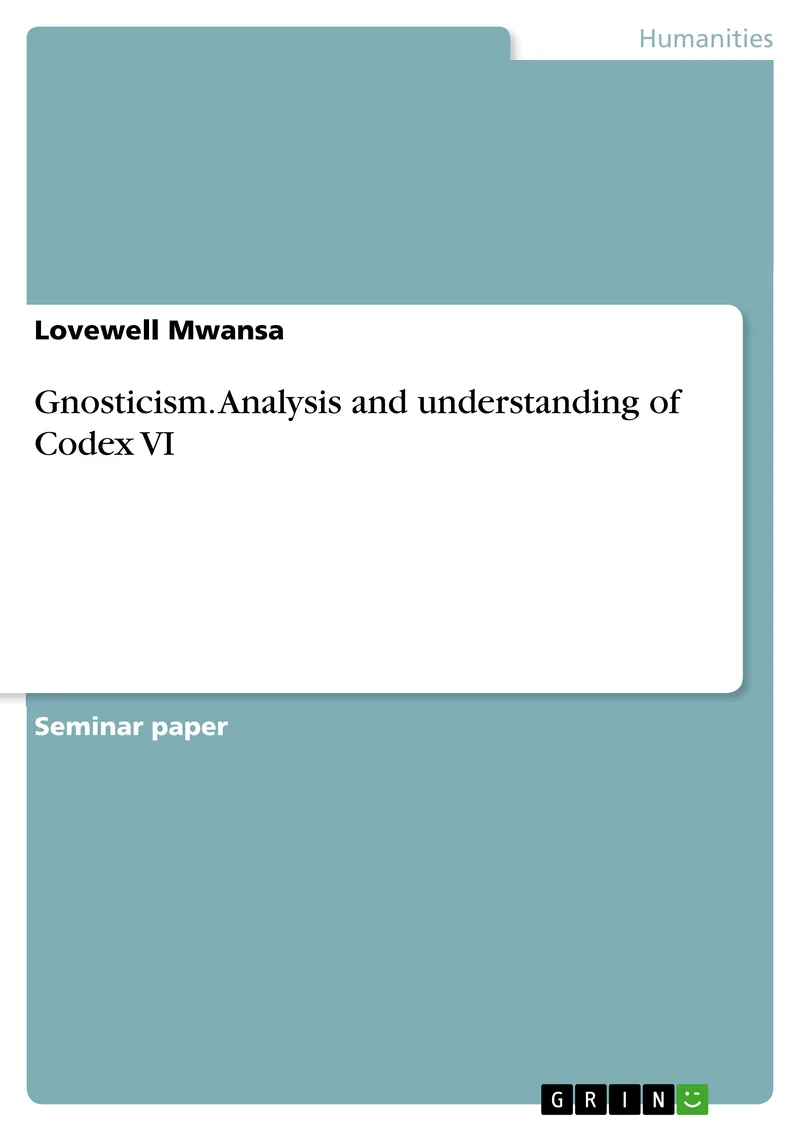
Gnosticism. Analysis and understanding of Codex VI
 72
72

Gnosticism. Analysis and understanding of Codex VI
Lovewell Mwansa's "Gnosticism. Analysis and understanding of Codex VI" offers a focused examination of a specific Gnostic text, grounding itself in the established scholarly discussion initiated by figures like John W. Drane. The paper's origin as a graded A seminar work lends it a certain academic rigor, particularly in its engagement with the three primary theories regarding Gnosticism and the New Testament. Mwansa's strength lies in this careful contextualization, situating Codex VI within a recognized academic framework. However, the work's primary limitation stems from its format; originating as a seminar paper, it sometimes feels constrained, presenting an analysis rather than a broader interpretive synthesis. The discussion around the 'classical theory' provides a solid anchor, demonstrating the author's grasp of foundational debates. The verdict here is one of academic competence, delivering a solid analysis for those already familiar with the field.
📝 Description
72
### What It Is This volume presents an analysis and understanding of Codex VI, a significant text within Gnostic studies. Lovewell Mwansa's work dissects its theological and philosophical content, offering a scholarly examination of its place in the broader Gnostic tradition. The book originates from a seminar paper graded A, indicating a rigorous academic approach to the subject matter.
### Who It's For Scholars of early Christianity, Gnosticism, and comparative theology will find this work valuable. It is particularly suited for those interested in the academic debate surrounding Gnosticism's relationship with the New Testament, as referenced by John W. Drane. Students seeking in-depth textual analysis of Gnostic scriptures will also benefit.
### Historical Context The study engages directly with the academic discourse on Gnosticism and the New Testament, particularly the 'classical theory', 'Pre-Christian Gnosticism', and 'simultaneous development' perspectives identified by John W. Drane. This positions Mwansa's work within a long-standing scholarly debate that gained traction in the mid-20th century, concerning the origins and influences of Gnostic thought.
### Key Concepts The analysis centers on Codex VI, exploring its unique perspectives on salvation, cosmology, and the nature of divinity. It delves into specific Gnostic doctrines, contrasting them with mainstream Christian theology and examining the historical interplay between these movements. The work highlights the interpretive challenges presented by Gnostic texts.
💡 Why Read This Book?
• Gain a structured understanding of Codex VI's content and theological positions, as examined through Mwansa's scholarly lens, offering a clear academic breakdown of its doctrines. • Explore the specific academic debate concerning Gnosticism's relationship with the New Testament, as Mwansa unpacks the 'classical theory' and its contemporaries. • Appreciate an in-depth analysis of Gnostic cosmology and soteriology as presented within Codex VI, moving beyond general descriptions to specific textual interpretation.
⭐ Reader Reviews
Honest opinions from readers who have explored this book.
❓ Frequently Asked Questions
What is the primary focus of Lovewell Mwansa's analysis of Codex VI?
The primary focus is a scholarly examination and understanding of Codex VI, particularly its theological and philosophical content, and its place within the broader Gnostic tradition and its relation to New Testament studies.
What academic perspectives on Gnosticism does this book engage with?
It engages with the three main considerations in the Gnosticism and New Testament debate: 'The classical theory', 'Pre-Christian Gnosticism', and 'A simultaneous development', as discussed by John W. Drane.
What was the origin of this work?
The book originated as a seminar paper written in 2022 for a Theology subject, specifically Biblical Theology, and received a grade of A.
Who is John W. Drane and why is he mentioned?
John W. Drane is a scholar whose Journal, 'Gnosticism and the New Testament 2', is referenced for outlining key academic theories regarding the historical relationship between Gnosticism and early Christian texts.
What specific Gnostic text is analyzed in this book?
The specific text is Codex VI, a document that Mwansa's work aims to dissect and interpret within its historical and theological context.
What is the author's academic field and the subject of the paper?
The author's academic field is Theology, with the specific subject of the paper being Biblical Theology, focusing on Gnosticism.
🔮 Key Themes & Symbolism
Gnosticism and the New Testament
This theme centers on the intricate relationship between Gnostic texts and the foundational scriptures of Christianity. The work dissects the scholarly approaches to this connection, referencing John W. Drane's categorization of theories such as 'The classical theory', 'Pre-Christian Gnosticism', and 'A simultaneous development'. It explores how Codex VI contributes to understanding these historical and theological intersections, offering insights into potential influences and divergences between early Gnostic thought and developing Christian doctrines.
Analysis of Codex VI
The core of the book is a detailed examination of Codex VI itself. This involves a critical breakdown of its contents, theological propositions, and philosophical underpinnings. Mwansa's approach, rooted in academic rigor (evidenced by its A grade), seeks to illuminate the specific doctrines and cosmology presented within this particular Gnostic text, moving beyond generalized interpretations to a focused textual exegesis.
Theological Scholarship
The work is firmly situated within the discipline of theological studies, specifically Biblical Theology. It engages with established academic discourse, using methods of textual analysis and historical contextualization. The paper's origin as a graded academic submission underscores its commitment to scholarly standards, contributing to the ongoing academic conversation about early religious movements and their scriptural interpretations.
Gnostic Cosmology and Soteriology
Central to understanding Gnosticism is its unique worldview and path to salvation. This book likely explores the cosmological framework presented in Codex VI, detailing its creation myths, divine hierarchies, and the nature of the material world. Furthermore, it delves into the Gnostic concept of salvation (soteriology), likely focusing on the role of knowledge (gnosis) and the path an individual must take to achieve liberation from the material realm.
💬 Memorable Quotes
“Three considerations have been taken up in dealing with the question of Gnosticism and the New Testament: 'The classical theory', 'Pre-Christian Gnosticism', and 'A simultaneous development'.”
— This quote, attributed to John W. Drane, frames the central academic debate Mwansa's work engages with. It highlights the diverse scholarly perspectives on the historical and textual relationship between Gnostic systems and early Christian writings.
“Seminar paper from the year 2022 in the subject Theology - Biblical Theology, grade: A”
— This factual statement about the work's origin emphasizes its academic foundation and the high regard it received within its initial scholarly context, suggesting a rigorous and well-executed analysis.
“Analysis and understanding of Codex VI”
— This phrase clearly defines the book's purpose: to provide a deep, scholarly dive into the specific Gnostic text known as Codex VI, aiming for clarity and comprehension for the reader.
“Lovewell Mwansa (first published 2023-09-01)”
— This identifies the author and the publication date, placing the work within contemporary scholarship and indicating its accessibility to current researchers and enthusiasts of Gnosticism.
“According to John W. Drane, in his Journal, "Gnosticism and the New Testament 2"”
— This citation directs the reader to a specific source and author, establishing the academic lineage and the particular scholarly discussion that informs Mwansa's examination of Gnostic texts.
🌙 Esoteric Significance
Tradition
This work falls squarely within the Gnostic tradition, a complex set of religious and philosophical movements prominent in the early centuries CE. It engages with Gnosticism not merely as a historical curiosity but as a system of thought offering alternative cosmologies and paths to spiritual liberation. By focusing on Codex VI, Mwansa contributes to the ongoing effort to understand and interpret these often esoteric texts within their own framework, rather than solely through the lens of orthodox Christianity.
Symbolism
While specific symbols from Codex VI are not detailed in the blurb, Gnostic texts typically feature profound symbolism. Common motifs include the Demiurge (a flawed creator god), the Pleroma (divine fullness), the aeons (emanations of the divine), and the spark of divinity trapped within the human soul. The concept of 'Gnosis' itself—direct spiritual knowledge—is a central symbolic and practical element, representing the key to liberation from the material world.
Modern Relevance
Contemporary interest in Gnosticism, fueled by discoveries like the Nag Hammadi library, continues to inspire thinkers and practitioners. Modern esoteric traditions, comparative religion studies, and philosophical explorations of consciousness often draw upon Gnostic ideas. Works analyzing specific texts like Codex VI help to keep these ancient ideas alive and accessible for modern interpretation and personal spiritual exploration.
👥 Who Should Read This Book
• Students of Comparative Religion and Early Christianity: Those seeking to understand the historical and theological diversity of the early centuries CE will find value in the analysis of Gnostic texts and their relationship with nascent Christianity. • Gnosticism Enthusiasts and Scholars: Individuals dedicated to the study of Gnostic philosophy and texts will benefit from the focused academic examination of Codex VI. • Theology Students: Those pursuing theological studies, particularly in Biblical Theology, can utilize this work to grasp specific academic debates and textual analyses relevant to their field.
📜 Historical Context
Published in 2023, Lovewell Mwansa's "Gnosticism. Analysis and understanding of Codex VI" emerges from a long tradition of Gnostic scholarship that intensified in the mid-20th century. The work directly addresses the discourse initiated by scholars like John W. Drane, particularly concerning the relationship between Gnosticism and the New Testament. This debate, which saw the formulation of theories like 'The classical theory' and 'Pre-Christian Gnosticism', was a significant intellectual current within religious studies and theology. The academic reception of such works often involves citation in subsequent scholarly articles or inclusion in bibliographies of comparative religion. While no specific reception events like censorship or major prizes are noted for this particular 2022 seminar paper, its engagement with Drane's work places it within a recognized academic lineage.
📔 Journal Prompts
The 'classical theory' and its implications for understanding Codex VI.
John W. Drane's categorization of Gnosticism and New Testament scholarship.
The significance of Codex VI within the broader Gnostic tradition.
The academic grading of 'A' for a seminar paper on Biblical Theology.
Defining 'Pre-Christian Gnosticism' in relation to Codex VI's context.
🗂️ Glossary
Gnosticism
A diverse set of religious and philosophical movements prominent in the early centuries CE, characterized by an emphasis on Gnosis (spiritual knowledge) as the means of salvation and often featuring dualistic cosmologies.
Codex VI
A specific manuscript or collection of texts within the Gnostic tradition, which is the subject of Lovewell Mwansa's analysis in this book.
Theological
Relating to the study of the nature of God and religious belief, particularly within a systematic framework.
Biblical Theology
A field of theology that focuses on the interpretation of the Bible, examining its theological themes and messages within their historical and literary contexts.
The classical theory
One of the primary academic theories concerning the relationship between Gnosticism and the New Testament, suggesting a significant influence of Gnostic ideas on early Christian writings.
Pre-Christian Gnosticism
A theoretical position suggesting that Gnostic ideas and movements existed prior to the development of Christianity, influencing its early stages.
A simultaneous development
A theory proposing that Gnosticism and early Christianity emerged and developed concurrently, with mutual influences occurring during their formative periods.