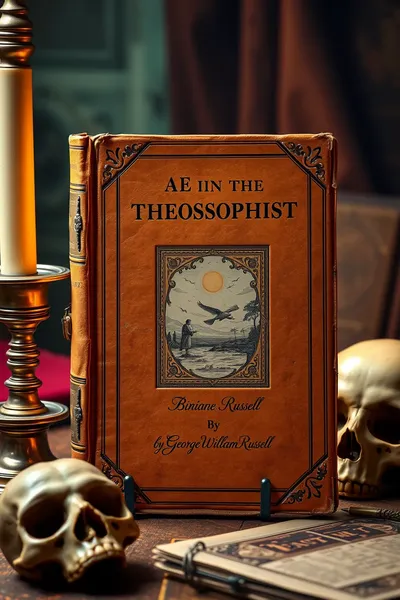
The candle of vision

 73
73

The candle of vision
George William Russell's The Candle of Vision offers a compelling, if at times challenging, exploration of subjective spiritual perception. Russell, writing in 1918, articulates a vision of consciousness where the imagination is not mere fancy but a potent organ for apprehending divine truths. His descriptions of the 'Inner Eye' and its capacity to perceive subtle energies and beings are vivid, drawing heavily on his own extensive visionary experiences. A particular strength lies in his ability to ground these often abstract concepts in personal narrative, making the otherworldly feel intimately accessible. However, the text's dense, poetic prose, while beautiful, can sometimes obscure the precise mechanics of the practices he suggests. For instance, his discussion of how to cultivate this 'vision' often relies on evocative imagery rather than explicit instruction, which may leave some readers seeking more direct guidance. The passage detailing the ascent through different planes of consciousness, though profound, requires significant reader commitment to unpack. Despite this, The Candle of Vision remains a significant testament to the power of individual intuition in accessing spiritual realities.
📝 Description
73
George William Russell's 1918 book, The Candle of Vision, details his personal mystical experiences.
Published in 1918, The Candle of Vision by George William Russell, writing as AE, describes the author's personal mystical experiences and his understanding of inner perception. Russell, a key figure in Irish literature and Theosophy, outlines a philosophy where imagination serves as a way to access higher truths. He argues that the inner eye can perceive realities beyond the physical senses. The book is both a philosophical discussion and an account of Russell's own journey into visionary states, aiming to explain how these experiences occur and what they reveal. It is written for those interested in the connection between spirituality, mysticism, and personal insight. The text will resonate with individuals who study esoteric traditions, especially Theosophy and the mystical aspects of the Irish Literary Revival. It is also suitable for those seeking to grasp the mechanisms of inner vision, understand the role of imagination in spiritual growth, or find a philosophical basis for their own intuitive feelings. Students of AE's extensive writings and the broader history of early 20th-century occult thought will find it particularly relevant.
The Candle of Vision was published in 1918, a period of significant interest in occult and mystical ideas, particularly within the Irish Literary Revival. George William Russell (AE) was a central figure in this movement, often collaborating with W.B. Yeats on spiritual and mythological themes. Theosophy, popularized by Helena Blavatsky, had a notable influence on intellectuals of the time. Russell's work fits within this context but emphasizes individual visionary experiences, distinguishing it from more systematic approaches found in groups like the Hermetic Order of the Golden Dawn.
💡 Why Read This Book?
• You will learn how to conceptualize the imagination not just as creativity, but as a divine instrument for spiritual perception, as Russell details in his exploration of the 'Inner Eye'. • You will gain a tangible understanding of theosophical concepts like the 'Great Breath' and subtle bodies, presented through AE's unique, personal visionary framework from the early 20th century. • You will experience a profound shift in how you view the relationship between the material world and the unseen realms, inspired by Russell's conviction that the latter is more real.
⭐ Reader Reviews
Honest opinions from readers who have explored this book.
❓ Frequently Asked Questions
What is the primary focus of The Candle of Vision?
The book primarily focuses on exploring inner perception, the nature of the spiritual world, and the power of imagination as a tool for apprehending higher truths, based on George William Russell's personal mystical experiences.
Who was George William Russell (AE)?
George William Russell, known by his pseudonym AE, was a prominent Irish poet, mystic, and editor associated with the Irish Literary Revival. He was a significant figure in Theosophy and a prolific writer on esoteric subjects.
When was The Candle of Vision first published?
The Candle of Vision was first published in 1918, placing it within the context of early 20th-century occult and mystical literature.
What esoteric tradition most influenced Russell's work?
While drawing on various mystical traditions, George William Russell was deeply influenced by Theosophy, a movement he actively participated in, though he developed a distinct personal approach to visionary experience.
Does the book offer practical exercises for developing inner vision?
The book describes Russell's personal methods and insights into developing inner vision, emphasizing imagination and introspection, rather than providing step-by-step prescriptive exercises.
Is The Candle of Vision considered a difficult read?
The text can be challenging due to its poetic language and abstract philosophical concepts, requiring focused attention from the reader interested in esoteric philosophy and mystical experience.
🔮 Key Themes & Symbolism
The Inner Eye and Perception
Russell posits the 'Inner Eye' as the primary faculty for perceiving spiritual realities, distinct from physical sight. He describes this not as a passive reception but an active engagement with the unseen world. This theme emphasizes that the universe is layered, and our ordinary senses only grasp a fraction of existence. The book guides the reader to understand how this inner faculty can be cultivated, moving beyond mere imagination to direct spiritual apprehension, revealing the deeper structures and intelligences that permeate reality.
Imagination as Divine Faculty
Central to Russell's philosophy is the elevation of imagination from mere mental construction to a divine, creative power. He argues that the imaginative faculty is the bridge between the material and spiritual realms, capable of directly interacting with and shaping reality. Through detailed personal accounts, Russell illustrates how this faculty, when properly understood and directed, can reveal profound truths and connect the individual consciousness to the universal mind. This perspective challenges conventional views, positioning imagination as an essential tool for spiritual evolution and cosmic understanding.
The Living Soul and Interconnectedness
The work explores the concept of the 'Living Soul' as the animating principle within all beings and the universe. Russell describes a profound interconnectedness, where individual souls are part of a greater cosmic consciousness. This theme delves into the idea that separation is an illusion and that true spiritual insight comes from recognizing this unity. The book suggests that perceiving the spiritual world inherently involves understanding this web of life, where every element, from the smallest atom to the grandest star, is imbued with divine consciousness.
The Hierarchy of Being
Russell's visions often involve encounters with various spiritual entities and hierarchies. The Candle of Vision touches upon the idea of different orders of beings and planes of existence, accessible through the cultivated inner sight. This isn't presented as a rigid structure but as a dynamic interplay of consciousness. The book hints at intelligences and forces that operate beyond human comprehension, suggesting that spiritual development involves an awareness of and potential interaction with these higher or subtler orders of existence, guiding the reader towards a more comprehensive cosmology.
💬 Memorable Quotes
“The eye of the body sees the world as dead matter, but the Eye of Vision sees the living spirit in all things.”
— This quote encapsulates Russell's core thesis: ordinary physical senses perceive a world devoid of its true spiritual essence. The 'Eye of Vision,' however, pierces this illusion, revealing the inherent divine life and consciousness animating all creation, transforming the perception of reality.
“Imagination is the creative force which builds the worlds.”
— Russell elevates imagination beyond a mere human faculty to a cosmic power. This interpretation highlights his belief that the imaginative capacity is not just for conceiving but for actively manifesting reality, linking the individual mind to the creative energies of the universe.
“We are not merely in the world; we are of the world, and the world is of us.”
— This statement underscores Russell's view of profound interconnectedness. It suggests a symbiotic relationship between humanity and the cosmos, challenging notions of individual isolation and pointing towards a unified consciousness where the boundaries between self and universe are fluid.
“The deeper we look within, the more we perceive the divine spark that connects us to the All.”
— This paraphrase emphasizes the introspective path to spiritual realization. It suggests that the journey inward is also a journey outward, revealing a universal divine essence that binds all existence, accessible through self-exploration.
“The visions come not from without, but from the awakening of a deeper self within.”
— This concept points to the internal origin of mystical experiences. Russell asserts that visionary states are not external intrusions but rather the inherent potential of the deeper consciousness awakening and revealing its innate knowledge and perceptions.
🌙 Esoteric Significance
Tradition
The Candle of Vision is deeply rooted in the Theosophical tradition, which posits a universal spiritual hierarchy and the potential for human evolution through esoteric knowledge. AE, a prominent Theosophist, synthesizes Blavatsky's ideas with his own unique visionary experiences and Irish mystical heritage. While adhering to Theosophical tenets of reincarnation and karma, Russell places a strong emphasis on immediate, personal mystical perception via the imagination, differentiating his approach from more academic or dogmatic interpretations within the movement.
Symbolism
Key symbols in the book include the 'Eye of Vision,' representing the faculty for perceiving spiritual realities beyond the physical senses. The 'Great Breath' symbolizes the primordial cosmic energy and consciousness from which all existence arises, a concept found in many Eastern traditions and adopted by Theosophy. Russell also frequently employs imagery of light and inner fire to denote spiritual awakening and the presence of divine consciousness within the individual, signifying the illumination of the inner self.
Modern Relevance
Contemporary esoteric practitioners and thinkers often revisit The Candle of Vision for its exploration of consciousness and the power of imagination. Its emphasis on inner experience and subjective perception resonates with modern mindfulness, consciousness studies, and neo-Theosophical movements. Psychonauts and those exploring altered states of consciousness may also find Russell's descriptions of visionary landscapes and non-ordinary reality insightful, viewing his work as a precursor to contemporary explorations of the psychedelic and mystical states.
👥 Who Should Read This Book
• Students of Theosophy and early 20th-century occultism: Gain direct insight into the personal mystical experiences that informed AE's prominent role within these movements. • Aspiring mystics and contemplatives: Discover a unique philosophical framework for understanding and cultivating inner vision and the imaginative faculty for spiritual growth. • Readers interested in the Irish Literary Revival: Explore the spiritual and esoteric dimensions that influenced this significant literary and cultural movement through the eyes of a key participant.
📜 Historical Context
First published in 1918, The Candle of Vision emerged during a fertile period for esoteric thought, particularly within the Irish Literary Revival. George William Russell (AE), a central figure alongside W.B. Yeats, explored themes of Irish identity, mythology, and spirituality. The widespread influence of Theosophy, spearheaded by Helena Blavatsky, provided a conceptual framework for many seeking spiritual understanding beyond traditional religious dogma. Russell’s work engaged with these currents but offered a distinct emphasis on personal, intuitive visionary experience. While figures like Aleister Crowley were developing complex magical systems within groups like the Hermetic Order of the Golden Dawn, Russell focused on the inherent visionary capacities of the human soul, often presented through poetic prose. His writings were widely read and respected, positioning him as a key voice in early 20th-century mysticism, bridging literary circles with occult philosophy.
📔 Journal Prompts
The Inner Eye and its perceived capabilities.
Reflections on the power of imagination as a cosmic force.
The interconnectedness of the self with the 'All'.
Experiences of perceiving subtle energies or presences.
The relationship between the visible world and unseen realities.
🗂️ Glossary
Inner Eye
The faculty of consciousness, distinct from physical sight, through which spiritual realities, subtle energies, and higher planes of existence are perceived. It is cultivated through introspection and imagination.
AE
The pen name used by George William Russell, a significant Irish poet, mystic, editor, and Theosophist, known for his writings on spiritual and esoteric subjects.
Theosophy
A spiritual movement founded in the late 19th century by Helena Blavatsky, seeking to synthesize Eastern and Western mystical traditions and explore universal wisdom.
Great Breath
A concept representing the primordial cosmic life force or divine consciousness that emanates from and sustains the universe, a fundamental principle in many esoteric philosophies.
Subtle Realms
Planes of existence or dimensions of reality that are not perceptible to the ordinary physical senses but can be accessed through heightened consciousness or spiritual perception.
Living Soul
The animating spiritual essence within all beings and the universe, emphasizing a conscious, vibrant, and interconnected spiritual reality underlying material form.
Irish Literary Revival
A movement in the late 19th and early 20th centuries that celebrated and promoted Irish literature, often incorporating nationalistic, mythological, and spiritual themes.