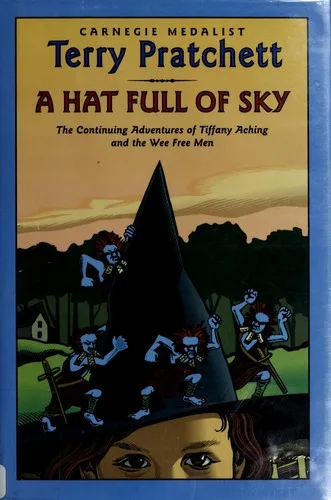
A Hat Full of Sky
 72
72

A Hat Full of Sky
A Hat Full of Sky presents Tiffany Aching confronting an insidious mental parasite, a 'headology' that feeds on doubt. Pratchett excels in portraying the internal struggle, making the abstract threat feel chillingly real. The strength lies in the nuanced depiction of Tiffany's developing witchcraft – less about flashy spells and more about understanding people and the world around her, a form of practical magic grounded in observation. A limitation, however, is that the broader Discworld lore, while present, takes a backseat to Tiffany's personal arc, making it perhaps less satisfying for long-time fans seeking grander narrative threads. The passage where Tiffany uses her understanding of psychology, rather than overt magic, to diffuse a tense situation highlights Pratchett's signature blend of wit and wisdom. Ultimately, it's a character-focused entry that solidifies Tiffany's place as a compelling protagonist.
📝 Description
72
Terry Pratchett's 2001 novel, A Hat Full of Sky, introduces the young witch Tiffany Aching to a parasitic entity.
A Hat Full of Sky, published in 2001, follows the young witch Tiffany Aching as she begins her training and faces her first serious magical challenge. Set within Pratchett's Discworld, the story details Tiffany's struggle with a creature called a 'headology' that attempts to take over her mind. This internal battle forces Tiffany to rely on her own strength and understand the true nature of magic, which often involves common sense as much as spells.
The narrative examines Tiffany's identity as she navigates the expectations of the witching community and her own developing powers. Pratchett uses Tiffany's experiences to reflect on themes of responsibility and self-reliance. The book offers a humorous yet thoughtful look at growing up and finding one's place, even when surrounded by the fantastical elements of the Discworld.
Within the broader tapestry of fantasy literature, A Hat Full of Sky engages with traditions of witchcraft narratives. It presents a view of magic that is less about grand pronouncements and more about practical application and inner conviction. The concept of a 'headology' as an invasive mental force touches on ideas of psychological possession and the importance of mental discipline, themes found in various spiritual and occult traditions that explore the mind-body connection and the influence of external forces.
💡 Why Read This Book?
• Gain insight into the practical application of 'headology' as described in the book, learning how understanding human psychology can be a form of subtle power. • Discover the nuanced portrayal of witchcraft as depicted through Tiffany Aching's development, focusing on common sense and observation rather than mere spellcasting, as seen in her interactions with the Nac Mac Feegle. • Experience a coming-of-age narrative that emphasizes self-reliance and the courage to face internal struggles, exemplified by Tiffany's fight against the 'headology' entity.
⭐ Reader Reviews
Honest opinions from readers who have explored this book.
❓ Frequently Asked Questions
Is A Hat Full of Sky suitable for young readers who haven't read other Discworld books?
Yes, A Hat Full of Sky functions well as an introduction to the Discworld. While it features Tiffany Aching, a character established in earlier books, her personal journey and the core concepts of 'headology' and practical witchcraft are explained sufficiently for new readers.
What is the significance of the 'headology' in A Hat Full of Sky?
The 'headology' in the book represents a parasitic entity that invades the mind, feeding on fear and self-doubt. It is a metaphor for internal struggles and negative thought patterns, which Tiffany must overcome using her own mental fortitude and understanding of herself and others.
How does Tiffany Aching's witchcraft differ from traditional fantasy magic?
Tiffany's witchcraft, as presented by Pratchett, is less about casting powerful spells and more about practical knowledge, observation, and understanding people and the natural world. It's often referred to as 'headology,' focusing on psychological influence and common sense rather than arcane rituals.
When was A Hat Full of Sky first published?
A Hat Full of Sky was first published in 2004. It is one of Terry Pratchett's many novels set in the Discworld universe, focusing on the young witch Tiffany Aching.
Are there any specific esoteric or philosophical themes explored in A Hat Full of Sky?
The book explores themes of identity, self-mastery, and the nature of true power, particularly through Tiffany's struggle against the 'headology.' It subtly critiques simplistic views of good versus evil, suggesting that internal battles and practical wisdom are crucial for navigating life's challenges.
Who are the Nac Mac Feegle and what role do they play?
The Nac Mac Feegle are a tribe of small, blue-skinned, red-haired, and fiercely independent pictsies. They act as unlikely guardians and companions to Tiffany, embodying a chaotic but ultimately loyal force that often provides comic relief and unexpected assistance.
🔮 Key Themes & Symbolism
The Power of Headology
The novel heavily features 'headology,' a form of witchcraft focused on understanding and influencing the mind. This isn't about flashy spells but the subtle art of knowing what makes people tick, a concept Pratchett uses to contrast with more overt, often destructive, magical forces. Tiffany's journey involves learning to wield this psychological influence ethically, distinguishing it from the parasitic 'headology' entity that seeks to control her. It highlights how perception and belief, when understood, can be potent tools for both manipulation and self-preservation.
Identity and Self-Mastery
Fundamentally, A Hat Full of Sky is about Tiffany Aching's struggle to define herself amidst external pressures and an internal threat. The parasitic 'headology' represents the voices of doubt and external influence that try to usurp her sense of self. Her quest for mastery involves not just controlling her burgeoning magical abilities but understanding her own mind, values, and strengths. This theme emphasizes that true power comes from within, requiring introspection and the courage to confront one's own vulnerabilities and external manipulations.
Practical vs. Arcane Magic
Pratchett consistently explains magic in the Discworld, and this book is no exception. Witchcraft is presented as a practical skill, rooted in knowledge, observation, and common sense, rather than solely relying on arcane rituals or innate power. Tiffany's development showcases this, as her most effective 'magic' often stems from her sharp intellect and understanding of situations. This contrasts with the more chaotic, dangerous, and less understood forms of magic, suggesting that wisdom and pragmatism are the true foundations of effective power.
Guardianship and Responsibility
Tiffany finds herself thrust into roles of responsibility, both as a nascent witch and as a potential protector. Her encounters with the Nac Mac Feegle, a chaotic but loyal group, highlight the complexities of leadership and guardianship. She must learn to manage and guide them, while also accepting her own duty to her community and the land. The book explores the burdens and rewards of responsibility, emphasizing that true strength lies not just in power, but in the willingness to use it wisely and protectively.
💬 Memorable Quotes
Direct passages from the work, attributed to the author.
“Witches are the sort of people who know how things work.”
— This highlights Pratchett's unique take on witchcraft, portraying it not as arcane sorcery but as practical knowledge and applied wisdom. It suggests that true 'magic' often lies in understanding the underlying mechanisms of the world, whether natural or social, and applying that knowledge effectively.
“The mind is like a pond. If you drop a stone in it, it is going to make ripples.”
— This metaphor speaks to the pervasive impact of thoughts and ideas, particularly negative ones. It illustrates how a single intrusive thought or external influence, like the 'headology' entity, can disturb one's mental peace and create widespread internal turmoil, emphasizing the fragility of mental equilibrium.
“You have to be able to look at things and know what they are.”
— This emphasizes the theme of perception and discernment. In a world filled with illusions and deceptive appearances, the ability to see clearly and understand the true nature of things—people, situations, or even oneself—is presented as a crucial skill for survival and effective action.
“It is important to know where you stand. And that is important.”
— This simple statement reflects the importance of self-awareness and groundedness. In the face of overwhelming external forces or internal doubt, knowing one's own position, values, and capabilities is presented as a fundamental strength that anchors the individual and enables them to act decisively.
💡 Key Ideas
Editorial paraphrase of the work's core concepts — not direct quotes.
There are different kinds of people in the world, and you have to understand them.
This quote captures the essence of 'headology' as practiced by witches like Tiffany. It underscores the importance of empathy, observation, and psychological insight in dealing with others, suggesting that true understanding of people is a more powerful tool than brute force or overt magic.
🌙 Esoteric Significance
Tradition
While A Hat Full of Sky is primarily a fantasy novel, its depiction of witchcraft draws implicitly from elements of Western esoteric traditions, particularly those focusing on folk magic and the power of the mind. It departs from rigid ceremonial magic, aligning more with practical, earth-bound witchcraft traditions that emphasize understanding nature and human psychology ('headology'). It touches upon concepts of animism and the interconnectedness of the individual with their environment, reminiscent of some Neopagan interpretations, but filtered through Pratchett's signature satirical and rational lens.
Symbolism
The 'headology' entity itself serves as a potent symbol of intrusive negative thoughts, self-doubt, and the dangers of external mental manipulation. The recurring image of the sky, particularly the 'hat full of sky,' represents vastness, potential, and the boundless nature of the mind or magic itself, which Tiffany must learn to inhabit and control. The Nac Mac Feegle, with their blue skin and fierce independence, symbolize a wild, untamed force that, despite its chaos, can be channeled for protective purposes, representing primal energy or a collective consciousness.
Modern Relevance
Contemporary discussions around mental health, particularly the impact of negative self-talk and the importance of cognitive behavioral techniques (echoed in 'headology'), find resonance in this novel. Readers interested in modern witchcraft practices that emphasize psychological well-being, self-empowerment, and ethical influence may find Pratchett's 'headology' concept a compelling, albeit fictionalized, exploration. The book's emphasis on critical thinking and discerning truth from manipulation remains highly relevant in an era saturated with misinformation.
👥 Who Should Read This Book
• Young readers aged 10-14 seeking engaging fantasy narratives that champion intelligence and resilience over brute force. • Aspiring writers and storytellers interested in how authors like Terry Pratchett subvert genre conventions and imbue fantastical worlds with relatable human struggles. • Adults revisiting Terry Pratchett's work or looking for character-driven fantasy that offers both humor and thoughtful commentary on identity and self-control.
📜 Historical Context
Published in 2004, A Hat Full of Sky arrived during a period where fantasy literature, particularly young adult fantasy, was experiencing a significant boom, following the global success of series like Harry Potter. Terry Pratchett, already a celebrated author with a devoted following for his Discworld series (which began in 1983), continued to use his platform to explore complex societal themes through allegory and satire. This novel, focusing on the development of the witch Tiffany Aching, arrived after the immense popularity of *The Wee Free Men* (2003). Pratchett's work often engaged with philosophical concepts, a trait shared with contemporaries like Ursula K. Le Guin, who also explored nuanced magic systems and societal structures. While Pratchett rarely faced outright censorship, his works were frequently lauded for their intelligence and wit, distinguishing them from more formulaic fantasy. The book's themes of practical magic and psychological understanding can be seen as a counterpoint to more traditional, power-focused fantasy narratives popular at the time.
📔 Journal Prompts
Tiffany's struggle against the parasitic 'headology' entity.
The practical application of 'headology' in managing social situations.
The Nac Mac Feegle as symbols of chaotic yet loyal guardianship.
The contrast between Tiffany's grounded witchcraft and more destructive magical forces.
Understanding the significance of the 'hat full of sky' metaphor.
🗂️ Glossary
Headology
In the Discworld, 'headology' is the art and science of understanding and influencing people's minds. It is a form of practical magic used by witches, focusing on psychology, common sense, and perception rather than overt spellcasting. The book also features a parasitic entity named 'headology' that preys on minds.
Tiffany Aching
The protagonist of this novel and several other Discworld books. She is a young, pragmatic, and exceptionally capable witch who develops her magical abilities and leadership skills throughout her adventures.
Witch
In Pratchett's Discworld, witches are typically portrayed as wise, practical women who use knowledge, observation, and 'headology' to help people and maintain balance, rather than wielding destructive arcane power.
Nac Mac Feegle
A tribe of small, blue-skinned, red-haired, kilt-wearing pictsies known for their fierce independence, love of fighting, and surprisingly loyal nature, particularly towards Tiffany Aching.
The Sky
A vast, almost incomprehensible entity or force that Tiffany Aching must learn to understand and integrate with. It represents potential, the unknown, and the boundless nature of magic and consciousness.
The Border
A metaphorical or literal boundary that separates different realms or states of being, often a place of transition and potential danger, which characters must navigate.
The Baron
A powerful, ancient, and malevolent entity that feeds on fear and despair, representing a significant threat that Tiffany must confront.
🔮 Readers Also Liked
Browse all →








More by Terry Pratchett
All books →





More Free Occult Philosophy Books
View all →