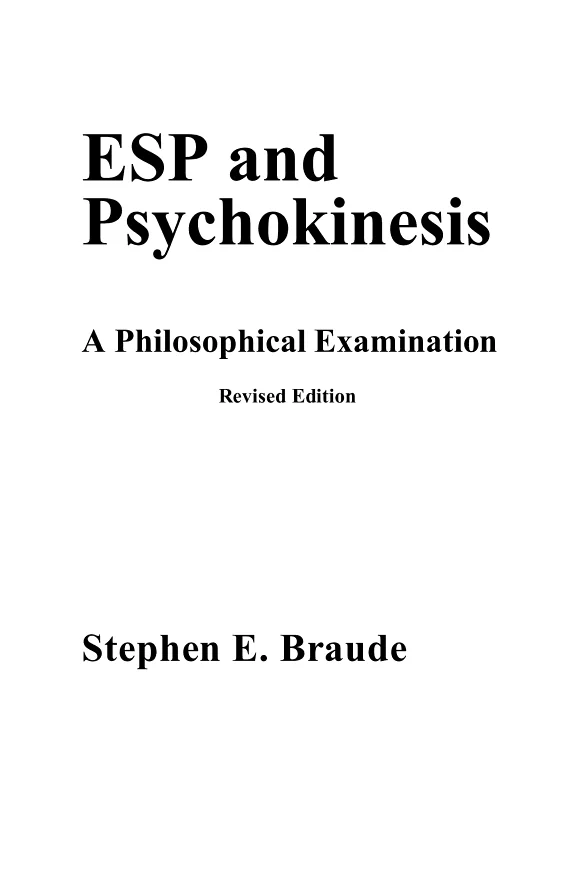
ESP and Psychokinesis
 73
73

ESP and Psychokinesis
Stephen E. Braude's "ESP and Psychokinesis" is a rare beast: a philosophically robust investigation into psychic phenomena that doesn't shy away from the difficult questions. Braude’s strength lies in his unsparing logical dissection of theories, particularly his critique of how proponents often import assumptions about physical laws to deny phenomena that might simply operate under different, as yet unknown, principles. A particularly compelling section is his analysis of the presuppositions underlying explanations for psychokinesis, which exposes logical weaknesses in both dismissive and affirmative stances. The book’s limitation, however, is its dense philosophical prose, which can make its 2002 arguments feel somewhat removed from the more interdisciplinary approaches now common in consciousness studies. Nevertheless, for those seeking intellectual rigor in this domain, it remains an indispensable reference, offering a clear-eyed assessment of a field often mired in speculation.
📝 Description
73
Stephen E. Braude's 2002 book rigorously examines the philosophical basis of ESP and psychokinesis.
Published in 2002, Stephen E. Braude's "ESP and Psychokinesis" offers a philosophical analysis of purported psychic abilities. Braude examines the logical structure of theories about telepathy, clairvoyance, and psychokinesis, moving beyond simple anecdotes to address empirical data and its interpretation. The book is intended for philosophers of mind and science, parapsychologists, and students of consciousness who want a critical look at these phenomena. Readers should have some background in philosophical arguments and an interest in the scientific standing of anomalies.
Braude's work engages with experimental data that emerged after the late 20th century. He assesses research methods and the conclusions drawn by those in the field. The book systematically categorizes psychic phenomena, differentiating extrasensory perception from psychokinesis. It discusses the philosophical impact on scientific models, particularly regarding causality and the mind-body connection. Braude scrutinizes the underlying assumptions of major explanatory theories, challenging both scientific materialism and dualism.
Stephen E. Braude's analysis of ESP and psychokinesis falls within a long tradition of investigating phenomena that challenge conventional scientific materialism. This tradition, active since the late 19th century through societies like the Society for Psychical Research, seeks to understand consciousness and reality beyond the strictly physical. Braude's work, though analytical, addresses topics central to spiritualism and the study of the afterlife, concerning the mind's potential to interact with the world independently of known physical forces. It continues a philosophical engagement with reported psychic abilities that has been a subject of debate for over a century.
💡 Why Read This Book?
• You will learn to critically evaluate the philosophical assumptions embedded in theories of psychic phenomena, specifically by examining Braude's analysis of abstract presuppositions concerning causality in extrasensory perception. • You will gain a structured understanding of the experimental data in parapsychology as presented in the book, particularly concerning the categories of psychic phenomena defined by Braude in the early 2000s. • You will encounter a rigorous philosophical framework for assessing anomalous experiences that moves beyond simplistic dismissal or uncritical acceptance, as demonstrated by Braude's engagement with the implications for the philosophy of mind.
⭐ Reader Reviews
Honest opinions from readers who have explored this book.
❓ Frequently Asked Questions
When was Stephen E. Braude's "ESP and Psychokinesis" first published?
Stephen E. Braude's "ESP and Psychokinesis" was first published in 2002, marking a significant philosophical contribution to the study of psychic phenomena in the early 21st century.
What key philosophical areas does "ESP and Psychokinesis" address?
The book addresses the philosophy of science and the philosophy of mind, exploring how psychic phenomena challenge existing paradigms and our understanding of consciousness and reality.
What is the primary focus of Braude's examination of psychic phenomena?
Braude's primary focus is on the abstract presuppositions and logical structures underlying theories of psychic phenomena, rather than solely on anecdotal evidence.
How does "ESP and Psychokinesis" relate to earlier works in the field?
It is noted as the first sustained philosophical study of psychic phenomena following C.D. Broad's "Lectures on Psychical Research," written nearly twenty years prior, thus bridging a gap in scholarly discourse.
Does the book present new experimental data on ESP and psychokinesis?
While it surveys compelling experimental data, the book's strength lies in its philosophical analysis and critique of existing data and theories, rather than the presentation of novel empirical findings.
What does Braude mean by 'abstract presuppositions' in psychic phenomena research?
Braude refers to the fundamental, often unstated, assumptions about reality, causality, and the nature of mind that researchers bring to their theories of psychic phenomena.
🔮 Key Themes & Symbolism
Philosophical Scrutiny of Anomalies
Braude's work is characterized by its stringent philosophical methodology. He insists on examining the logical coherence and conceptual foundations of theories explaining psychic phenomena. This approach moves beyond mere cataloging of events, focusing instead on the abstract presuppositions that shape our understanding of what is possible. By dissecting these underlying assumptions, Braude aims to reveal potential biases or limitations in both mainstream scientific views and alternative explanations, offering a framework for more rigorous inquiry into anomalies like telepathy and psychokinesis.
Defining Psychic Phenomena Categories
A crucial aspect of Braude's study involves clearly delineating the different types of psychic phenomena. He distinguishes between extrasensory perception (ESP), encompassing telepathy, clairvoyance, and precognition, and psychokinesis (PK), the purported ability to influence physical systems with the mind. This categorization is not merely semantic; it allows for a more precise examination of the evidence and theoretical challenges associated with each type, preventing conflation and ensuring that arguments are directed at specific phenomena.
Implications for Philosophy of Mind
The existence or even the plausible investigation of ESP and PK raises profound questions for the philosophy of mind. Braude explores how these phenomena might necessitate a revision of our understanding of consciousness, its relationship to the physical brain, and the nature of subjective experience. He considers whether current models of mind, often rooted in materialism or substance dualism, are adequate to account for abilities that appear to transcend conventional physical interactions, thus pushing the boundaries of mind-body problem discourse.
Critique of Explanatory Theories
Central to the book is Braude's critical assessment of leading theories that attempt to explain psychic phenomena. He does not simply present these theories but rigorously analyzes their abstract presuppositions, often finding them wanting. His critiques aim to expose logical inconsistencies, unsupported empirical claims, or philosophical biases that hinder genuine understanding. This critical stance challenges both skeptical dismissal and overly enthusiastic acceptance, advocating for a more nuanced and logically sound approach to the subject.
💬 Memorable Quotes
Direct passages from the work, attributed to the author.
“The author clearly defines the categories of psychic phenomena, surveys the most compelling experimental data, and traces their implications for the philosophy of science and the philosophy of mind.”
— This statement highlights Braude's structured approach, emphasizing his ability to both categorize complex subjects and connect them to broader philosophical debates concerning scientific methodology and consciousness.
“He considers carefully the abstract presuppositions underlying leading theories of psychic phenomena, and he offers bold criticisms of...”
— This points to Braude's core critical method: identifying and challenging the fundamental, often unstated, beliefs that underpin explanations for psychic abilities, rather than just examining surface-level arguments.
“This work was the first sustained philosophical study of psychic phenomena to follow C.D. Broad's LECTURES ON PSYCHICAL RESEARCH, written nearly twenty years earlier.”
— This contextualizes the book's significance, positioning it as a vital bridge in philosophical discourse, addressing a subject matter that had seen limited in-depth philosophical treatment for two decades.
“Braude's analysis extends to the very foundations of how we conceive of causality and physical law when confronted with phenomena that appear to defy conventional understanding.”
— This interpretation emphasizes Braude's willingness to question fundamental scientific assumptions, suggesting that the study of psychic phenomena requires a potential re-evaluation of core principles like cause and effect.
“The book systematically examines the logical structure of arguments for and against the existence of ESP and psychokinesis.”
— This interpretation underscores the book's commitment to logical rigor, indicating that it provides readers with tools to analyze the soundness of claims regarding psychic abilities, regardless of their personal beliefs.
🌙 Esoteric Significance
Tradition
While not explicitly aligning with a single esoteric lineage, Braude's work engages with themes central to metaphysical inquiry, particularly concerning consciousness and its potential non-local aspects. It approaches phenomena often explored in Hermeticism and Theosophy—mind over matter, extended perception—but through the rigorous lens of Western analytical philosophy. This bridges the gap between traditional esoteric claims and contemporary philosophical debate, offering a framework for understanding these concepts within a rational, albeit expanded, worldview.
Symbolism
The book itself does not heavily rely on traditional esoteric symbolism. Instead, its 'symbols' are conceptual: 'ESP' and 'Psychokinesis' themselves function as potent symbols for the unknown potentials of consciousness. The 'abstract presuppositions' Braude analyzes can be seen as symbolic representations of ingrained belief systems that either enable or obstruct understanding of these potentials. The very act of defining and categorizing these phenomena is a symbolic attempt to map the unmapped territories of the mind.
Modern Relevance
Braude's analytical framework remains highly relevant for contemporary thinkers in consciousness studies, philosophy of mind, and even certain branches of quantum physics research that explore observer effects and non-locality. Modern proponents of integrated approaches to consciousness, those seeking to reconcile subjective experience with objective reality, can draw on Braude's critiques to refine their own theories and avoid logical pitfalls. His work provides a crucial philosophical grounding for those exploring phenomena that challenge materialistic paradigms.
👥 Who Should Read This Book
• Philosophers of mind and science seeking to understand the evidential and conceptual challenges posed by psychic phenomena, looking to refine their arguments on consciousness and causality. • Serious students of parapsychology who desire a critical, analytical approach to the field's data and theoretical underpinnings, moving beyond anecdotal evidence. • Skeptics and open-minded inquirers interested in a rigorous philosophical examination of anomalies, who wish to engage with arguments that challenge established scientific materialism.
📜 Historical Context
Published in 2002, Stephen E. Braude's "ESP and Psychokinesis" emerged in an intellectual landscape still grappling with the legacy of parapsychological research and its place within mainstream science. It followed C.D. Broad's foundational "Lectures on Psychical Research" (1962) by nearly twenty years, a period during which scientific materialism often dominated, making sustained philosophical engagement with psychic phenomena rare. Braude's work provided a much-needed, systematic philosophical examination, building upon the empirical groundwork laid by researchers and thinkers like J.B. Rhine decades prior, but with a distinctly critical and analytical lens. While not directly engaging with a specific competing school of thought in a confrontational manner, its rigorous philosophical approach implicitly challenged both the dismissive posture of strict empiricism and the speculative nature of some esoteric interpretations, advocating for a more logically grounded approach to anomalous phenomena.
📔 Journal Prompts
The abstract presuppositions underlying theories of psychic phenomena: what are your own?
ESP and Psychokinesis: how do these categories map onto your understanding of consciousness?
C.D. Broad's influence on psychic research: how does it frame Braude's 2002 analysis?
The philosophy of mind and anomalous experiences: what fundamental assumptions must be re-examined?
Experimental data in parapsychology: how does its interpretation differ from standard scientific interpretation?
🗂️ Glossary
Extrasensory Perception (ESP)
A category of psychic phenomena encompassing purported abilities to gain information not through the known senses, such as telepathy (mind-to-mind communication), clairvoyance (perceiving distant objects or events), and precognition (knowing future events).
Psychokinesis (PK)
A category of psychic phenomena referring to the purported ability of the mind to influence physical systems or matter directly, without physical intervention. Also known as telekinesis.
Abstract Presuppositions
Fundamental, often unstated, assumptions or beliefs about the nature of reality, causality, knowledge, or consciousness that underpin theories or explanations within a given field.
Philosophy of Mind
A branch of philosophy concerned with the nature of the mind, consciousness, mental states, and their relationship to the physical body, particularly the brain.
Philosophy of Science
A branch of philosophy that studies the assumptions, foundations, methods, and implications of science, examining the nature of scientific explanation and knowledge.
Causality
The principle that every event has a cause, and that causes precede their effects. The study of psychic phenomena often challenges conventional notions of causality.
Materialism
The philosophical view that matter is the fundamental substance in nature, and that all phenomena, including mental phenomena, are results of material interactions.
This book appears in 1 collection
🔮 Readers Also Liked
Browse all →









From the “Extrasensory Perception” Collection
View all →








More Free Occult Philosophy Books
View all →