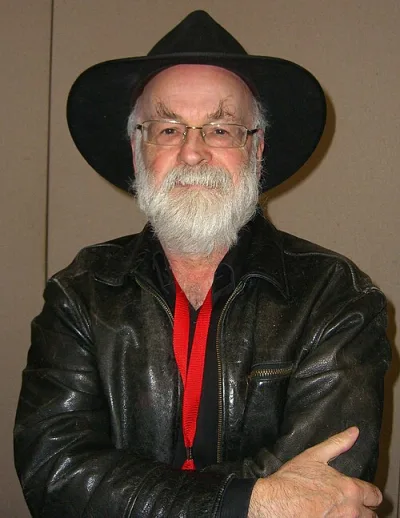
Terry Pratchett was a highly successful English author, celebrated for his humorous fantasy novels, particularly the Discworld series.
Sir Terence David John Pratchett (1948–2015) was an English writer, humorist, and satirist, most recognized for his extensive "Discworld" series, a collection of 41 comic fantasy novels published from 1983 to 2015. He also co-authored the apocalyptic comedy "Good Omens" with Neil Gaiman. Pratchett's literary career began with "The Carpet People" in 1971, and he maintained a prolific output, averaging two books annually after the debut of the Discworld series. His books achieved immense global popularity, selling over 100 million copies worldwide and establishing him as the UK's top-selling author of the 1990s. He received numerous accolades, including an OBE, a knighthood for his contributions to literature, and the Carnegie Medal. In his later years, Pratchett publicly shared his experiences after being diagnosed with early-onset Alzheimer's disease, becoming an advocate for research.
Early Life and Influences
Born in Beaconsfield, England, Terry Pratchett was an only child. His early education involved attending Holtspur School, where he faced bullying due to speech impediments and received critical attention from a headteacher who judged future success by early literacy. He later attended High Wycombe Technical High School, where he engaged in the debating society and contributed to the school magazine. Pratchett's early interests included astronomy, and he was a fan of science fiction, attending conventions in his youth. His foundational reading included authors like H. G. Wells and Arthur Conan Doyle. His first published story appeared in his school magazine at age 13, with commercial publication following shortly after. He pursued further education in Art, English, and History, and began his career in journalism as an apprentice at the Bucks Free Press.
Writing Career and Success
Pratchett's first novel, "The Carpet People," was published in 1971. He later worked in journalism and public relations for the Central Electricity Generating Board, a period he humorously linked to the Three Mile Island incident. The launch of the "Discworld" series in 1983 marked a significant turning point, leading him to pursue writing full-time in 1987. The series' popularity grew rapidly, making him the UK's best-selling author of the 1990s and a consistent presence on bestseller lists. His books achieved widespread international recognition, translated into numerous languages and selling tens of millions of copies globally. He received prestigious awards for his work, including the Carnegie Medal for "The Amazing Maurice and His Educated Rodents" and a World Fantasy Award for Life Achievement.
Later Life and Advocacy
In 2007, Terry Pratchett disclosed his diagnosis of early-onset Alzheimer's disease. He subsequently became a public advocate for Alzheimer's research, making significant donations and producing BBC documentaries detailing his personal journey with the condition. He also became a patron for Alzheimer's Research UK. Pratchett maintained a lifelong interest in astronomy, even building an observatory at his home, and appeared on television programs discussing space. He was also an early adopter and enthusiast of computer technology for writing and communication, engaging with fans online and expressing concerns about the spread of misinformation in the digital age. His passion for natural history, particularly carnivorous plants, was also a recurring theme in his life and work.