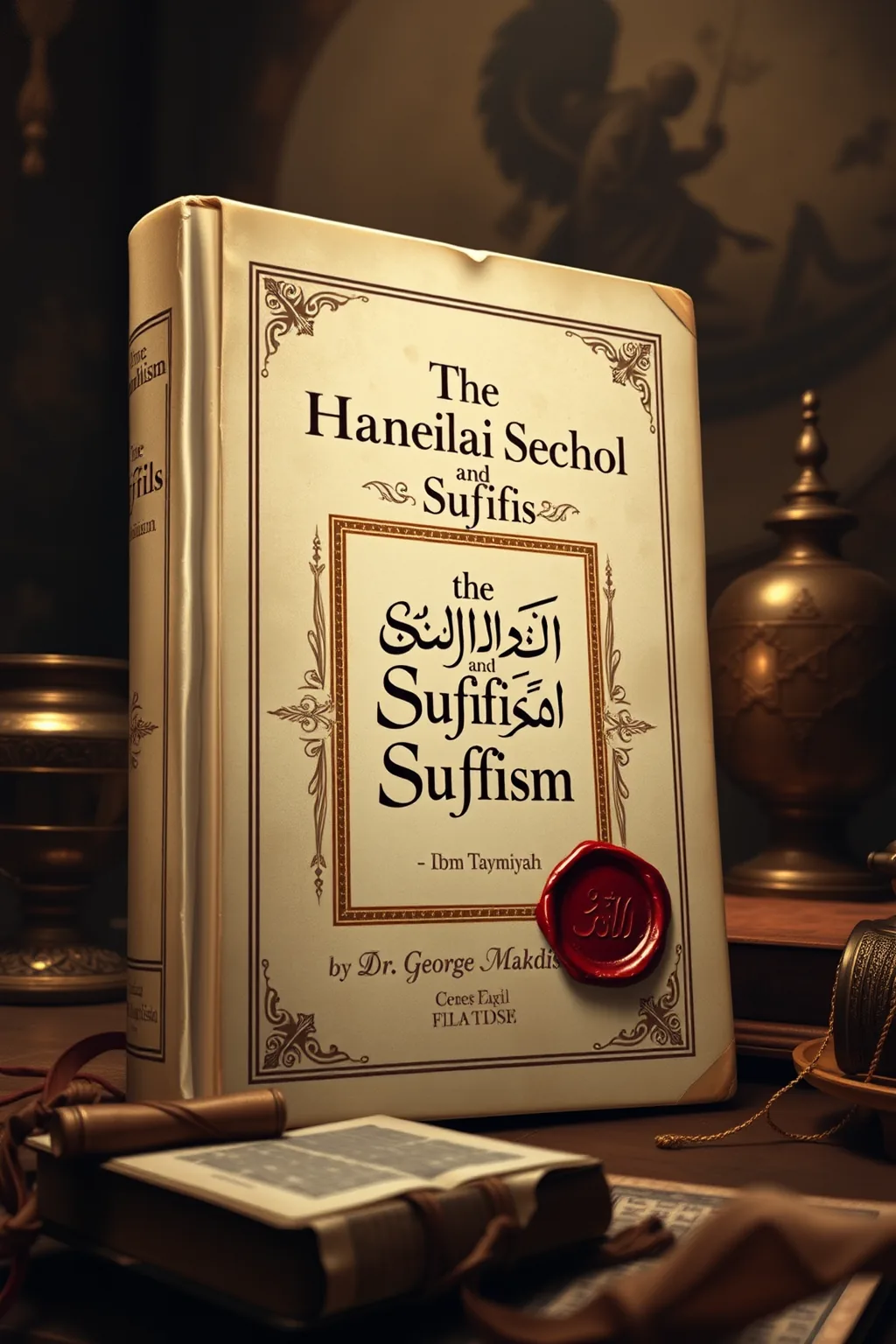
The Hanbali School and Sufism
 83
83

The Hanbali School and Sufism



Ophelia Vance, Mystical Literature Reviewer — Dr. George Makdisi's "The Hanbali School and Sufism" is a seminal work that pierces through conventional interpretations of Islamic thought. It brilliantly reveals the often-veiled spiritual undercurrents within the Hanbali tradition, demonstrating a sophisticated integration of jurisprudence and mysticism. Makdisi's meticulous scholarship unearths the nuanced relationship between legal rigor and the soul's ascent, particularly highlighting Imam Ibn Taymiyyah's engagement with Sufi paths. This book is indispensable for scholars of Islamic esotericism and for serious practitioners seeking a deeper, historically grounded understanding of tasawwuf. It offers profound insights into the perennial quest for divine proximity.
📝 Description
83
George Makdisi's 1997 work examines the Hanbali legal school's relationship with Sufism.
This book investigates the historical and theological connections between the Hanbali legal tradition and Islamic mysticism, known as Sufism. Makdisi details the intellectual exchanges that occurred, demonstrating how contemplative practices influenced even the most legally oriented scholars. The work addresses figures such as Imam Ibn Taymiyyah, challenging the common perception of him as solely a strict legalist. It shows his engagement with tasawwuf and links to Sufi orders like the Qadiri Tariqa.
The study reveals a more complex picture of Islamic intellectual history, where adherence to strict legal interpretations did not preclude engagement with inner spiritual development. Makdisi's research uncovers the subtle ways in which these two facets of Islamic practice interacted and shaped one another. The book is for those interested in the devotional and intellectual heritage of Islam, offering a deeper view of its development.
Within the broader study of Islamic esoteric traditions, this book addresses the often-overlooked integration of legalistic frameworks with mystical aspirations. It moves beyond a simple dichotomy, showing how scholars within a rigorously defined legal school, the Hanbali, also participated in or were influenced by Sufi thought and practice. This challenges a monolithic view of Islamic scholarship and highlights the internal diversity of spiritual approaches within seemingly orthodox structures. The work situates the quest for inner purification and direct spiritual experience within the context of established Islamic jurisprudence.
💡 Why Read This Book?
Uncover the surprising confluence of rigorous Islamic jurisprudence and the ecstatic heart of Sufism. "The Hanbali School and Sufism" reveals the spiritual depth within seemingly austere traditions, offering a more nuanced understanding of key figures like Imam Ibn Taymiyyah. Ideal for scholars, seekers of esoteric knowledge, and practitioners of tasawwuf who wish to explore the profound integration of Sharia and Tariqa.
⭐ Reader Reviews
Honest opinions from readers who have explored this book.
❓ Frequently Asked Questions
What is the primary focus of this book?
The book primarily explores the historical and theological relationship between the Hanbali school of Islamic jurisprudence and the mystical path of Sufism (tasawwuf), examining their points of convergence and divergence.
Who was Imam Ibn Taymiyyah in relation to Sufism?
Dr. Makdisi investigates Imam Ibn Taymiyyah's complex relationship with Sufism, detailing his connections to orders like the Qadiri Tariqa and his approach to mystical practices within an orthodox framework.
Is this book suitable for beginners in Islamic studies?
While scholarly, the book's clear exposition makes it accessible to dedicated beginners interested in the esoteric dimensions of Islam. Prior familiarity with basic Islamic concepts would be beneficial but not strictly required.
What is the significance of the Hanbali school in this context?
The Hanbali school, known for its strict adherence to the Quran and Sunnah, is examined to demonstrate how contemplative and mystical practices could coexist and even be integrated within its jurisprudential framework.
What does 'tasawwuf' refer to?
Tasawwuf is the Arabic term for Islamic mysticism or Sufism, encompassing the spiritual disciplines, practices, and philosophical dimensions aimed at achieving divine knowledge and proximity.
🔮 Key Themes & Symbolism
The Jurisprudence-Mysticism Synthesis
This theme explores the intricate interplay between the outward legal rulings of the Hanbali school and the inward spiritual journey of Sufism. It explores how adherence to Sharia can serve as a foundation for, rather than an obstacle to, the pursuit of esoteric knowledge and divine union. The work illuminates how scholars and mystics within this tradition found common ground, bridging the apparent divide between legalistic rigor and contemplative ascent, revealing a holistic approach to faith and practice.
Imam Ibn Taymiyyah's Sufi Path
A central focus is the nuanced portrayal of Imam Ibn Taymiyyah, a towering figure often associated with strict orthodoxy. Dr. Makdisi meticulously examines his engagement with Sufi orders, particularly the Qadiri Tariqa, and his own spiritual practices. This theme challenges simplistic views, revealing Ibn Taymiyyah not as an opponent of mysticism, but as a complex scholar who sought to purify and integrate Sufi ideals within the framework of Islamic law, emphasizing sincerity and the remembrance of God.
The Esoteric Dimensions of Islamic Law
This theme uncovers the often-overlooked spiritual and symbolic meanings embedded within Islamic jurisprudence, particularly within the Hanbali madhhab. It suggests that the meticulous study and application of divine law can itself be a form of worship and a path to spiritual purification. The work explores how the pursuit of knowledge and righteous action, central to Hanbali thought, can lead to profound inner transformation and a deeper connection with the Divine, revealing the 'batin' (inner meaning) alongside the 'zahir' (outer form).
💬 Memorable Quotes
Direct passages from the work, attributed to the author.
“The law is the body, and the spirit is the Sufi.”
— This evocative statement suggests that outward adherence to Islamic law provides the necessary structure and discipline for the inner spiritual journey, which is the animating spirit of faith.
“Where the jurist fears God, the mystic sees Him.”
— This highlights the different modes of experiencing the Divine: one through apprehension and adherence to divine command, the other through direct, experiential vision and presence.
“The path is paved with stones of Sunnah.”
— This emphasizes that the Sufi path is not detached from the Prophet's traditions, but rather firmly grounded in and guided by his example and teachings.
“To know the law is to understand His Will; to embody it is to achieve His Presence.”
— This posits a progression where intellectual understanding of divine commands leads to their practical application, culminating in a state of spiritual nearness to God.
“The heart's purification is the ultimate jurisprudence.”
— This profound statement elevates inner spiritual development above mere outward observance, suggesting that a purified heart is the highest form of legal and ethical attainment.
🌙 Esoteric Significance
Tradition
The book explores the esoteric dimensions of Sunni Islam, specifically focusing on the intersection of the Hanbali school of jurisprudence and tasawwuf (Sufism). It explores the hidden meanings and spiritual practices that can be found within a tradition often perceived as strictly legalistic, revealing a rich inner life and contemplative depth that complements outward observance.
Symbolism
Key symbols explored include the meticulous adherence to the Quran and Sunnah as the 'body' of faith, with Sufi practices representing the animating 'spirit.' The concept of 'purification of the heart' emerges as a central symbol, signifying the ultimate goal of both legal and mystical endeavors. The path itself is metaphorically represented as being 'paved with stones of Sunnah,' underscoring the integration of tradition and inner transformation.
Modern Relevance
In an era often marked by polarization within religious discourse, this book offers a crucial reminder of the historical capacity for integration and nuanced understanding within Islam. It provides contemporary seekers and scholars with a model for reconciling outward religious practice with inward spiritual development, demonstrating that adherence to law and the pursuit of mystical experience are not mutually exclusive but can be deeply complementary.
👥 Who Should Read This Book
This clear text is essential for scholars of Islamic theology, jurisprudence, and mysticism seeking a deeper, historically nuanced understanding of tasawwuf. It is also profoundly beneficial for spiritual seekers and practitioners of Sufism who wish to explore the roots of their tradition and understand how it has historically interacted with Islamic law. Beginners interested in the esoteric dimensions of Islam will find it an accessible yet scholarly introduction, offering a bridge between outward religious practice and inward spiritual exploration.
📜 Historical Context
This work is situated within the rich intellectual field of medieval Islam, a period characterized by vibrant scholarly debate and the flourishing of diverse religious movements. The emergence and consolidation of the four major Sunni legal schools, including the Hanbali, provided a foundational framework for Islamic life. Simultaneously, Sufism, the mystical dimension of Islam, was evolving, with various orders and shaykhs developing distinct paths of spiritual discipline and contemplation. This era witnessed significant theological discourse, with scholars grappling with the integration of Sharia (divine law) and Tariqa (spiritual path). Figures like Imam Ibn Taymiyyah (1263–1328 CE) lived during a time of considerable political and intellectual flux, influencing and being influenced by these prevailing currents, making the exploration of his relationship with Sufism particularly significant.
📔 Journal Prompts
How does the concept of 'purification of the heart' inform your understanding of Islamic law?
In what ways can strict adherence to religious rules paradoxically lead to spiritual liberation?
Reflect on a time when outward discipline facilitated your inner growth. What was the connection?
Consider the potential for hidden spiritual dimensions within seemingly mundane religious practices.
How might the historical integration of law and mysticism offer a model for contemporary religious life?
🗂️ Glossary
Tasawwuf
The Arabic term for Islamic mysticism or Sufism, referring to the spiritual path and practices aimed at achieving direct knowledge of God and spiritual purification.
Hanbali School
One of the four major Sunni schools of Islamic jurisprudence (fiqh), known for its strict adherence to the Quran and Sunnah, and its emphasis on textual evidence.
Tariqa
An order or path within Sufism, typically founded by a spiritual master, characterized by specific teachings, practices, and lineages of spiritual transmission.
Sharia
Islamic law derived from the Quran and Sunnah, encompassing religious, moral, and legal codes that guide the lives of Muslims.
Imam Ibn Taymiyyah
A prominent 14th-century Islamic scholar, theologian, and jurist from the Hanbali school, known for his reformist ideas and extensive writings on various Islamic sciences.
This book appears in 2 collections
🔮 Readers Also Liked
Browse all →









From the “Christian Mysticism” Collection
View all →









More Free Mysticism & Contemplation Books
View all →