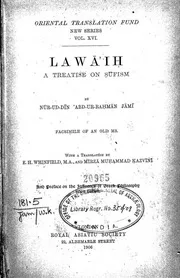
Lawaih a treatise on sufism
 79
79

Lawaih a treatise on sufism



Evander Ashcroft (Alchemy & Hermeticism Editor) — Whinfield's 'Lawa'ih' stands as a beacon for serious students of Sufism. This translation and exposition masterfully decode the subtle nuances of mystical Islamic thought, revealing profound spiritual insights often veiled in poetic language. Its strength lies in its clarity and the author's deep reverence for the subject matter. Whinfield's work is particularly valuable for its bridge-building between Western philosophical inquiry and Eastern contemplative traditions. This is essential reading for anyone seeking to understand the esoteric dimensions of Sufism, offering a rich tapestry of knowledge for scholars and practitioners alike.
📝 Description
79
E.H. Whinfield translated and published 'Lawa'ih', a key Sufi text, in 1880.
Whinfield's 1880 translation of 'Lawa'ih' presents a significant Persian treatise on Sufism. The work details the mystical path within Islam, focusing on concepts like divine love and the ego's dissolution, known as fana. It uses allegorical language to guide readers toward understanding the soul's desire for union with the Divine.
The text moves beyond simple academic explanation. It invites readers on an internal spiritual quest, aiming to connect with the heart of Sufi philosophy. It speaks to those interested in the contemplative aspects of Islamic mysticism and the deeper meanings behind its symbolic expressions.
This treatise belongs to the Persian Sufi tradition, a branch of Islamic mysticism. It addresses the inner dimensions of faith, emphasizing direct spiritual experience and the purification of the self. Sufism, with its roots in the Quran and the Prophet Muhammad's teachings, developed rich devotional practices and philosophical schools. 'Lawa'ih' contributes to this lineage by articulating core tenets through metaphor and contemplative insight, aiming for a realization of unity with God.
💡 Why Read This Book?
Embark on an inner journey towards divine wisdom. 'Lawa'ih' offers a rare glimpse into the heart of Sufi mysticism, unveiling hidden spiritual truths and contemplative practices. Ideal for seekers of esoteric knowledge, scholars of Eastern philosophies, and practitioners of mindfulness seeking deeper connection.
⭐ Reader Reviews
Honest opinions from readers who have explored this book.
❓ Frequently Asked Questions
What is Sufism?
Sufism is the mystical dimension of Islam, focused on direct, personal experience of God through love, devotion, and asceticism, emphasizing inner purification and spiritual transformation.
What does 'Lawa'ih' mean?
'Lawa'ih' translates from Arabic to English as 'Glimmers' or 'Manifestations,' suggesting sudden flashes of divine insight or the unveiling of hidden truths.
Who was E.H. Whinfield?
E.H. Whinfield was a translator and scholar known for his significant contributions to making classical Sufi texts accessible to a Western audience, particularly through his translations of Rumi and works on Sufism.
What is the significance of its origin?
Its origin within the collection of the Archaeological Survey of India and the Indira Gandhi National Centre for the Arts signifies its historical importance and scholarly preservation, lending it an aura of deep cultural and academic value.
Is this book suitable for beginners?
While dense with wisdom, 'Lawa'ih' can be approached by dedicated beginners with an open mind and a willingness to engage with complex philosophical and spiritual concepts. It rewards patient study.
🔮 Key Themes & Symbolism
The Path of Divine Love
This core theme studies the Sufi concept of Ishq, or divine love, as the primary impetus and ultimate goal of the spiritual journey. It explores how love for the Divine permeates all aspects of existence, transforming the seeker's heart and mind. The treatise elucidates how this fervent devotion acts as the catalyst for shedding egoic attachments and fostering a profound connection with the Absolute, guiding the soul through stages of longing, recognition, and union. This exploration reveals love not merely as an emotion, but as the very essence of reality and the driving force behind creation.
Annihilation of the Self (Fana)
Central to Sufi practice is the concept of fana, the annihilation or effacement of the individual ego in the presence of the Divine. 'Lawa'ih' meticulously details the process and significance of transcending personal desires, limitations, and self-identity to achieve a state of pure receptivity to God's will. This is not an act of destruction, but a sublimation and transformation, where the limited self dissolves into the boundless ocean of divine consciousness, allowing for true spiritual liberation and enlightenment. It is the ultimate surrender that leads to eternal life.
Symbolism and Veiled Knowledge
The text is rich with allegory and symbolic language, characteristic of esoteric traditions. 'Lawa'ih' employs metaphors drawn from nature, human relationships, and the cosmos to convey profound spiritual truths that are not immediately apparent. Whinfield’s translation invites readers to look beyond the literal meaning, decoding the hidden layers of wisdom that speak directly to the soul. Understanding these symbols is crucial for grasping the deeper philosophical and mystical dimensions of Sufism, revealing a universe of meaning accessible to those who seek with an open heart and discerning mind.
💬 Memorable Quotes
Direct passages from the work, attributed to the author.
“The Lover is consumed by the Beloved.”
— This concise statement expresses the Sufi ideal of complete devotion and surrender, where the ego is dissolved in the overwhelming presence of the Divine, leading to a state of ecstatic union.
“The path is paved with longing.”
— This highlights the essential role of yearning and desire for God as the driving force on the spiritual journey, a constant aspiration that propels the seeker forward.
“In the mirror of the heart, the Divine is reflected.”
— This poetic metaphor emphasizes the inner nature of spiritual realization, suggesting that the human heart, when purified, becomes a perfect receptacle for experiencing divine presence.
“To know oneself is to know God.”
— This profound statement points to the interconnectedness of self-awareness and divine knowledge, implying that through introspection and self-understanding, one can apprehend the divine nature.
💡 Key Ideas
Editorial paraphrase of the work's core concepts — not direct quotes.
The universe is but a whisper of His name.
This quote illustrates the Sufi concept of divine immanence, where all of creation is seen as a manifestation or echo of God's eternal essence and power.
🌙 Esoteric Significance
Tradition
This work is deeply rooted in the esoteric tradition of Sufism, the mystical branch of Islam. It explores the path of direct experiential knowledge of God, emphasizing love, inner purification, and the transcendence of the ego. Sufism, often referred to as the 'science of the heart,' offers useful insights into the nature of the soul, divine reality, and the journey towards spiritual annihilation and eternal union with the Absolute.
Symbolism
The text is replete with detailed symbolism, employing metaphors of the lover and the beloved, the tavern, the veil, and the mirror to convey complex spiritual states and concepts. These symbols are not mere literary devices but represent stages of the soul's journey, the nature of divine grace, and the obstacles encountered on the path. Understanding this symbolic language is key to unlocking the deeper, esoteric meanings embedded within the treatise, revealing a cosmology of the inner life.
Modern Relevance
In an age often characterized by materialism and disconnection, 'Lawa'ih' offers a timeless path to inner peace and profound self-discovery. Its teachings on love, surrender, and the pursuit of truth resonate powerfully with contemporary seekers looking for spiritual depth and meaning. The contemplative practices and philosophical insights presented provide practical guidance for cultivating mindfulness, transcending egoic limitations, and fostering a more compassionate and connected existence in the modern world.
👥 Who Should Read This Book
This profound treatise is essential for scholars of comparative religion and philosophy, particularly those interested in Islamic mysticism and Indian philosophical traditions. Aspiring mystics and seekers of spiritual enlightenment will find it an invaluable guide to the Sufi path, offering useful insights into contemplative practices and the nature of divine love. Practitioners of meditation and mindfulness will discover profound wisdom for deepening their inner work, while those drawn to esoteric knowledge and the exploration of consciousness will find 'Lawa'ih' a richly rewarding text that illuminates the veiled dimensions of existence.
📜 Historical Context
Published in London, likely in the late 19th or early 20th century, 'Lawa'ih' by E.H. Whinfield emerges during a period of burgeoning Western interest in Eastern philosophies and religions. This era saw scholars and mystics actively seeking to translate and interpret texts from ancient traditions, aiming to bridge cultural divides and explore universal spiritual truths. Whinfield's work is a product of this intellectual curiosity and a evidence of the enduring appeal of Sufism's mystical teachings. Its preservation within the esteemed Archaeological Survey of India and the Indira Gandhi National Centre for the Arts underscores its significance as a scholarly and cultural artifact, reflecting a deep engagement with India's rich philosophical heritage.
📔 Journal Prompts
Reflect on a moment when you felt a profound sense of longing for something greater than yourself. How did this feeling manifest?
Consider the concept of 'annihilation of the ego.' What aspects of your own ego do you find most challenging to relinquish?
How can the symbolism of a 'mirror' help you understand your own spiritual journey and reflections?
Explore the idea of divine love as a driving force in your life. Where do you see its influence, and how can you cultivate it further?
What 'veiled knowledge' or hidden truth do you feel is currently being revealed to you in your life?
🗂️ Glossary
Sufism
The mystical dimension of Islam, focused on direct, personal experience of God through love, devotion, and asceticism, emphasizing inner purification and spiritual transformation.
Fana
An Arabic term meaning 'annihilation' or 'dissolution,' referring to the Sufi concept of the effacement of the individual ego in the presence of the Divine.
Ishq
An Arabic word for intense, passionate, or divine love, a central concept in Sufism representing the soul's fervent longing for God.
Dhikr
The remembrance of God, a central Sufi practice involving the repetition of divine names or phrases, often through chanting or silent contemplation, to achieve spiritual presence.
Murshid
A spiritual guide or master in Sufism who leads disciples on the path towards God, offering instruction and wisdom.
This book appears in 2 collections
🔮 Readers Also Liked
Browse all →







From the “Christian Mysticism” Collection
View all →








More Free Mysticism & Contemplation Books
View all →