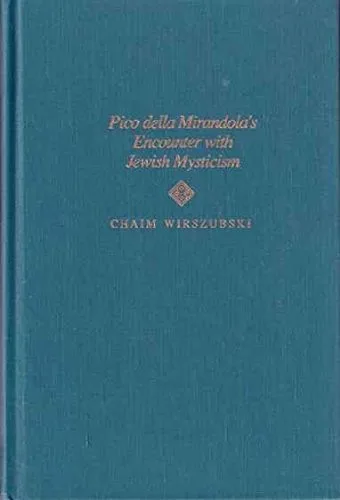
Pico della Mirandola's encounter with Jewish mysticism
 61
61

Pico della Mirandola's encounter with Jewish mysticism


Evander Ashcroft (Alchemy & Hermeticism Editor) — Wirszubski's "Pico della Mirandola's Encounter with Jewish Mysticism" is a scholarly tour de force, meticulously charting the intellectual currents that allowed a Renaissance titan to engage with Kabbalah. The author deftly navigates the complex philosophical terrain, revealing Pico's genuine grasp of esoteric concepts. This work is indispensable for understanding the cross-pollination of spiritual ideas in a pivotal era. Its strength lies in its rigorous scholarship and its ability to make profound, often veiled, mystical doctrines accessible. Highly recommended for serious students of Western esotericism and Renaissance philosophy.
📝 Description
61
Chaim Wirszubski's 1989 study examines Pico della Mirandola's engagement with Kabbalah.
This book details the intellectual exchange between the Renaissance thinker Pico della Mirandola and Jewish mystical traditions, particularly Kabbalah. Wirszubski shows how Pico, in his pursuit of a universal understanding, found resonance with Kabbalistic concepts. The study traces connections between Pico's ideas, Neoplatonism, Hermeticism, and the Zohar.
It discusses the symbolic language, hidden correspondences, and spiritual ideas that engaged Pico. The book is intended for those interested in comparative mysticism, Renaissance studies, and the synthesis of different spiritual paths. It aims to shed light on the historical interactions between these traditions and the human desire for spiritual knowledge.
This work sits within the scholarly examination of Renaissance esotericism, specifically how Christian thinkers engaged with Jewish mystical texts. It investigates the syncretic tendencies of the period, where figures like Pico sought to find common ground between diverse philosophical and religious traditions. The book places Pico's interest in Kabbalah within a broader context of Hermetic and Neoplatonic thought, traditions that were often interpreted through an esoteric lens during the Renaissance. It is a study of how specific esoteric traditions interacted and influenced figures outside their immediate cultural origins.
💡 Why Read This Book?
Uncover the secret dialogues between Renaissance humanism and ancient Kabbalah. Explore how Pico della Mirandola synthesized diverse mystical traditions, seeking a unified vision of the divine. This book offers a rare glimpse into the esoteric underpinnings of Western thought and is essential for scholars, spiritual seekers, and practitioners interested in the cross-cultural exchange of mystical knowledge.
⭐ Reader Reviews
Honest opinions from readers who have explored this book.
❓ Frequently Asked Questions
What is the primary focus of this book?
The book focuses on the intellectual and spiritual encounter between Pico della Mirandola and the rich tradition of Jewish Kabbalah, exploring how he integrated its esoteric wisdom into his own philosophical system.
Who was Pico della Mirandola?
Giovanni Pico della Mirandola was an Italian nobleman and philosopher of the Renaissance, renowned for his ambitious pursuit of syncretic knowledge and his "900 Theses" on all of human learning.
What is Kabbalah?
Kabbalah is the esoteric teaching of Judaism, a mystical tradition that seeks to understand the divine nature, the creation of the universe, and the relationship between God and humanity through symbolic interpretation of scripture and spiritual practice.
What kind of knowledge does this book reveal?
It reveals hidden knowledge concerning the symbolic language of Kabbalah, its correspondence with other mystical traditions, and its profound influence on Renaissance thought, particularly on Pico's search for universal truth.
Is this book suitable for beginners?
While scholarly, the book is accessible to dedicated beginners interested in comparative mysticism and the history of esoteric thought. It provides context for understanding complex ideas.
🔮 Key Themes & Symbolism
The Syncretic Quest for Universal Wisdom
This theme examines Pico della Mirandola's ambitious endeavor to synthesize disparate philosophical and religious traditions into a unified range of divine knowledge. It highlights his belief that truth is not confined to any single doctrine but is scattered across various mystical and esoteric streams, with Kabbalah representing a crucial, clear source for his comprehensive worldview.
Kabbalah as Esoteric Revelation
Here, the focus is on Kabbalah not merely as a theological system but as a profound esoteric tradition containing hidden meanings and symbolic keys to understanding the cosmos and the divine. The book examines how Pico perceived Kabbalistic texts, such as the Zohar, as repositories of ancient, divinely inspired secrets, offering insights into creation, angelic hierarchies, and the nature of God.
The Interplay of Judaism and Renaissance Humanism
This theme explores the fascinating cultural and intellectual exchange between Jewish mystical thought and the burgeoning humanism of the Renaissance, personified by Pico. It investigates how Christian scholars like Pico engaged with Hebrew texts and Kabbalistic concepts, often seeing them as complementary to, or even foundational for, Christian theology and philosophy, thus challenging traditional religious boundaries.
💬 Memorable Quotes
Direct passages from the work, attributed to the author.
“Within the Hebrew tongue, secrets of creation lie veiled.”
— This highlights the perceived esoteric significance of the Hebrew language in Kabbalah, implying that its structure and letters hold profound cosmological and divine knowledge.
“Kabbalah: a bridge between earth and the celestial spheres.”
— This metaphorical quote points to Kabbalah's role as a system that connects the mundane world with higher, spiritual realities, offering pathways for ascent and divine communion.
“Wisdom is a mosaic, each shard a divine spark.”
— This suggests that true wisdom is many-sided, derived from various sources, and that each distinct tradition contributes a piece of the overarching divine truth.
“Mirandola sought the elements of God in every sacred tongue.”
— This emphasizes Pico's dedication to finding common threads of divine revelation across different religious and philosophical systems, particularly his interest in Jewish mysticism.
💡 Key Ideas
Editorial paraphrase of the work's core concepts — not direct quotes.
The quest for divine illumination knows no creed.
This quote captures Pico's universalist approach, suggesting that the pursuit of spiritual understanding transcends religious boundaries and can be found across diverse traditions.
🌙 Esoteric Significance
Tradition
This work is deeply rooted in the esoteric traditions of Kabbalah, the mystical dimension of Judaism, and its confluence with Renaissance Hermeticism and Neoplatonism. It explores the symbolic language, gematria, and meditative practices inherent in Kabbalistic thought, framing them as pathways to direct spiritual experience and an understanding of divine emanations and cosmic architecture.
Symbolism
Key symbols explored include the Sephiroth, the Tree of Life, the divine name, and the concept of Ein Sof (the Infinite). These symbols are presented not as mere allegories but as potent keys that unlock profound metaphysical truths about creation, divine immanence, and the soul's journey towards its source, offering a rich visual and conceptual language for esoteric understanding.
Modern Relevance
In an age seeking deeper meaning and integration of diverse spiritual perspectives, this book's exploration of Pico's interfaith dialogue remains profoundly relevant. It demonstrates the enduring power of seeking common ground in spiritual quests and offers timeless insights into the symbolic language of mysticism, the human desire for transcendence, and the interconnectedness of all wisdom traditions.
👥 Who Should Read This Book
This key work is essential for scholars of Renaissance intellectual history and comparative religion, offering clear insights into the syncretic nature of Pico della Mirandola's thought. Spiritual seekers and practitioners interested in the historical roots of esoteric traditions, particularly Kabbalah and its influence, will find a rich source of wisdom. Beginners in mysticism can approach it for an introduction to the profound connections between different faith streams, while advanced practitioners will appreciate the detailed exploration of symbolic systems and their transformative potential.
📜 Historical Context
The late 15th century, the era of Pico della Mirandola, was a period of profound intellectual ferment in Europe. The Renaissance was in full bloom, characterized by a renewed interest in classical antiquity, a spirit of humanism, and a daring exploration of diverse philosophical and religious ideas. This was also a time when contact between Christian and Jewish scholars, though often fraught, led to significant intellectual cross-pollination. The rediscovery of Kabbalistic texts, particularly through translations and discussions within Christian circles, opened up new avenues for understanding the divine, the cosmos, and the human soul. Pico's engagement with these traditions was part of a broader trend among Renaissance thinkers to seek a universal "prisca theologia" – an ancient, original theology believed to underlie all religions.
📔 Journal Prompts
Reflect on a time when you discovered unexpected wisdom in a tradition outside your own. How did it expand your perspective?
Consider the concept of 'universal wisdom'. Where do you see its threads woven in different cultures or belief systems today?
If you were to seek a hidden meaning in a common object or concept, what would it be and what might it symbolize?
How can understanding the esoteric dimensions of ancient texts enrich our contemporary spiritual lives?
Imagine you are Pico della Mirandola, encountering a mystical text for the first time. What questions would you pose to unlock its secrets?
🗂️ Glossary
Kabbalah
A system of Jewish mysticism that explores the divine nature, creation, and the relationship between God and humanity through esoteric interpretation of scripture and symbolic representation.
Sephiroth
The ten divine emanations or attributes through which God is said to have created the universe, often depicted on the Kabbalistic Tree of Life.
Ein Sof
A Hebrew term meaning 'Without End' or 'Infinite', referring to the absolute, unknowable, and transcendent aspect of God before manifestation.
Zohar
The foundational work of Kabbalah, a mystical commentary on the Torah, rich in symbolism, narrative, and theological discourse.
Gematria
A method of biblical interpretation in Kabbalah where words with equal numerical values are considered to have related meanings, revealing hidden connections.
This book appears in 1 collection
🔮 Readers Also Liked
Browse all →








From the “Kabbalah” Collection
View all →









More Free Kabbalah & Jewish Mysticism Books
View all →