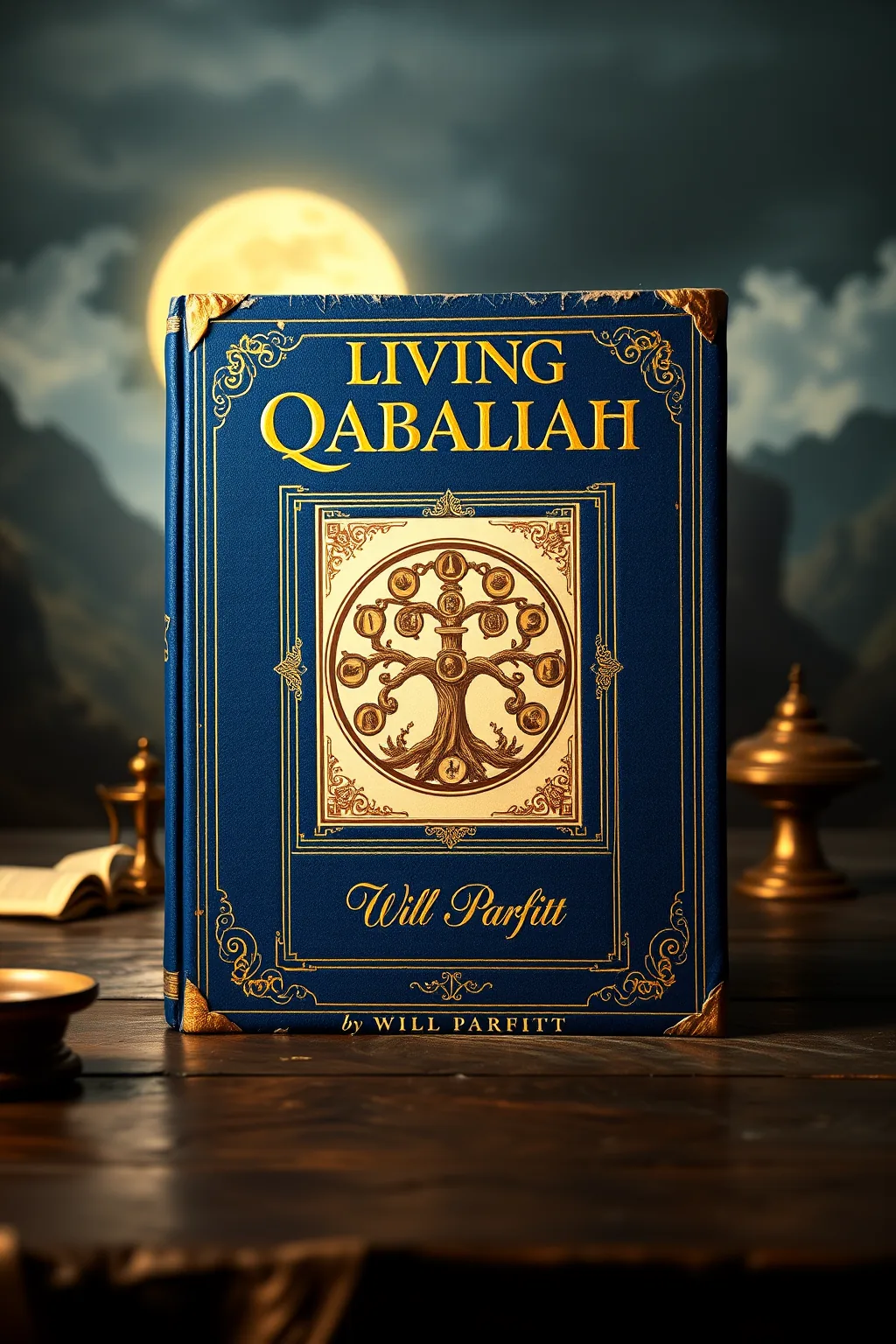
Living Qabalah
 63
63

Living Qabalah


Silas Hawthorne, Hermetic Studies Editor: Will Parfitt's 'Living Qabalah' is a beacon for those seeking to transcend mere intellectual understanding of the Kabbalah and embrace its living essence. Parfitt's approach is both deeply reverent and refreshingly practical, demystifying the complex symbolism of the Tree of Life without sacrificing its profound esoteric depth. He masterfully bridges the gap between ancient textual tradition and contemporary spiritual seeking, providing actionable insights for personal growth. This work is an essential acquisition for any serious student of Western esotericism, offering a clear and potent guide to integrating Kabbalistic principles into the fabric of one's life. Highly recommended for both neophytes and seasoned practitioners.
📝 Description
63
Will Parfitt's 'Living Qabalah' (2017) presents the Tree of Life as a practical map for spiritual growth.
Will Parfitt's 'Living Qabalah' approaches the Tree of Life not as a mere diagram, but as a living system for personal transformation. The book examines the ten Sephiroth and the 22 paths, drawing connections between these Qabalistic concepts and everyday experience. Parfitt aims to make these ancient teachings understandable and applicable to the modern spiritual seeker.
The author guides readers through the symbolic language of Qabalah, encouraging an understanding of the interconnectedness between the universe and the individual. The text focuses on practical application, suggesting ways to integrate Qabalistic principles for greater self-awareness and a more conscious engagement with life. It seeks to breathe vitality into traditional doctrines, making them relevant for contemporary practice.
This book sits within the Western Esoteric tradition, specifically focusing on Qabalah as a framework for understanding existence and consciousness. It draws from the Lurianic Qabalah and other historical interpretations of the Tree of Life, but recontextualizes them for contemporary practice. The emphasis is on a personal, experiential engagement with Qabalistic concepts, moving beyond purely intellectual study to a lived application of its principles for spiritual development.
💡 Why Read This Book?
Unlock the ancient secrets of the Tree of Life and apply Kabbalistic wisdom to your modern existence. 'Living Qabalah' offers a practical, experiential approach, transforming esoteric theory into tangible spiritual growth. Ideal for seekers yearning for deeper meaning, scholars investigating mystical traditions, and practitioners aiming to enhance their spiritual disciplines with profound, time-tested insights.
⭐ Reader Reviews
Honest opinions from readers who have explored this book.
❓ Frequently Asked Questions
What is the primary focus of 'Living Qabalah'?
The primary focus is on understanding and actively applying the principles of the Kabbalah, particularly the Tree of Life, as a living, dynamic system for personal and spiritual development, rather than as purely theoretical knowledge.
Is prior knowledge of Kabbalah required to read this book?
While some familiarity can be helpful, Will Parfitt's clear and accessible writing style makes 'Living Qabalah' suitable for beginners. He guides readers through complex concepts with clarity, making it an excellent entry point into Kabbalistic studies.
How does this book differ from other Kabbalah texts?
'Living Qabalah' distinguishes itself by emphasizing practical application and experiential understanding. It moves beyond historical or purely academic study to offer methods for integrating Kabbalistic energies and concepts into daily life for personal transformation.
What are the 'Sephiroth' and 'Paths' mentioned in the book?
The Sephiroth are the ten divine emanations or attributes of God on the Tree of Life, representing fundamental principles of existence. The Paths are the connections between these Sephiroth, embodying the processes and energies that link them.
Can 'Living Qabalah' help with self-discovery?
Absolutely. By exploring the archetypal energies and symbolic landscapes of the Tree of Life, readers gain profound insights into their own psychological makeup, spiritual potential, and the interconnectedness of all things, fostering deep self-discovery.
🔮 Key Themes & Symbolism
The Tree of Life as a Living Blueprint
This theme explores the Tree of Life not as a static diagram but as a dynamic, energetic map of consciousness and creation. Parfitt reveals how each Sephirah and Path represents a vital force or archetype that can be understood and integrated into one's personal journey. The emphasis is on experiencing these energies, not just intellectually grasping them, allowing for profound personal transformation and a deeper connection to the divine flow of existence. It's a guide to perceiving the universe through a Kabbalistic lens, fostering a sense of awe and interconnectedness.
Practical Kabbalah for Daily Life
Beyond abstract philosophy, 'Living Qabalah' provides actionable techniques for applying Kabbalistic principles to everyday challenges and aspirations. This includes methods for spiritual practice, meditation, and self-awareness that draw directly from the wisdom of the Tree of Life. Readers are empowered to use these ancient teachings as tools for navigating life's complexities, enhancing their intuition, manifesting their goals, and cultivating inner peace and resilience. It bridges the gap between the esoteric and the mundane, making profound spiritual wisdom accessible and relevant.
Symbolism and Archetypal Resonance
The book delves deeply into the strong symbolism inherent in Kabbalistic cosmology, decoding the meanings behind the Hebrew letters, divine names, and archetypal figures associated with the Tree of Life. Parfitt illustrates how these symbols act as keys to unlocking higher states of consciousness and understanding the fundamental patterns of reality. By engaging with this potent symbolic language, readers can tap into universal archetypes, expand their perception, and gain a profound appreciation for the intricate beauty and order of the cosmos, fostering a deeper resonance with the sacred.
💬 Memorable Quotes
Direct passages from the work, attributed to the author.
“Each Sephirah is a divine name echoing within us.”
— This highlights the immanence of the divine within the human, suggesting that the attributes and energies of the Sephiroth are not external but are inherent potentials waiting to be recognized and awakened within the individual consciousness.
“The Paths are not journeys, but transformations.”
— This reframes the concept of progression on the Tree of Life, suggesting that movement along the Paths is less about physical or linear travel and more about fundamental shifts in consciousness, perception, and spiritual being.
“To live Kabbalah is to breathe its light into every moment.”
— This captures the book's core message of practical application, urging readers to integrate Kabbalistic wisdom into their daily lives, infusing their actions and experiences with its profound principles and energies.
💡 Key Ideas
Editorial paraphrase of the work's core concepts — not direct quotes.
The Tree of Life is not a map of the heavens, but a map of the soul.
This quote emphasizes the deeply personal and internal nature of Kabbalistic study, positioning the Tree of Life as a tool for self-exploration and understanding one's own spiritual landscape and potential.
The universe is a reflection of the divine architecture within.
This quote speaks to the fundamental hermetic principle of 'as above, so below,' suggesting a deep correspondence between the macrocosm and the microcosm, and that understanding our inner divine blueprint allows us to perceive the order of the external world.
🌙 Esoteric Significance
Tradition
This work is firmly rooted in the Western Esoteric Tradition, particularly its Kabbalistic and Hermetic branches. It draws upon centuries of mystical interpretation of Jewish Kabbalah, recontextualizing its symbols and principles for a broader audience interested in spiritual development, consciousness expansion, and the application of esoteric knowledge for personal transformation.
Symbolism
The core symbolism revolves around the Tree of Life, a diagram representing the manifest universe and the path of divine emanation. Each of the ten Sephiroth (divine attributes) and the 22 Paths connecting them are imbued with profound meaning, archetypal energies, and correspondences to various aspects of existence, from the divine to the material, offering a comprehensive symbolic language for understanding reality.
Modern Relevance
In an era often characterized by disconnection and existential searching, 'Living Qabalah' offers a framework for deeper meaning and spiritual integration. Its emphasis on practical application makes ancient wisdom accessible for contemporary challenges, providing tools for self-awareness, personal growth, and cultivating a more conscious and connected relationship with oneself, others, and the universe.
👥 Who Should Read This Book
This book is a treasure for a diverse range of seekers. For the **beginner** to Kabbalah, it provides an accessible and engaging introduction, explaining complex concepts. **Scholars** of mysticism will appreciate its insightful interpretations and the practical grounding of theoretical knowledge. **Spiritual seekers** yearning for a deeper connection to the divine and a roadmap for personal evolution will find invaluable guidance. **Practitioners** of various esoteric disciplines, from meditation to magic, can enrich their practice with the clear insights and energetic understanding offered by 'Living Qabalah.'
📜 Historical Context
Will Parfitt's 'Living Qabalah' emerges from a collection of esoteric thought, drawing heavily from the Western Esoteric Tradition, which saw a resurgence and reinterpretation of Kabbalistic ideas from the late 19th century onwards. Thinkers like Eliphas Levi, S.L. MacGregor Mathers, and later Aleister Crowley and Dion Fortune, all engaged with Kabbalistic texts, adapting them for magical and psychological exploration. Parfitt builds upon this legacy, but with a distinct emphasis on experiential and personal application, moving away from solely ceremonial magic towards a more integrated, 'living' approach to Kabbalistic principles. His work reflects a modern desire to make these ancient systems relevant and accessible for spiritual seekers in the contemporary world, while remaining deeply rooted in the historical transmission of Kabbalistic wisdom.
📔 Journal Prompts
Reflect on a time you experienced a profound connection to something larger than yourself. How might this relate to the concept of Keter or Malkuth?
Consider one of the Sephiroth that resonates most strongly with you currently. What aspects of your life does this Sephirah illuminate?
The Paths represent the journey between the Sephiroth. Describe a recent challenge you faced and how it felt like traversing a 'Path' of transformation.
How can the principle of 'Ein Sof' (The Infinite) inform your perspective on limitations or challenges you face in your daily life?
Meditate on the concept of 'Tikkun' (Rectification). What personal 'rectifications' feel most pertinent to your spiritual journey at this time?
🗂️ Glossary
Sephiroth
The ten divine emanations or attributes of God on the Kabbalistic Tree of Life, representing fundamental principles of existence and stages of creation. They are often depicted as spheres or vessels of divine light.
Tree of Life (Etz Chaim)
A central diagram in Kabbalah, consisting of ten Sephiroth and 22 Paths, which serves as a symbolic map of the universe, the process of creation, and the ascent of the soul towards divine consciousness.
Ein Sof
The Kabbalistic concept of the Infinite, the utterly unknowable and undifferentiated Godhead that exists beyond all creation and comprehension. It is the ultimate source from which all emanations proceed.
Paths
The 22 connections or channels that link the ten Sephiroth on the Tree of Life. Each Path represents a specific type of energy, process, or archetypal experience that facilitates the flow of divine influence and spiritual development.
Malkuth
The tenth Sephirah on the Tree of Life, often representing the physical world, the Earth, the Kingdom, and the culmination of divine emanation in manifest reality. It is the point of reception and grounding for higher energies.
This book appears in 1 collection
🔮 Readers Also Liked
Browse all →









More by Will Parfitt
All books →




From the “Kabbalah” Collection
View all →








More Free Kabbalah & Jewish Mysticism Books
View all →