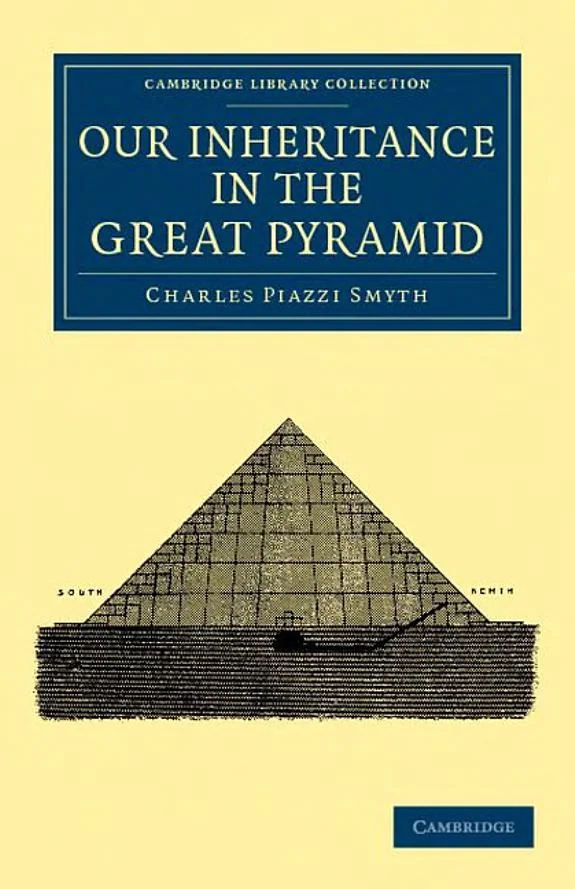
Our Inheritance in the Great Pyramid
 73
73

Our Inheritance in the Great Pyramid
Charles Piazzi Smyth's "Our Inheritance in the Great Pyramid" is a foundational text for pyramidologists, presenting a meticulously argued case for the Great Pyramid of Giza as a divinely engineered monument. Smyth, a respected astronomer, leverages his technical skills to present complex geometrical and metrological analyses, a significant strength. His insistence on empirical measurement, despite its eventual reinterpretation, grounds his speculative theories in a way that was compelling for his Victorian audience. A notable limitation, however, is the inherent bias; Smyth begins with the conclusion that the pyramid is divinely inspired and then proceeds to find evidence that supports this pre-existing belief, a common pitfall in esoteric research. The detailed exposition of the "pyramid inch" and its purported connection to sacred measurements, while central to his thesis, highlights this tendency to conflate measurement with mystical meaning. Despite its dated interpretations, the book remains a vital historical document for understanding the development of esoteric Egyptology and the intersection of science and mysticism in the 19th century. It offers a challenging, though not always convincing, perspective on ancient monumental architecture.
📝 Description
73
Charles Piazzi Smyth's 1864 book argues the Great Pyramid encodes divine measurement and theology.
First published in 1864, Charles Piazzi Smyth's "Our Inheritance in the Great Pyramid" details his measurements of the Giza monument. Smyth, Astronomer Royal for Scotland, proposed that the pyramid's dimensions and internal layout are not accidental. Instead, he argued they contain a divinely inspired system of measurement and theological truths. The book focuses on deciphering this supposed sacred geometry and metrology. Smyth's central thesis suggests the pyramid reveals a pre-Mosaic, divinely revealed scientific and religious system.
This work is less a historical account of the pyramid's construction and more an interpretation of its supposed hidden meaning. Smyth's extensive on-site measurements and calculations form the basis of his arguments. He posited that the pyramid's design surpassed ordinary human engineering capabilities of its time. His interpretations were made during a period of significant interest in Egyptology and biblical literalism, offering a unique perspective on ancient monumental architecture.
Published in 1864, "Our Inheritance in the Great Pyramid" sits within the Victorian era's fascination with esoteric interpretations of ancient sites and biblical prophecy. Smyth, a respected scientist, applied his empirical methods to a monument already subject to speculative theories. This approach, using precise measurements to uncover hidden divine messages, aligned with a broader occult interest in numerology, sacred geometry, and the idea that ancient structures held forgotten knowledge. His work contributed to the development of pyramidology, a field seeking symbolic and prophetic meaning within the Great Pyramid's dimensions.
💡 Why Read This Book?
• Gain an understanding of the "pyramid inch" and Charles Piazzi Smyth's specific metrological theories, which formed a cornerstone of early 19th-century pyramidology. • Explore Smyth's detailed measurements and calculations of the Great Pyramid of Giza, presented as evidence for divine design and a pre-Biblical system of weights and measures. • Discover how Smyth interpreted the pyramid's internal passages and chambers as symbolic prophecies, connecting ancient architecture to biblical chronology and eschatology.
⭐ Reader Reviews
Honest opinions from readers who have explored this book.
❓ Frequently Asked Questions
What is the "pyramid inch" as proposed by Charles Piazzi Smyth?
The "pyramid inch" is a unit of measurement proposed by Charles Piazzi Smyth in his 1864 work. He claimed it was the original unit used by the pyramid builders and derived it from his precise measurements of the Great Pyramid's dimensions.
What is the main argument of "Our Inheritance in the Great Pyramid"?
The central argument is that the Great Pyramid of Giza was built under divine guidance, encoding a perfect system of weights, measures, and theological truths, rather than by human effort alone.
When was Charles Piazzi Smyth's "Our Inheritance in the Great Pyramid" first published?
Charles Piazzi Smyth's "Our Inheritance in the Great Pyramid" was first published in 1864, a significant year for esoteric and proto-archaeological interpretations of ancient wonders.
How did Smyth justify his claims about the Great Pyramid?
Smyth justified his claims through extensive, detailed measurements of the pyramid's dimensions, passages, and chambers, which he then interpreted through a lens of biblical prophecy and a divinely revealed metrology.
What historical context influenced Smyth's work on the Great Pyramid?
Smyth's work was influenced by the Victorian era's fascination with Egyptology, biblical literalism, and the burgeoning field of speculative science, seeking to reconcile ancient mysteries with religious doctrine.
Does "Our Inheritance in the Great Pyramid" discuss the builders of the pyramid?
While it discusses the builders conceptually as divinely guided agents, the book focuses more on deciphering the pyramid's encoded message rather than the historical or anthropological details of its construction workforce.
🔮 Key Themes & Symbolism
Divine Engineering
Smyth posits that the Great Pyramid's precise dimensions and internal architecture are proof of divine intervention. He argues that the level of scientific and mathematical knowledge required to build such a structure, particularly its sophisticated metrology, was beyond the capabilities of ancient Egyptians and must have been divinely revealed. This concept challenges conventional historical accounts by presenting the pyramid as a sacred text inscribed in stone, a literal inheritance from a higher power.
Sacred Metrology
A central theme is the "pyramid inch" and the "sacred cubit," which Smyth believed were divinely ordained units of measurement. He meticulously details his calculations, attempting to prove that these units correlate with biblical measures and a pre-diluvian scientific system. This focus on metrology transforms the pyramid from a tomb or monument into a measuring instrument, a repository of lost, perfect knowledge intended for humanity's spiritual and scientific advancement.
Prophetic Chronology
Smyth interprets the pyramid's dimensions, particularly the lengths of passages and the height of chambers, as encoding specific chronological data. He links these measurements to biblical prophecies, especially those concerning historical events and future eschatology. This thematic element positions the pyramid as a prophetic calendar or a geodetic prophecy, revealing God's plan for humanity across vast stretches of time.
Lost Science
The book explores the idea of a "lost science" or "primitive revelation" that predates known human civilizations. Smyth suggests that the knowledge embedded in the Great Pyramid represents this ancient, perfect science, which was revealed by God and subsequently lost or corrupted over time. His work is an effort to recover this lost wisdom through the interpretation of monumental architecture.
💬 Memorable Quotes
“The Great Pyramid is a divine revelation in stone.”
— This core statement encapsulates Smyth’s thesis: the pyramid is not merely a human construction but a divinely authored text, a physical manifestation of sacred knowledge meant to be deciphered by humanity.
“Its builders were divinely guided, not merely skilled architects.”
— Smyth emphasizes the supernatural influence behind the pyramid's construction, suggesting the builders acted as instruments of a higher power, imbuing the structure with a significance far beyond its material form.
“The dimensions encode a perfect unit of measure, the pyramid inch.”
— This highlights Smyth's focus on metrology and his belief in a precise, divinely established standard of measurement embedded within the pyramid's structure.
“The internal passages are maps of time and prophecy.”
— This interpretation points to Smyth's view of the pyramid's interior as a symbolic representation of historical epochs and future events, linking its architecture to biblical eschatology.
“The structure reveals a pre-Mosaic, divinely revealed scientific system.”
— This paraphrase suggests Smyth's conviction that the knowledge contained within the pyramid predates even the biblical law given to Moses, pointing to an even older, primordial divine science.
🌙 Esoteric Significance
Tradition
Smyth’s work fits within the Hermetic and Pythagorean traditions, which emphasize the divine order of the cosmos and the power of number and geometry. It also aligns with early Theosophical leanings, predating Blavatsky’s major works, by suggesting ancient monuments hold keys to forgotten spiritual sciences and lost civilizations. However, Smyth’s approach is distinct in its heavy reliance on direct measurement and biblical chronology, grounding his esoteric interpretations in a more literalistic, scientific framework than many contemporaries.
Symbolism
The primary symbols Smyth interprets are the Great Pyramid itself, seen as a divine revelation in stone, and its internal passages, which he views as symbolic representations of historical epochs and prophetic timelines. The "pyramid inch" and "sacred cubit" function as symbolic units of divine order, representing a perfect, lost science. The very act of measurement becomes a symbolic key, unlocking hidden divine truths encoded within the monument's physical form.
Modern Relevance
Smyth's theories, while largely superseded by modern archaeology, continue to influence fringe archaeological and esoteric circles. Contemporary pyramidologists and alternative historians still reference his work, particularly his ideas about the "pyramid inch" and prophetic measurements. His approach has also indirectly informed discussions on sacred geometry and the potential for ancient sites to hold complex, non-obvious information, resonating with modern interests in archaeoastronomy and consciousness studies.
👥 Who Should Read This Book
• Researchers of Victorian-era esoteric thought and the history of pyramidology, seeking primary source material on early interpretations of the Great Pyramid. • Students of comparative religion and ancient cosmology interested in how biblical prophecy and geological timescales were integrated with monumental architecture in the 19th century. • Skeptics and critical thinkers interested in analyzing historical examples of pseudoscientific reasoning, particularly how scientific authority was applied to support pre-determined esoteric conclusions.
📜 Historical Context
Charles Piazzi Smyth's "Our Inheritance in the Great Pyramid," first published in 1864, emerged during a fervent period of Victorian Egyptomania and biblical literalism. As Astronomer Royal for Scotland, Smyth brought a scientific gravitas to his esoteric interpretations. His work contrasted sharply with the emerging, more secular archaeological approaches to ancient Egypt, such as those being developed by Flinders Petrie, who would later conduct more systematic excavations. Smyth’s meticulous, though biased, measurements of the Great Pyramid of Giza were intended to provide empirical proof for his theories of divine design and a pre-Mosaic metrological system. The book gained traction within circles interested in speculative science and religious apologetics, finding audiences among those seeking to reconcile scientific discovery with scriptural authority. It contributed to a growing body of literature on pyramidology, a field that flourished in the late 19th and early 20th centuries.
📔 Journal Prompts
The concept of "divine revelation in stone" as applied to the Great Pyramid.
Smyth's interpretation of the "pyramid inch" and its supposed connection to sacred measurement.
The relationship between the Great Pyramid's dimensions and biblical prophecy in Smyth's analysis.
An evaluation of Smyth's methodology in using precise measurements to support a theological argument.
The idea of a "lost science" encoded within ancient monuments.
🗂️ Glossary
Pyramid Inch
A unit of length proposed by Charles Piazzi Smyth, derived from his measurements of the Great Pyramid. He claimed it was the original unit of measurement used by the pyramid's builders and that it held significant symbolic and scientific meaning.
Sacred Cubit
An ancient unit of length, often associated with biblical or Egyptian measures. Smyth believed this cubit was divinely ordained and encoded within the Great Pyramid's dimensions, linking it to sacred texts and divine knowledge.
Metrology
The scientific study of measurement. Smyth applied principles of metrology to the Great Pyramid, arguing its dimensions revealed a sophisticated and divinely inspired system of weights and measures.
Geodetic Prophecy
The concept that geographical features or monumental structures, like the Great Pyramid, contain encoded prophecies or historical timelines within their measurements and alignments.
Primitive Revelation
The idea that fundamental scientific and spiritual knowledge was revealed by God in the earliest periods of human history, a knowledge that was later lost or corrupted, which Smyth believed the Great Pyramid preserved.
Eschatology
The study of final events or the end times. Smyth connected the pyramid's measurements to biblical eschatological prophecies, interpreting them as a divine timeline leading to the end of the world.
Pyramidology
The study or interpretation of the Great Pyramid of Giza, often focusing on esoteric, pseudoscientific, or religious theories regarding its construction, purpose, and supposed hidden meanings.