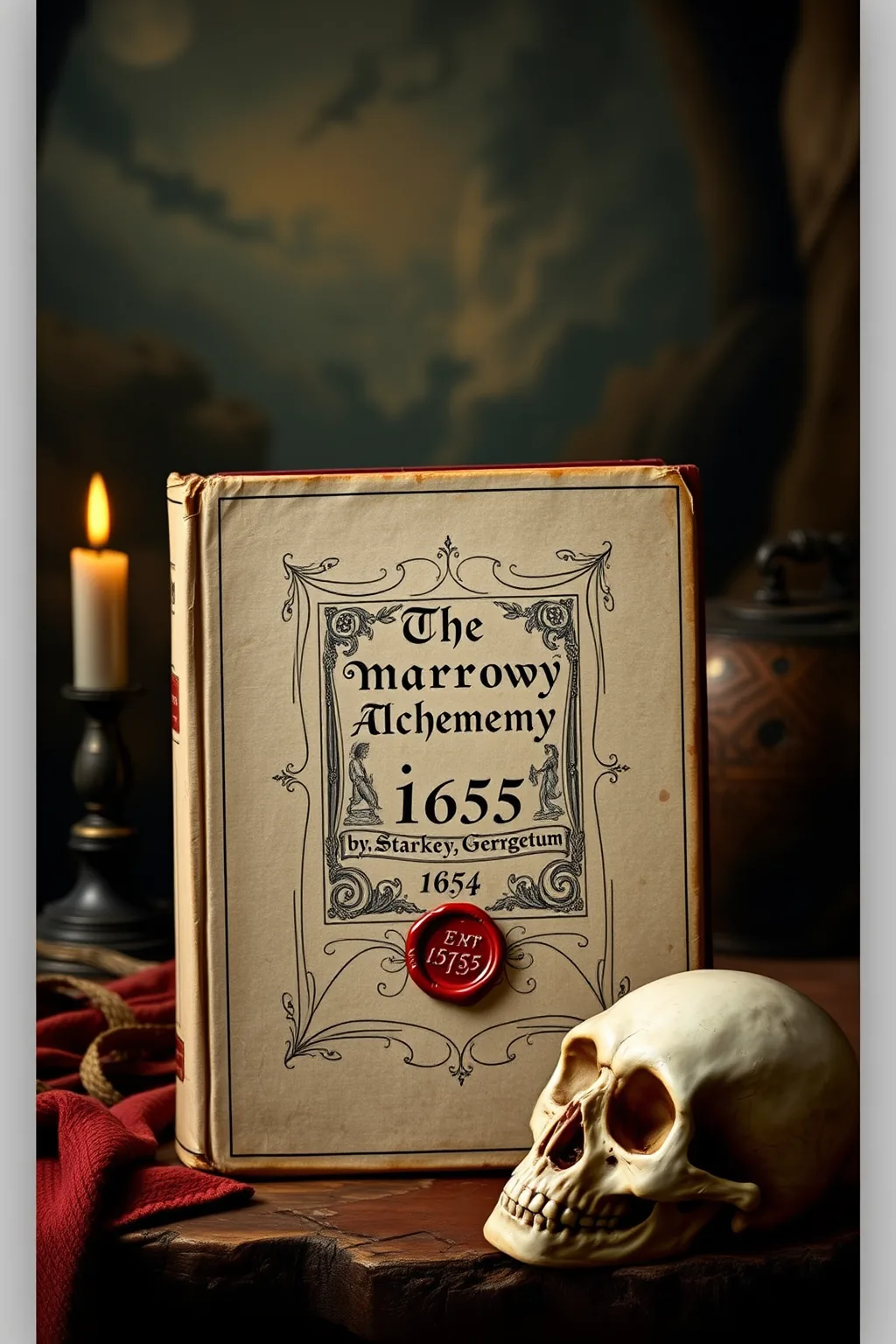
The marrow of alchemy, ... 1655
 72
72

The marrow of alchemy, ... 1655


Isolde Whitaker, Sacred Texts Editor: George Starkey's "The Marrow of Alchemy" (1655) stands as a pillar of early modern Hermetic literature. Starkey masterfully deciphers the layered symbolism of the alchemical art, moving beyond mere metallic transformation to illuminate its profound spiritual and philosophical implications. This digitized edition offers unparalleled access to a text rich in esoteric insight, revealing the interconnectedness of the microcosm and macrocosm. It is essential reading for scholars of alchemy, practitioners seeking deeper theoretical grounding, and any soul drawn to the pursuit of hidden knowledge. Its enduring relevance lies in its ability to connect ancient wisdom with timeless spiritual aspirations.
📝 Description
72
George Starkey's 1655 text, "The Marrow of Alchemy," decodes the spiritual dimensions of chemical processes.
This 1655 work by George Starkey presents alchemy not as mere metallic transformation, but as a symbolic system reflecting divine principles. Starkey uses veiled language to guide practitioners through the spiritual aspects of the Great Work. The book details the subtle pathways of alchemical transformation and connects them to the underlying spiritual realities of existence. It encourages a deeper understanding of the hidden forces shaping the world.
For the serious student, "The Marrow of Alchemy" offers a path toward an alchemical awakening, connecting the quest for the philosopher's stone to the development of the soul. The text invites readers to move beyond ordinary perception and engage with the fundamental nature of creation as understood through alchemical symbolism. It is a dense work that rewards careful study and contemplation.
Published in 1655, "The Marrow of Alchemy" belongs to the Western esoteric tradition that synthesized Neoplatonism, Hermeticism, and Christian mysticism with alchemical practice. This lineage viewed material operations as allegories for inner spiritual purification and union with the divine. Starkey's text fits within this stream, interpreting the physical stages of alchemy as metaphors for the soul's journey toward enlightenment and perfection, reflecting a worldview where the cosmos is imbued with spiritual significance.
💡 Why Read This Book?
Unlock the profound spiritual and philosophical secrets embedded within the art of alchemy. "The Marrow of Alchemy" offers a unique window into the Hermetic tradition, revealing hidden knowledge and symbolic pathways to transformation. Ideal for seekers of esoteric wisdom, scholars of ancient traditions, and practitioners looking to deepen their understanding of the Great Work beyond material pursuits.
⭐ Reader Reviews
Honest opinions from readers who have explored this book.
❓ Frequently Asked Questions
What is the primary focus of "The Marrow of Alchemy"?
While discussing alchemical processes, its primary focus is on the spiritual and philosophical underpinnings of the Great Work, emphasizing transformation of the soul rather than just material elements.
Is this book suitable for beginners in alchemy?
It requires dedication and an open mind due to its symbolic language and esoteric nature. Beginners may find it challenging but rewarding with careful study and supplementary resources.
Who was George Starkey?
George Starkey was an influential 17th-century English alchemist and physician, known for his cryptic writings that veiled profound spiritual and philosophical insights within alchemical symbolism.
What does "The Marrow of Alchemy" offer to modern readers?
It provides a timeless perspective on spiritual growth, the nature of reality, and the power of symbolic language, offering profound insights relevant to contemporary seekers of meaning and self-transformation.
How does this edition relate to previous and subsequent works by Starkey?
This 1655 edition follows an earlier version from 1654 and precedes Starkey's "Opus Tripartitum" from 1678, offering a developmental view of his alchemical thought.
🔮 Key Themes & Symbolism
The Spiritual Transmutation of the Soul
This theme explores the core alchemical concept of 'transmutation' not just as a physical process of changing metals, but as a profound metaphor for the purification, refinement, and elevation of the human spirit. Starkey guides the reader to understand how the alchemical laboratory serves as a symbolic space for inner work, where the base elements of the self are transmuted into higher states of consciousness and spiritual perfection. It emphasizes the arduous yet attainable journey towards spiritual enlightenment and divine union.
Hermetic Symbolism and the Language of Nature
Central to "The Marrow of Alchemy" is the intricate range of Hermetic symbolism. Starkey employs a rich lexicon of allegorical figures, celestial influences, and elemental forces to communicate profound truths that lie beyond ordinary language. This theme explores how alchemists perceived the natural world as a living book, filled with divine messages and hidden correspondences. Understanding this symbolic language is presented as the key to unlocking the secrets of creation and the universe's underlying order, bridging the material and the spiritual realms.
The Great Work as a Path to Divine Union
This theme frames the entire alchemical endeavor as the 'Great Work' – the ultimate quest for spiritual perfection and reconciliation with the divine. Starkey portrays alchemy as a sacred science, a rigorous discipline designed to lead the practitioner back to their primordial, untainted essence and ultimately, to a state of conscious union with the universal spirit. It highlights the alchemical process as a microcosm of cosmic evolution and the individual's role in fulfilling the divine plan through dedicated inner and outer pursuit.
💬 Memorable Quotes
Direct passages from the work, attributed to the author.
“Nature is the book of God, written in the language of symbols.”
— This highlights the Hermetic belief that the natural world is imbued with divine meaning, accessible through the understanding of its symbolic language and hidden correspondences.
“To know the Marrow is to know the secret of the Seed.”
— This suggests that grasping the fundamental essence or core principle of alchemy (the Marrow) is akin to understanding the generative potential and underlying truth of all creation (the Seed).
“The Philosopher's Stone is not found, but made within.”
— This poignant statement underscores that the ultimate alchemical achievement is an internal transformation, a spiritual realization cultivated through personal effort and divine grace.
“Seek the unity in the multiplicity, and the light in the darkness.”
— This encourages the seeker to find the underlying oneness of all things and to discover wisdom and spiritual illumination even in challenging or obscure circumstances.
💡 Key Ideas
Editorial paraphrase of the work's core concepts — not direct quotes.
The true gold is not that which glitters, but that which glows within.
This quote distinguishes material wealth from inner spiritual richness, emphasizing that true alchemical success lies in the soul's purification and enlightenment, not in physical riches.
🌙 Esoteric Significance
Tradition
This work is deeply rooted in the Hermetic tradition, a philosophical and religious system originating from the teachings attributed to Hermes Trismegistus. It encompasses Neoplatonic, Gnostic, and Kabbalistic elements, all aimed at understanding the divine architecture of the universe and the path to spiritual reintegration. The emphasis on correspondence between the microcosm (humanity) and the macrocosm (universe) is a hallmark of Hermetic thought, as is the belief in a unified, underlying divine principle.
Symbolism
The text is replete with rich alchemical symbolism, where common elements like metals, minerals, and celestial bodies represent deeper spiritual states and processes. Fire symbolizes purification and divine inspiration, water represents the subconscious and emotional realms, and earth signifies the material plane. Animals, mythological figures, and arcane processes like calcination, distillation, and coagulation all serve as allegorical representations of the soul's journey through trials and purification towards perfection.
Modern Relevance
In an age often characterized by materialism and spiritual fragmentation, "The Marrow of Alchemy" offers a compelling counter-narrative. Its emphasis on inner transformation, the interconnectedness of all things, and the pursuit of wisdom beyond superficial understanding resonates deeply with contemporary seekers. The alchemical metaphors for personal growth, overcoming challenges, and achieving spiritual wholeness provide a timeless framework for working through the complexities of modern life and fostering a more profound connection to the self and the universe.
👥 Who Should Read This Book
This profound alchemical text is a treasure for a diverse readership. For the **aspiring alchemist** and **practitioner**, it offers foundational insights into the spiritual dimensions of the Great Work, moving beyond mere laboratory techniques to the heart of transformation. **Scholars of esoteric traditions** and **religious studies** will find invaluable primary source material useful 17th-century Hermetic thought and its symbolic language. **Seekers of wisdom** and **spiritual explorers** will discover a wide range of philosophical inquiry and guidance on the path of self-discovery and inner perfection. Even those new to these concepts, but possessing a curious mind and a yearning for deeper understanding, will find this work a challenging yet immensely rewarding journey into the heart of ancient mysteries.
📜 Historical Context
Published in 1655, "The Marrow of Alchemy" emerges from the fertile ground of the early modern period, an era marked by intense intellectual and spiritual ferment. This was a time when the boundaries between science, philosophy, and mysticism were fluid, and the study of alchemy represented a significant branch of natural philosophy. The English Civil War had recently concluded, creating a climate of both upheaval and a renewed search for order and deeper meaning. Alchemists like George Starkey were heirs to a long tradition stretching back to Hellenistic Egypt and the Islamic Golden Age, yet they were also innovating, seeking to reconcile ancient wisdom with burgeoning empirical observation. Their work was often cloaked in allegory and symbolic language, partly to protect their knowledge from the uninitiated and partly because they believed that spiritual truths could only be conveyed through such veiled means. Starkey's text reflects this intricate blend of the scientific, the philosophical, and the deeply spiritual, resonating with a generation grappling with profound questions about the cosmos and humanity's place within it.
📔 Journal Prompts
Reflect on the alchemical concept of 'transmutation' as it applies to your own personal development. What aspects of yourself do you wish to purify or elevate?
Consider the symbolic language used in the text. How can you apply this principle of seeking hidden meaning in the 'books' of nature and your own experiences?
If the Philosopher's Stone represents ultimate spiritual realization, what steps are you currently taking to 'make' it within yourself?
Explore the concept of 'unity in multiplicity.' Where do you see interconnectedness in your own life or the world around you?
How does the idea of the 'Marrow' (essential truth) influence your understanding of your own core beliefs and motivations?
🗂️ Glossary
Hermeticism
A philosophical and spiritual tradition attributed to Hermes Trismegistus, emphasizing divine wisdom, the interconnectedness of the cosmos, and the pursuit of spiritual knowledge and transformation through symbolic understanding.
Great Work (Major work)
In alchemy, the ultimate process of spiritual and material transformation, often symbolized by the creation of the Philosopher's Stone, leading to enlightenment and perfection.
Philosopher's Stone
The legendary alchemical substance believed to be capable of transmuting base metals into gold and, more importantly, to grant immortality or spiritual perfection to its possessor.
Microcosm
The belief that the human being (the small world) is a reflection or miniature version of the universe (the great world), containing within themselves the same fundamental principles and forces.
Macrocosm
The entire universe or cosmos, viewed as a unified and ordered whole, often seen as containing divine principles that are mirrored in the microcosm of the human being.
This book appears in 3 collections
🔮 Readers Also Liked
Browse all →








More by Starkey, George.
All books →

From the “Hermeticism” Collection
View all →









More Free Alchemy & Hermeticism Books
View all →