H. Krishna Sastri
S. Srikanta Sastri was a prolific Indian historian and polyglot, known for his extensive research on Indian culture, history, and ancient civilizations.
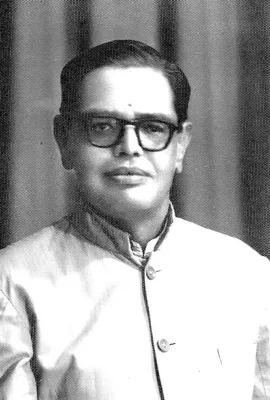
Sondekoppa Srikanta Sastri (1904-1974) was a distinguished Indian historian, Indologist, and polyglot who authored approximately 12 books and over 200 articles in multiple languages including English, Kannada, Telugu, and Sanskrit. His academic career spanned four decades, during which he significantly contributed to the understanding of Indian history and culture. He held a prominent position as the Head of the Department of History & Indology at Maharaja College, University of Mysore, from 1940 to 1960. Sastri's scholarly pursuits covered diverse topics, from ancient Indian town planning and religious traditions to the geopolitical landscape of Asia and the architectural heritage of the Hoysala period.
His work garnered significant recognition, including the Kannada Literary Academy award in 1970 and honors from the Governor of Karnataka. A Festschrift titled "Srikanthika" was presented to him in 1973, featuring contributions from esteemed scholars. Sastri's research on the Indus Valley Civilization, town planning at Harappa and Mohenjodaro, and his critical examination of historical theories like the Aryan Invasion theory and the date of Adi Sankaracharya, remain subjects of academic interest. His academic journey began early, with his first article published in the "Journal of the Royal Asiatic Society of Great Britain & Ireland" at the age of twenty-two.
Scholarly Contributions and Research Areas
S. Srikanta Sastri made substantial contributions to the fields of history and Indology, authoring around twelve books and over two hundred articles. His research interests were broad, encompassing the history of Karnataka, Indian culture and tradition, and ancient civilizations. He delved into the town planning of the Indus Valley Civilization at sites like Harappa and Mohenjodaro, attracting considerable scholarly attention. Sastri also engaged with significant historical debates, publishing articles on the Aryan Invasion theory, the dating of Adi Sankaracharya, and the Proto-Vedic religion of the Indus Valley. His work extended to studies on temple architecture, such as his book "Hoysala Vastushilpa," and geopolitical analyses, as seen in "Geopolitics of India & Greater India," where he envisioned a union of nations. His writings were published in English, Kannada, Telugu, and Sanskrit, reflecting his extensive linguistic abilities.
Academic Career and Influence
Srikanta Sastri dedicated a significant portion of his career to academia, serving as the Head of the Department of History & Indology at Maharaja College, University of Mysore, for two decades (1940-1960). He began his academic journey as a tutor in 1930 and rose to become a lecturer. His influence extended beyond his direct teaching, as he delivered numerous lectures on state radio and reviewed books for prominent newspapers. He also penned forewords and introductions for various publications. As a founding professor of the Indology department at the University of Mysore, he played a crucial role in developing course materials. His students included notable figures such as U. R. Ananthamurthy and R. K. Narayan, highlighting his impact on subsequent generations of scholars and intellectuals.
Linguistic Prowess and Scholarly Recognition
A remarkable polyglot, S. Srikanta Sastri was proficient in fourteen languages, including Greek, Latin, Pali, Prakrit, Sanskrit, and German. This linguistic mastery enabled him to engage with a vast array of historical and cultural texts. His scholarly achievements were widely recognized. He was awarded a D. Litt. degree by the University of Mysore in 1949, becoming the second person to receive this honor. In 1970, he received the Kannada Literary Academy award. The Governor of Karnataka honored him in 1973 for his lifetime contributions to historical research. The University of Mysore published a Festschrift titled "Srikanthika" in his honor, comprising articles by distinguished scholars in history and Indology. His portrait was later unveiled at The Mythic Society, Bangalore, and his birth centenary was marked by a national seminar and the publication of a "Centenary Commemoration Volume."