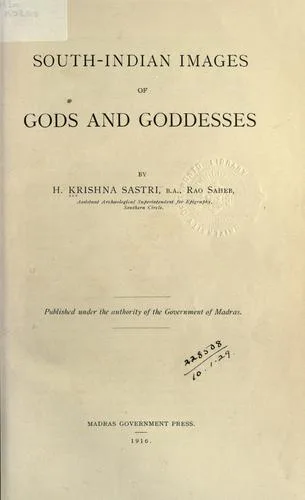
South-Indian images of gods and goddesses
 78
78

South-Indian images of gods and goddesses
Krishna Sastri's treatise on South Indian divine imagery is a dense, academic cornerstone. Its strength lies in the exhaustive cataloging and detailed descriptions of sculptures, often referencing obscure textual sources. The work excels at presenting the canonical forms, for instance, detailing the precise *mudras* and *ayudhas* (hand gestures and weapons) of deities like Vishnu and Shiva. However, the book's original publication context means its analysis sometimes lacks the critical theoretical frameworks common in contemporary art history, potentially leaving readers seeking deeper interpretative layers wanting. A passage detailing the specific iconography of *Nataraja* (Shiva as cosmic dancer), while accurate, could benefit from a more nuanced discussion of its philosophical implications beyond mere representation. Ultimately, it is an indispensable, if sometimes dry, reference for the visual theology of South India.
📝 Description
78
H. Krishna Sastri's 1986 book examines Hindu deity iconography in South India.
Published in 1986, South-Indian Images of Gods and Goddesses by H. Krishna Sastri is a scholarly work detailing the iconography and sculptural traditions of Hindu deities as represented in South India. The book meticulously describes the forms, attributes, and symbolic meanings of various gods and goddesses, referencing scriptural sources and artistic practices specific to the region. It serves as a significant resource for understanding the visual language of South Indian religious art.
This study is valuable for students of Indian art history, comparative religion, and iconography. Researchers and practitioners seeking to understand the visual representations of Hindu deities will find Sastri's analyses useful. The work also appeals to those interested in the philosophical and theological aspects of religious imagery, especially within the Dravidian cultural context. The early to mid-20th century saw a surge in academic study of South Indian art, with Sastri's research contributing to a critical framework for interpreting these visual traditions by focusing on the distinct South Indian developments.
This book fits within the tradition of understanding sacred imagery as a conduit for divine presence. It draws upon the principles of *Vastu Shastra* and *Shilpa Shastra*, ancient Indian sciences that govern the creation of religious art, dictating proportions, materials, and symbolic attributes. The concept of the *pratima* itself is treated not merely as an object but as a focal point for devotion and a medium through which the divine is manifest. This approach aligns with esoteric traditions that see physical forms and symbols as keys to spiritual understanding and connection.
💡 Why Read This Book?
• Gain precise knowledge of the iconographic rules governing South Indian deity sculptures, understanding the prescribed proportions and attributes for figures like *Dakshinamurti*. • Learn about the scriptural basis for image creation, exploring the significance of texts such as the *Vishnudharmottara Purana* in shaping artistic representations. • Discover the symbolic language embedded in divine forms, deciphering the meaning behind specific *mudras* and *vahana* (vehicles) associated with deities like Ganesha.
⭐ Reader Reviews
Honest opinions from readers who have explored this book.
❓ Frequently Asked Questions
What are the primary sources H. Krishna Sastri draws upon for South-Indian Images of Gods and Goddesses?
H. Krishna Sastri extensively references ancient Indian Sanskrit texts on iconography and art, such as the *Vishnudharmottara Purana*, and various *Agamas* and *Puranas* specific to South Indian traditions.
Does the book cover the materials used in South Indian sculptures?
Yes, while primarily focused on iconography, the work touches upon the common materials like stone and bronze, and the stylistic implications tied to these mediums in South Indian temple art.
What period of South Indian art does this book primarily focus on?
The book examines sculptures spanning various historical periods, but places significant emphasis on classical and medieval South Indian art, particularly from the Pallava, Chola, and Vijayanagara eras.
Is H. Krishna Sastri's work accessible to a general reader or primarily for specialists?
While foundational, the detailed scholarly nature and technical terminology make it more suitable for specialists and dedicated students of art history and religious studies rather than a casual reader.
How does this book differentiate South Indian iconography from North Indian traditions?
Sastri highlights regional variations, stylistic differences, and distinct iconographic prescriptions that evolved in South India, often influenced by local traditions and the patronage of dynasties like the Cholas.
When was the original research for 'South-Indian Images of Gods and Goddesses' conducted?
Although published in 1986, the research and scholarship underpinning H. Krishna Sastri's work likely stems from the mid-20th century, reflecting the academic focus of that era on Indian art.
🔮 Key Themes & Symbolism
Iconographic Accuracy
The book rigorously details the precise visual characteristics mandated for depicting Hindu deities in South India. It emphasizes how specific attributes, postures, and accompanying symbols are not arbitrary but are derived from scriptural injunctions and traditional artistic canons. This focus ensures that the images serve as accurate visual representations, facilitating devotion and conveying theological truths according to established doctrines. Sastri meticulously lists these requirements for various gods and goddesses, serving as a crucial guide for scholars and artists alike.
Devotional Aesthetics
Beyond mere technical descriptions, the work implicitly explores how the visual form of deities is intended to evoke specific spiritual responses. The arrangement of multiple arms, the choice of *vahana* (mount), and the subtle expressions are all designed to communicate the power, grace, and specific roles of each deity. Sastri's analysis helps readers appreciate the devotional intent embedded within the sculptural forms, transforming them from static objects into potent symbols of the divine accessible through aesthetic contemplation.
Regional Artistic Traditions
A significant aspect of the book is its focus on the distinct artistic and iconographic traditions prevalent in South India. It highlights how these traditions, while rooted in broader Hindu principles, developed unique stylistic features and interpretations under the influence of local rulers, philosophical schools, and cultural practices. Sastri’s work serves to delineate these regional characteristics, differentiating them from those found in other parts of the subcontinent.
Scriptural Authority in Art
The core of Sastri's argument rests on the idea that religious art is guided by authoritative scriptures. He consistently links the visual elements of the sculptures back to specific textual references from the *Agamas*, *Puranas*, and other canonical works. This establishes a hierarchy where scriptural knowledge informs artistic creation, ensuring that the images are not merely artistic expressions but divinely sanctioned representations.
💬 Memorable Quotes
Direct passages from the work, attributed to the author.
“The canonical texts prescribe the exact proportions and features for divine images.”
— This highlights the author's central argument that South Indian religious art is not improvisational but meticulously regulated by ancient scriptures, ensuring iconographic fidelity.
“The *pratima* serves as a conduit for the divine presence.”
— This interpretation underscores the theological function of religious imagery, suggesting that the sculpted form is more than an artistic object; it is a sacred vessel.
“Specific *mudras* and *ayudhas* convey distinct aspects of a deity's power.”
— This points to the symbolic language of iconography, where hand gestures and attributes are coded messages communicating specific attributes and functions of the gods and goddesses.
“South Indian sculptural styles often exhibit unique regional characteristics.”
— This acknowledges the diversity within Indian art, emphasizing that the region of South India developed its own distinct aesthetic and iconographic norms over centuries.
“Understanding the *Shilpa Shastras* is key to interpreting the images.”
— This emphasizes the importance of the underlying architectural and sculptural sciences, suggesting that a deeper appreciation of the art requires knowledge of the technical and philosophical texts guiding its creation.
🌙 Esoteric Significance
Tradition
This work aligns with the broader tradition of Indic esoteric thought, specifically within the devotional (Bhakti) and philosophical (Vedanta, Shaivism, Vaishnavism) schools that underpin Hindu practice. It meticulously details the visual manifestations of deities central to Tantric and Puranic Hinduism. While not a manual for esoteric practice itself, it provides the essential iconographic grammar required for understanding visualizations, meditations, and ritualistic deployments of these divine forms within yogic and tantric lineages.
Symbolism
The book deciphers the strong symbolism inherent in divine forms. For instance, the multi-armed depictions of deities like Vishnu or Durga are explained not as literal representations but as symbolic condensations of various powers and aspects – each hand and attribute (like the *chakra*, *shankha*, or *trishula*) representing specific cosmic functions or divine energies. The postures, such as the graceful *tribhanga* or the dynamic *Nataraja* pose, are also discussed in terms of their symbolic meaning, conveying balance, cosmic dance, or divine poise.
Modern Relevance
Contemporary practitioners of yoga, meditation, and various forms of Tantra often draw upon Sastri's detailed iconographic analyses. Scholars in comparative mythology and religious studies continue to cite his work for its foundational data. Furthermore, artists seeking to create authentic representations of Hindu deities frequently consult such texts. The book remains relevant for anyone exploring the visual language of the divine in South Asian traditions, bridging ancient scriptural mandates with tangible artistic expressions.
👥 Who Should Read This Book
• Students of Indian Art History: Researchers and academics seeking a comprehensive, textually-supported guide to the iconography of South Indian deities will find this an indispensable reference. • Comparative Religion Scholars: Individuals studying the visual manifestations of religious beliefs will benefit from the detailed analysis of how theological concepts are translated into sculptural form. • Devotees and Practitioners: Those engaged in Hindu devotional practices or contemplative traditions who wish to deepen their understanding of the deities they worship will gain insight into the symbolic meaning of divine imagery.
📜 Historical Context
Published in 1986, H. Krishna Sastri's *South-Indian Images of Gods and Goddesses* emerged during a period of burgeoning scholarship on Indian art history. The mid-20th century saw influential figures like Ananda Coomaraswamy and Stella Kramrisch laying foundational work in understanding Indian iconography and aesthetics. Sastri's research, however, carved a specific niche by focusing intently on the Dravidian south, a region with distinct artistic developments. This work implicitly engaged with the broader discourse on preserving cultural heritage, a significant concern in post-independence India. While not facing overt censorship, such detailed scholarly works often operated within academic circles, with reception primarily marked by citations in subsequent art historical studies rather than public controversy. Its meticulous referencing of textual sources provided a counterpoint to purely stylistic analyses, grounding iconographic study in scriptural authority.
📔 Journal Prompts
The precise proportions of the *Saligrama* as described in the texts.
The symbolic meaning conveyed by the *Nandi* bull as Shiva's mount.
How the depiction of *Lakshmi*'s *mudras* reflects her attributes.
The textual basis for the iconography of *Ganesha*'s multiple arms.
Regional variations in the representation of the *Trimurti* (Brahma, Vishnu, Shiva).
🗂️ Glossary
Pratima
A Sanskrit term referring to an image, idol, or icon, particularly one consecrated in a temple or used for worship in Hinduism.
Vahana
The Sanskrit word for a mount or vehicle, typically an animal, associated with a specific Hindu deity and symbolizing their power or nature.
Mudra
A symbolic hand gesture used in Hindu and Buddhist iconography and ritual, each gesture conveying specific meanings or blessings.
Ayudha
Refers to the weapons, tools, or emblems held by deities in their hands, each item carrying specific symbolic significance related to the deity's attributes or functions.
Agamas
A collection of ancient or medieval Tamil and Sanskrit religious works, forming a common canon of scripture for Tantra and the Agamic religions, particularly significant in temple rituals and iconography.
Shilpa Shastra
Ancient Indian treatises on the art of sculpting, architecture, and craftsmanship, providing detailed guidelines on proportions, materials, and iconography for creating religious images and structures.
Dravidian
Pertaining to the culture, languages, and people of southern India, often used in art history to denote stylistic and iconographic conventions specific to that region.
🔮 Readers Also Liked
Browse all →









More by H. Krishna Sastri
All books →
More Free Occult Philosophy Books
View all →