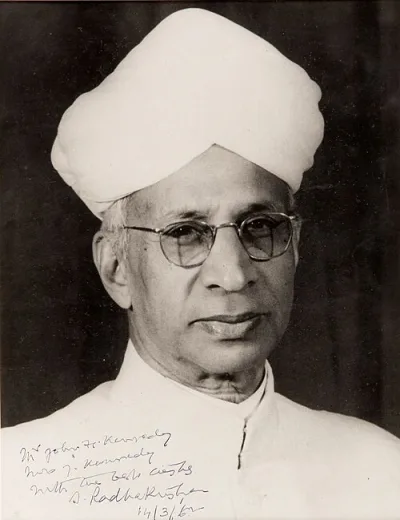
Sarvepalli Radhakrishnan
An Indian academic, philosopher, and statesman, Radhakrishnan was a distinguished scholar of comparative religion and a key figure in interpreting Advaita Vedanta.
Sarvepalli Radhakrishnan was a prominent Indian academic, philosopher, and statesman who significantly shaped the understanding of Hinduism both in India and the West. He served as India's Vice President and President, and also as its ambassador to the Soviet Union. Radhakrishnan held esteemed academic positions, including chairs at the University of Calcutta and the University of Oxford, focusing on comparative religion and philosophy. His philosophical work was rooted in Advaita Vedanta, which he reinterpreted for contemporary audiences. He actively defended Hinduism against what he perceived as uninformed Western critique, contributing to a modern Hindu identity and earning a reputation as a bridge between Eastern and Western thought. His academic career was marked by scholarships and impactful publications, including his early thesis on Vedanta ethics. He received numerous accolades, including India's highest civilian award, the Bharat Ratna.
Philosophical Foundations and Defense of Hinduism
Radhakrishnan's philosophical contributions were deeply anchored in Advaita Vedanta, a school of Hindu philosophy. He dedicated himself to reinterpreting this ancient tradition to make it relevant and comprehensible in the modern era. A significant aspect of his work involved defending Hinduism against what he described as uninformed criticisms from the West. This effort not only helped shape a contemporary understanding of Hindu identity but also established him as a crucial figure in bridging the gap between Indian and Western philosophical perspectives. His early academic work, including his bachelor's thesis on "The Ethics of the Vedanta and its Metaphysical Presuppositions," directly addressed the charge that Vedanta lacked an ethical dimension, asserting that ethics were fundamental to the system. He articulated the concept of "The Spirit of Abheda" (non-difference), emphasizing the view of all creation as interconnected and leading to ethics of love and brotherhood, where every individual is to be treated with equal respect and dignity.
Academic and Statesmanlike Career
Throughout his life, Radhakrishnan held influential academic posts, including the King George V Chair of Mental and Moral Science at the University of Calcutta and the Spalding Chair of Eastern Religion and Ethics at the University of Oxford. His academic journey began with scholarships, leading him to study philosophy, though he initially considered mathematics. He later served as Vice-Chancellor of Andhra University and Banaras Hindu University. Beyond academia, Radhakrishnan played a significant role in public life. He was India's ambassador to the Soviet Union and later served as Vice President (1952–1962) and President (1962–1967) of India. His belief that "teachers should be the best minds in the country" underscored his commitment to education and intellectual leadership.
Key Ideas
- Reinterpretation of Advaita Vedanta for contemporary understanding
- Defense of Hinduism against Western criticism
- Promoting a bridge-builder role between India and the West
- The concept of 'The Spirit of Abheda' (non-difference) leading to universal ethics
- Emphasis on respecting human dignity and the interconnectedness of all beings
Notable Quotes
“teachers should be the best minds in the country.”
“The Vedanta system had no room for ethics.”
“The Vedanta philosophy has not neglected the important sphere of ethics; but on the contrary, we find ethics in the beginning, ethics in the middle, and ethics in the end, to say nothing of the fact that minds, so engrossed with divine things as Vedanta philosophers, are not likely to fall victims to the ordinary temptations of the world, the flesh, and other powers.”
“In morals, the individual is enjoined to cultivate a Spirit of Abheda, or non-difference.”
“Every other individual is to be regarded as your co-equal, and treated as an end, not a means.”