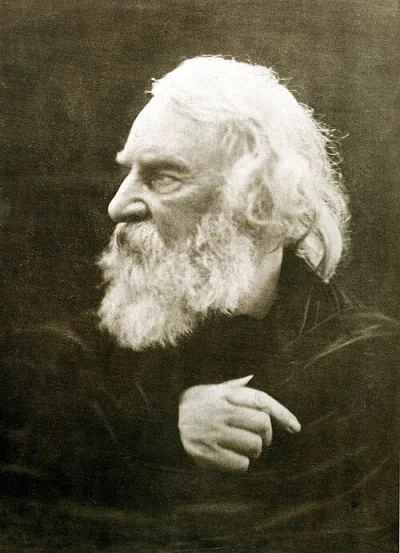
Henry Wadsworth Longfellow
Henry Wadsworth Longfellow was a prominent 19th-century American poet and educator known for narrative poems and translations.
Henry Wadsworth Longfellow (1807-1882) was a highly regarded American poet and professor during the 19th century. He achieved widespread popularity for his narrative poems, which often drew on mythology and legend, and for his lyrical style. Longfellow also held academic positions at Bowdoin College and Harvard University, dedicating significant time to studying languages and translating European works.
His life was marked by personal tragedy, including the deaths of both his wives. These losses profoundly impacted his writing, leading him to focus on translation for periods. Despite facing criticism for sentimentality and imitation of European styles, Longfellow became one of the most celebrated American poets of his era, with his work finding an audience both domestically and internationally. He was also the first American to fully translate Dante Alighieri's "Divine Comedy."
Early Life and Education
Born in Portland, Maine, in 1807, Henry Wadsworth Longfellow came from a family with a history in law and the Revolutionary War. He displayed an early aptitude for learning, attending private school from a young age and becoming fluent in Latin. Encouraged by his mother to read widely, he published his first poem at the age of 13. He entered Bowdoin College at 15, where he developed aspirations for a literary career, contributing numerous poems to periodicals. After graduating, he was offered a professorship at Bowdoin, which he accepted after undertaking study abroad.
European Studies and Academic Career
Longfellow's initial European tour, lasting three years, allowed him to immerse himself in languages such as French, Spanish, and Italian, greatly influencing his literary perspective. Upon returning to the United States, he accepted a professorship at Bowdoin College, where he also worked as a librarian and translated foreign texts. Later, he moved to Harvard College as a professor of Modern Languages, a position that also involved European study. His time at Harvard was marked by his residence in the historic Craigie House, George Washington's former headquarters.
Literary Output and Personal Life
Longfellow's major poetry collections, "Voices of the Night" (1839) and "Ballads and Other Poems" (1841), brought him significant acclaim, featuring popular works like "The Village Blacksmith" and "The Wreck of the Hesperus." His writing often explored themes of mythology and legend with a musical quality. However, his personal life was shadowed by the early deaths of his wives, Mary Potter in 1835 and Frances Appleton in 1861. These tragedies deeply affected him, leading to periods where he turned to translation, including his complete rendering of Dante's "Divine Comedy," as a focus for his creative energy.
Legacy and Criticism
Henry Wadsworth Longfellow achieved immense popularity during his lifetime, becoming the most widely read American poet of his day, with a considerable international following. His poetry was celebrated for its accessibility and narrative strength. Nevertheless, he also faced criticism, with some reviewers finding his work imitative of European literary traditions and overly sentimental. Despite these critiques, his contributions to American literature, including his role as an early translator of major European works, remain significant.
Key Ideas
- Narrative poetry drawing on mythology and legend
- Lyrical and musical quality in verse
- Importance of translation in bridging literary cultures
Notable Quotes
“I will not disguise it in the least...the fact is, I most eagerly aspire after future eminence in literature, my whole soul burns most ardently after it, and every earthly thought centres in it...I am almost confident in believing, that if I can ever rise in the world it must be by the exercise of my talents in the wide field of literature.”
“I hate the sight of pen, ink, and paper ... I do not believe that I was born for such a lot. I have aimed higher than this”
“One thought occupies me night and day...She is dead – She is dead! All day I am weary and sad”