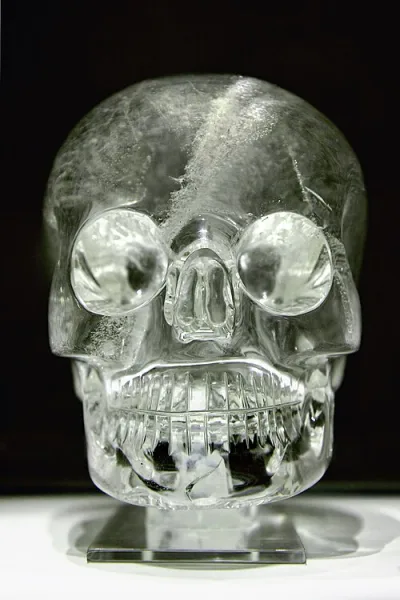
Drunvalo Melchizedek is associated with the New Age movement's interest in crystal skulls, which scientific studies indicate are 19th-century European creations.
Drunvalo Melchizedek is linked to the New Age movement's fascination with crystal skulls. These objects, often claimed to possess mystical or paranormal powers, are widely featured in popular literature and fiction. However, scientific investigations have consistently refuted claims of their ancient Mesoamerican origin. Studies conducted by institutions like the British Museum and the Smithsonian have demonstrated that the crystal skulls examined were manufactured in the mid-19th century or later, likely in Germany, specifically in Idar-Oberstein, a town known for its gemstone crafting. The legends surrounding their mystical properties do not align with genuine Native American mythologies. Despite these findings, crystal skulls remain a popular subject within esoteric circles and popular culture, often depicted as artifacts with extraordinary abilities.
Crystal Skulls and New Age Beliefs
Crystal skulls are carved from quartz and are often presented as ancient Mesoamerican artifacts with purported mystical or paranormal abilities. These claims are prevalent within the New Age movement and popular culture, appearing in numerous fictional works. Despite these assertions, extensive scientific research has debunked the notion of their ancient origins. Analyses by major museums and research institutions have concluded that the examined crystal skulls were produced in the 19th century, with strong evidence pointing to European workshops, particularly in Germany. The esoteric lore surrounding these objects, including their alleged psychic powers, is not supported by genuine Mesoamerican or other Native American spiritual traditions.
Scientific Scrutiny and Provenance
Numerous crystal skulls, often attributed to ancient Aztec or Maya civilizations, have undergone scientific examination. These studies, utilizing techniques such as electron microscopy and X-ray crystallography, have revealed manufacturing methods and materials inconsistent with pre-Columbian craftsmanship. For instance, tool marks indicate the use of modern rotary tools, and the type of quartz used, often containing inclusions found only in Madagascar and Brazil, was not available or known in ancient Mesoamerica. The historical trade in spurious antiquities in the late 19th century, particularly by dealers like Eugène Boban, is well-documented, with many prominent crystal skulls traced back to this period and likely European origins.
The Mitchell-Hedges Skull
The renowned Mitchell-Hedges skull, famously associated with F. A. Mitchell-Hedges and his adopted daughter Anna, has been subject to significant scrutiny. While claims suggest it was discovered in the 1920s during an excavation in British Honduras, evidence indicates it was purchased by F. A. Mitchell-Hedges at a Sotheby's auction in 1943. Scientific examinations have noted details like mechanical grinding on the teeth and drilled holes suggesting metal tools, contradicting claims of ancient, non-metallic carving methods. Despite some speculation about its age and properties, laboratory tests confirmed it was fashioned from a single quartz crystal, but further scientific investigation has been limited by the owners' refusal to submit it for more comprehensive testing.
Key Ideas
- Crystal skulls are quartz carvings claimed by some to have mystical powers and ancient origins.
- Scientific evidence indicates crystal skulls are modern creations, likely from 19th-century Europe.
- Legends of crystal skulls' paranormal abilities are not found in authentic Mesoamerican or Native American mythologies.
- The New Age movement has widely adopted crystal skulls as objects of esoteric significance.
Books by
11 free public domain books · Read online or download