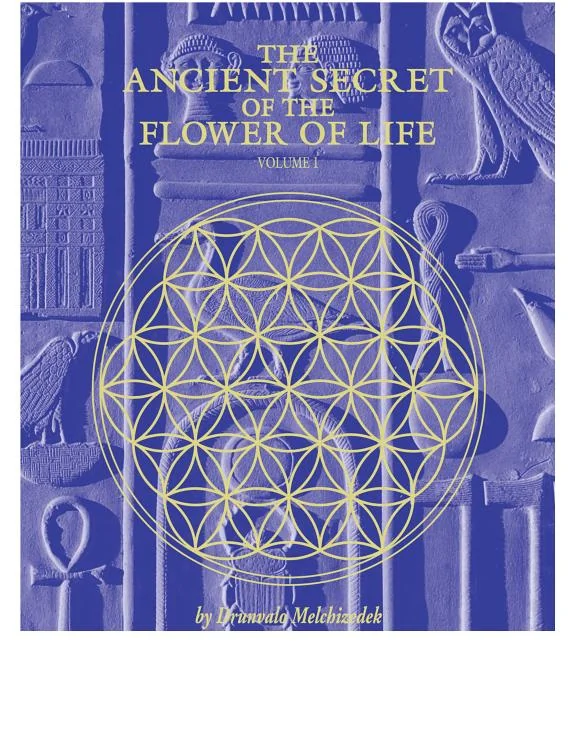
The Ancient Secret of the Flower of Life, Volume 1
 72
72

The Ancient Secret of the Flower of Life, Volume 1
Drunvalo Melchizedek's "The Ancient Secret of the Flower of Life, Volume 1" undertakes the ambitious task of demystifying a symbol found across disparate ancient cultures. The book excels in its visual presentation of the geometric progressions that form the titular pattern, making complex concepts accessible through detailed diagrams. Melchizedek’s assertion that the Flower of Life is the fundamental code of creation is compelling, particularly when he connects it to biological forms and celestial mechanics. However, the narrative occasionally strains under the weight of its own metaphysical claims, sometimes presenting speculative interpretations as definitive truths without sufficient empirical grounding. The historical connections drawn, while intriguing, could benefit from more rigorous academic cross-referencing beyond esoteric circles. The work’s strength lies in its ability to inspire wonder about universal patterns, though its limitations appear when seeking strict historical or scientific validation. It offers a unique perspective on cosmic origins for those open to metaphysical exploration.
📝 Description
72
Drunvalo Melchizedek's 2012 book posits the Flower of Life geometry as the blueprint of all creation.
The Ancient Secret of the Flower of Life, Volume 1, published in 2012, details Drunvalo Melchizedek's interpretation of a geometric pattern he believes forms the basis of all existence. This volume shares the initial portions of his "Flower of Life Workshop." Melchizedek suggests this sacred geometry was once commonly understood as the template for reality, linking individuals to a divine source. The book aims to reintroduce this knowledge through detailed explanations and accompanying visuals, addressing the connection between consciousness, geometry, and the universe's origins.
It is directed toward those interested in the interplay of consciousness and universal origins, students of sacred geometry, and readers exploring esoteric cosmologies. The work also appeals to individuals curious about the historical encoding of universal truths within ancient symbols and spiritual thought. The "Flower of Life" symbol itself appears across various ancient cultures, from Egyptian temples to European art, indicating a historical reverence for its form. Melchizedek places this symbol within a lineage of esoteric thought, connecting it to traditions like Theosophy and Hermeticism.
This work situates itself within the esoteric tradition by focusing on sacred geometry as a key to understanding creation and consciousness. Melchizedek connects the Flower of Life symbol to a lineage of thought that includes Theosophy and Hermeticism, traditions concerned with uncovering universal laws through symbolic systems. The book suggests a lost understanding of this geometry, aligning with esoteric narratives of forgotten wisdom. Its 2012 publication date also places it within a contemporary period of renewed interest in consciousness studies and ancient mysteries.
💡 Why Read This Book?
• Understand the geometric basis of creation as presented by Melchizedek, exploring how the Flower of Life pattern is depicted as the blueprint for all existence in Chapter 2. • Learn about the historical and cultural presence of the Flower of Life symbol, recognizing its recurrence in ancient sites and artifacts as discussed in the historical context sections. • Explore the potential for personal transformation through understanding sacred geometry, including concepts like the Merkaba, which is introduced as a vehicle for consciousness expansion.
⭐ Reader Reviews
Honest opinions from readers who have explored this book.
❓ Frequently Asked Questions
What is the Flower of Life symbol according to Drunvalo Melchizedek?
Drunvalo Melchizedek describes the Flower of Life as a sacred geometric pattern representing the fundamental blueprint of creation. He posits it's the source from which all life and consciousness emerge, appearing in various ancient cultures and encoded within the universe.
When was "The Ancient Secret of the Flower of Life, Volume 1" first published?
The first edition of "The Ancient Secret of the Flower of Life, Volume 1" by Drunvalo Melchizedek was published on April 28, 2012.
What is the Merkaba mentioned in the book?
The Merkaba, as presented in the book, is described as a sacred geometric energy field, a counter-rotating field of light formed around the body, which Melchizedek suggests can be activated through specific meditations to facilitate spiritual ascension and connection to higher dimensions.
Where can I find examples of the Flower of Life symbol in ancient history?
The book references the symbol's appearance in numerous ancient contexts, including Egyptian temples (like the Temple of Abydos), medieval European carvings, and various cultural artifacts, suggesting its widespread recognition across different civilizations.
Is this book suitable for beginners in esoteric studies?
Yes, Volume 1 is designed to introduce core concepts of the Flower of Life and sacred geometry, making it accessible for beginners interested in esoteric knowledge, consciousness, and ancient symbolism.
Does the book explain how to draw the Flower of Life?
The book provides detailed explanations and visual guides that illustrate the step-by-step construction of the Flower of Life pattern, enabling readers to understand and potentially replicate its geometric formation.
🔮 Key Themes & Symbolism
Sacred Geometry as Cosmic Blueprint
The central thesis is that the Flower of Life is not merely a symbol but the fundamental geometric matrix from which all reality originates. Melchizedek illustrates how this pattern, derived from simple circles, expands to encompass the structure of atoms, DNA, planets, and galaxies. The work argues that understanding this geometry is key to comprehending the interconnectedness of all things and the underlying order of the universe. The visual progression from a single circle to the complex Flower of Life is presented as a direct mapping of the creative process.
The Fall and Remembering
Melchizedek introduces a narrative of a cosmic 'fall' from a state of unified consciousness into duality and separation. This forgetting, he suggests, led humanity to lose awareness of its divine origins and the interconnected web of life represented by the Flower of Life. Volume 1 begins the process of 'remembering' by reintroducing the foundational geometry and the energetic principles associated with it, aiming to reawaken this latent knowledge within the reader.
Merkaba and Consciousness
The book connects the Flower of Life geometry to the Merkaba, a concept referring to a divine light vehicle utilized for interdimensional travel. Melchizedek describes the Merkaba as a specific geometric field of energy that can be activated through meditation and breathwork. This section explores how understanding and potentially activating one's Merkaba can lead to expanded consciousness, spiritual healing, and a reconnection with higher states of being.
Global Sacred Sites and Symbols
Melchizedek highlights the recurring presence of the Flower of Life and related geometric patterns in ancient sites and artifacts across the globe, from Egypt to indigenous cultures. This ubiquity is presented as evidence of a primordial, universal understanding of creation's pattern. The work encourages readers to see these symbols not as mere decoration but as remnants of a sophisticated ancient cosmology that held profound truths about existence.
💬 Memorable Quotes
Direct passages from the work, attributed to the author.
“The Flower of Life is the geometric language of creation.”
— This statement expresses the core idea that the geometric design, once universally understood, serves as the fundamental code or 'language' through which the universe and all its forms were brought into being.
“We fell out of the light and forgot.”
— This refers to a narrative of a collective descent from a higher, unified state of consciousness into a more limited, dualistic reality, resulting in the loss of awareness of our true origins and the interconnectedness of all things.
“The geometry holds the key to understanding consciousness.”
— This highlights the book's central premise that the patterns of sacred geometry are intrinsically linked to the nature of consciousness itself, offering a path to unlock deeper self-understanding and cosmic awareness.
“Ancient artifacts reveal the forgotten knowledge.”
— This points to the author's method of tracing the Flower of Life symbol and related geometries in historical sites and objects as evidence of a lost but recoverable wisdom tradition.
“Activating the Merkaba allows for higher perception.”
— This suggests that specific energetic and geometric practices, like those associated with the Merkaba, can enhance one's perceptual abilities, opening the door to experiencing higher dimensions or states of consciousness.
🌙 Esoteric Significance
Tradition
This work draws heavily from the Hermetic and Gnostic traditions, which emphasize hidden knowledge (gnosis) and the understanding of cosmic principles through symbolic representation. It also aligns with Theosophical ideas about ancient root races and lost wisdom. Melchizedek departs by focusing intensely on sacred geometry as the primary vehicle for understanding creation, presenting a systematic, visual cosmology that aims to be both intellectually comprehensible and experientially accessible.
Symbolism
The primary symbol is the "Flower of Life" itself, a geometric pattern composed of overlapping circles. In esoteric traditions, it represents the unity of creation, the interconnectedness of all life, and the fundamental energetic matrix from which existence springs. Another key symbol is the "Seed of Life," an early stage of the Flower, signifying potential and the genesis of form. The "Egg of Life" and "Fruit of Life" are also explored as stages in this geometric unfolding.
Modern Relevance
Melchizedek's work continues to influence contemporary spiritual seekers, alternative educators, and practitioners of consciousness-raising techniques. Schools and workshops dedicated to sacred geometry, conscious breathing, and Merkaba meditation often cite his teachings. Thinkers in fields like cymatics (the study of visible sound and vibration) and those exploring the intersection of consciousness and physics find resonance with his geometric models of reality.
👥 Who Should Read This Book
• Students of sacred geometry seeking to understand the foundational patterns of the universe, particularly how geometric forms relate to consciousness and creation. • Individuals exploring ancient wisdom traditions and esoteric cosmologies who are interested in symbols that appear across diverse cultures and historical periods. • Practitioners of meditation and consciousness work looking for methods to expand their awareness and reconnect with perceived universal energies, such as the Merkaba.
📜 Historical Context
Published in 2012, "The Ancient Secret of the Flower of Life, Volume 1" emerged during a period of renewed interest in consciousness studies, esoteric traditions, and ancient mysteries, often fueled by New Age movements. Drunvalo Melchizedek's work taps into a lineage of thought exploring sacred geometry, a field that has captivated thinkers from Plato to modern proponents like Walter Russell. While the Flower of Life symbol itself has roots stretching back millennia, appearing in places like the Temple of Abydos in Egypt and medieval European churches, Melchizedek's presentation integrates it with concepts of consciousness, meditation, and a specific cosmogony. This approach differentiates it from purely academic or historical analyses of geometric patterns. The book's publication coincided with popular interest in 2012 as a potential turning point, aligning with Mayan calendar prophecies and other eschatological ideas prevalent at the time, distinguishing its reception from purely academic discourse.
📔 Journal Prompts
The geometric unfolding of the Flower of Life pattern.
Your understanding of the 'fall' narrative and its implications.
The concept of the Merkaba as a vehicle for consciousness.
Personal resonance with symbols found in ancient artifacts.
The relationship between geometric form and energetic fields.
🗂️ Glossary
Flower of Life
A sacred geometric pattern composed of multiple evenly-spaced, overlapping circles, containing patterns of creation like the platonic solids. It's presented as the fundamental blueprint of existence.
Seed of Life
A symbol derived from the Flower of Life, consisting of seven overlapping circles arranged in a flower-like pattern. It represents the seven days of creation in some interpretations.
Merkaba
A divine light vehicle described as a counter-rotating field of energy around the human body, formed from specific geometric patterns. It's believed to facilitate spiritual ascension and interdimensional travel.
Sacred Geometry
The study of geometric shapes, patterns, and proportions that are found in nature and are considered to have symbolic or spiritual significance, believed to reveal the underlying order of the universe.
Metatron's Cube
A complex geometric figure derived from the Flower of Life, containing all five Platonic solids. It is said to represent the underlying structure of the universe and contain the essence of all creation.
Platonic Solids
The five convex regular polyhedra (tetrahedron, cube, octahedron, dodecahedron, icosahedron). They are considered fundamental building blocks of the universe in ancient philosophies and are derived from the Flower of Life geometry.
Creation Pattern
The fundamental geometric and energetic blueprint from which all reality is believed to manifest. In this work, the Flower of Life is identified as this primary pattern.