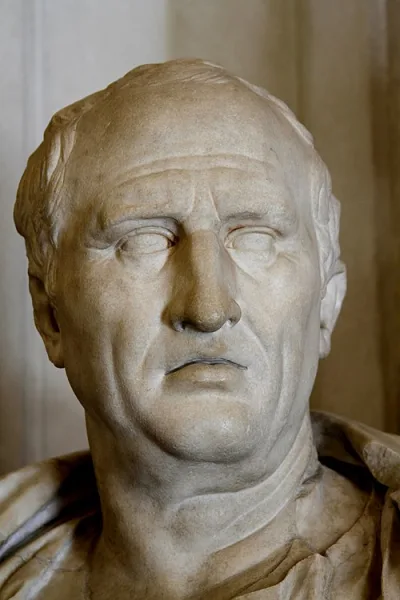
Cicero was a Roman statesman, orator, and writer who significantly shaped Latin philosophy and rhetoric.
Marcus Tullius Cicero, a prominent Roman statesman, lawyer, orator, and writer, lived from 106 to 43 BC. He played a crucial role in the turbulent final years of the Roman Republic, attempting to preserve its optimate principles. Cicero's extensive writings, covering rhetoric, philosophy, and politics, were foundational to Roman intellectual life. He is celebrated as one of Rome's greatest orators and stylists, credited with innovating "Ciceronian rhetoric" and enriching the Latin language with philosophical terminology through lexical innovation and translation of Greek concepts. His education spanned Rome and Greece, and he came from a wealthy equestrian family, eventually serving as consul in 63 BC.
Cicero's career was marked by significant political events, including his suppression of the Catilinarian conspiracy, which led to his temporary exile. He navigated the complex political landscape, supporting Pompey during Caesar's civil war and later opposing Mark Antony after Caesar's assassination. His outspoken stance against Antony ultimately led to his proscription and execution by the Second Triumvirate. Despite his political struggles, Cicero's intellectual legacy endured, influencing the Renaissance and Enlightenment thinkers, and his works remain vital for understanding Roman history and culture.
Philosophical and Rhetorical Innovations
Cicero's engagement with Hellenistic philosophy was profound, as he adapted the arguments of major Greek philosophical schools into Latin for a Roman audience. This endeavor involved not only translating complex ideas but also coining a substantial portion of the Latin philosophical vocabulary. Through lexical innovation and the creation of neologisms, he introduced terms such as 'evidentia,' 'humanitas,' and 'quantitas,' many of which were direct translations of Greek philosophical concepts. This effort made abstract philosophical thought more accessible to Latin speakers and laid crucial groundwork for later philosophical discourse in the Western tradition. His mastery of rhetoric, honed through extensive education in Rome and Greece and further refined by study with leading orators, led to the development of what became known as "Ciceronian rhetoric," a style and methodology that profoundly influenced subsequent oratory and writing.
Political Life and Legacy
Despite his acclaimed achievements in law and oratory, Cicero considered his political career his most significant contribution. His consulship in 63 BC saw him decisively quell the Catilinarian conspiracy. However, his controversial decision to execute several conspirators without trial resulted in his exile and subsequent return. Throughout the political turmoil of the 50s BC, he served as governor of Cilicia before returning to Italy on the brink of Caesar's civil war. He aligned himself with Pompey, earning a pardon from Caesar after the war. Following Caesar's assassination, Cicero emerged as a leading voice against Mark Antony, delivering influential speeches known as the Philippicae. He initially supported Octavian against Antony, but after their reconciliation into the Second Triumvirate, Cicero was proscribed and executed. His death marked a tragic end to a career dedicated to the Republic, yet his writings and ideas continued to shape intellectual and political thought for centuries, influencing figures from Petrarch to Enlightenment thinkers.
Key Ideas
- Ciceronian rhetoric: a style and methodology of oratory and prose.
- Latin philosophical vocabulary: coinage of numerous Latin terms for philosophical concepts.
















![Cicero in twenty eight volumes. Vol.20: De senectute, De amicitia, De divinatione [Loeb 154]](/img/thumb/cicero-in-twenty-eight-volumes-vol-20-de-senectute-de-amicitia-de-divinatione-loeb-154-cicero-marcus-tulius-106-43-bce.webp)