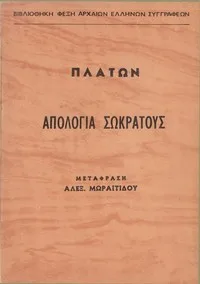
Ἀπολογία Σωκράτους
 71
71

Ἀπολογία Σωκράτους
Plato's *Apology* offers a stark, unvarnished account of Socrates' final stand. What strikes me immediately is Socrates' refusal to pander to the Athenian court; his defense is an intellectual assertion, not a plea for mercy. He frames his life's work – the persistent questioning of Athenian citizens – as a service to the gods and the polis, a perspective that is both admirable and, to a modern reader, perhaps a touch arrogant. The limitation lies in Plato's own philosophical agenda, which undoubtedly shapes the portrayal of Socrates. We are given Socrates as Plato understood him, not necessarily Socrates as he was. The passage where Socrates likens himself to a "gadfly" (μύωψ) stinging a noble but sluggish horse (the Athenian state) is particularly potent, illustrating his perceived role as a societal irritant necessary for awakening civic virtue. The verdict? A foundational text on philosophical integrity, albeit filtered through a distinct philosophical lens.
📝 Description
71
Plato's Apology records Socrates' defense at his 399 BCE Athenian trial.
Plato's *Apology* recounts Socrates' speech during his trial in Athens around 399 BCE. While not Socrates' own writing, it is Plato's philosophical dialogue that portrays his teacher's defense. The text shows Socrates committed to questioning Athenian assumptions about virtue and knowledge, embodying the Socratic method. This work is important for understanding the beginnings of Western philosophy and the idea of standing firm for one's beliefs.
Its historical context is crucial; the dialogue emerged in a turbulent Athens after the Peloponnesian War. Socrates faced charges of impiety and corrupting the youth, reflecting societal unease with intellectual questioning. His accusers, including Meletus, Anytus, and Lycon, represented a conservative response to philosophical inquiry. Socrates' trial and death became a significant moment, contrasting with the Sophist focus on rhetoric over genuine pursuit of truth.
While often read as a historical or philosophical text, the *Apology* touches on themes that resonate within esoteric traditions. Socrates' claim of a divine mission and his commitment to an examined life, even unto death, can be seen as a radical form of spiritual discipline. His pursuit of truth, unswayed by societal pressure or fear of punishment, aligns with mystical ideals of inner conviction and detachment from worldly concerns. The text presents a model of how one's inner life and philosophical integrity can be paramount, regardless of external circumstances.
💡 Why Read This Book?
• Learn about the Socratic method of elenchus, a rigorous questioning technique Plato attributes to Socrates, which forms the basis for critical thinking and philosophical debate. • Understand Socrates' concept of the 'examined life' and his insistence on virtue as the highest good, even when facing death in Athens in 399 BCE. • Gain insight into the political and social climate of ancient Athens, including the specific charges of impiety and corrupting the youth that led to Socrates' trial.
⭐ Reader Reviews
Honest opinions from readers who have explored this book.
❓ Frequently Asked Questions
What were the primary charges against Socrates during his trial?
Socrates was formally accused of impiety, specifically not recognizing the gods the state recognized and introducing new deities. He was also charged with corrupting the youth of Athens.
Who were Socrates' main accusers in the Apology?
The primary accusers named in Plato's *Apology* are Meletus, Anytus, and Lycon. Meletus is presented as the main instigator, representing the poets, while Anytus represents the craftsmen and politicians.
What is the Socratic method as depicted in the Apology?
The Socratic method, or elenchus, involves a series of questions designed to expose contradictions in a person's beliefs and lead them toward a more consistent understanding of concepts like justice and virtue.
When and where did Socrates deliver his defense speech?
Socrates delivered his defense speech, recorded as the *Apology*, during his trial in Athens around 399 BCE.
Does Plato's Apology represent an accurate historical account of Socrates' trial?
While Plato was present at Socrates' trial, the *Apology* is a philosophical dialogue. It presents Socrates' defense through Plato's own philosophical framework and literary style, rather than a verbatim transcript.
What does Socrates mean by the 'examined life'?
Socrates famously stated that 'the unexamined life is not worth living.' He meant that a life without critical self-reflection, questioning one's beliefs and actions, lacks true meaning and purpose.
🔮 Key Themes & Symbolism
The Examined Life
Central to Socrates' defense is the concept of the "examined life." He posits that existence devoid of self-reflection and critical inquiry into one's own beliefs and values is fundamentally lacking. This pursuit of wisdom, even if it leads to societal disapproval or personal peril, is presented as the highest human endeavor. The *Apology* frames Socrates' persistent questioning of Athenians not as an annoyance, but as a divine mandate to awaken them from intellectual complacency, urging them toward a more conscious and virtuous existence.
Ignorance and Wisdom
Socrates famously declared his own wisdom to lie in recognizing his ignorance. Unlike the Sophists who claimed to possess and teach knowledge, Socrates engaged in dialogue (elenchus) to expose the unfounded certainty of others and highlight the limits of human understanding. His defense emphasizes that true wisdom begins with acknowledging what one does not know. This intellectual humility is contrasted with the arrogance of those who believe they possess definitive answers, positioning Socrates' philosophical quest as a path to genuine insight.
Divine Mission and Public Service
Socrates presents his philosophical activities as a divinely ordained mission, a service to the gods and the city of Athens. He describes a calling, akin to that of the Olympian athletes or the heroes of myth, to stimulate the citizens toward greater moral and intellectual awareness. This framing justifies his often-unpopular role as a societal critic, likening himself to a "gadfly" (μύωψ) that provokes a sluggish but noble steed. His defense is thus not just personal but an assertion of the vital role of philosophical inquiry in a healthy polis.
💬 Memorable Quotes
Direct passages from the work, attributed to the author.
“The unexamined life is not worth living.”
— This is arguably the most famous assertion attributed to Socrates in the *Apology*. It expresses his core belief that human existence gains its value through critical self-reflection and the philosophical inquiry into one's own beliefs and actions.
“I would rather die having spoken in accordance with my nature, than live having been false.”
— This statement underscores Socrates' unwavering commitment to his principles and his philosophical integrity. He prioritizes truthfulness and living authentically, even when faced with the ultimate consequence of death.
“Men of Athens, I am grateful to you and thankful for your compliance with my request that you should listen to my defence; but I have not been able to get from you any compliance with my request, which was that you should hear the tale of the truth.”
— This sentiment, expressed in various forms, reflects Socrates' frustration that the court is more interested in rhetoric and acquittal than in the philosophical truth he endeavors to convey about his life and actions.
“I am like a gadfly sent by the god to a great and noble horse that is sluggish in its gait and needs to be aroused.”
— This metaphor, central to Socrates' defense, illustrates his self-perceived role. He sees himself as an irritant, divinely appointed to provoke the citizens of Athens (the horse) into a more active and virtuous state of being.
💡 Key Ideas
Editorial paraphrase of the work's core concepts — not direct quotes.
I am wiser than this man; for neither of us knows anything of worth, but he thinks he knows something when he does not know, while I, as I do not know, so I do not think I know.
This paraphrased concept highlights Socrates' famous epistemological stance. He distinguishes himself from those who are confidently ignorant by acknowledging his own lack of knowledge, which he sees as the first step toward true wisdom.
🌙 Esoteric Significance
Tradition
While not directly aligned with a specific esoteric school like Hermeticism or Gnosticism, Socrates' life and teachings, as presented in the *Apology*, form a bedrock for Western philosophical traditions that later influenced esoteric thought. His emphasis on inner purification, the pursuit of self-knowledge, and the conviction that the soul's well-being transcends material concerns echo themes found in mystical and Gnostic traditions. His martyrdom for truth also aligns with the archetype of the spiritual seeker who sacrifices worldly existence for higher principles.
Symbolism
The primary symbolic element is Socrates himself, representing the enlightened seeker or philosopher-martyr. The "gadfly" (μύωψ) serves as a symbol of the disruptive but necessary force of truth, rousing complacency. The "examined life" symbolizes the inner journey of self-awareness and ethical refinement, a core practice in many esoteric paths. The trial itself can be seen as an initiatory ordeal, testing the seeker's commitment to wisdom against the forces of ignorance and societal conformity.
Modern Relevance
Socrates' unwavering commitment to truth and ethical inquiry, as depicted in the *Apology*, continues to inspire contemporary thinkers and practitioners across various fields. His method of questioning forms the basis for critical thinking in education and psychology. In spiritual circles, his dedication to inner knowledge and virtue remains a potent example for those seeking personal transformation and ethical living, often cited by modern philosophers and spiritual teachers engaging with classical wisdom.
👥 Who Should Read This Book
• Students of Western philosophy and classical antiquity seeking foundational texts on ethics and epistemology. • Individuals interested in the historical context of ancient Athens and its legal and social structures. • Readers drawn to narratives of intellectual courage and personal integrity in the face of societal opposition.
📜 Historical Context
Plato's *Apology*, recounting Socrates' defense during his 399 BCE trial in Athens, is a product of a city still reckoning with the aftermath of the Peloponnesian War and internal political turmoil. Socrates, an Athenian citizen, found himself accused of impiety and corrupting the youth by figures like Meletus, representing a segment of society wary of intellectual innovation. His trial occurred during a period where philosophical discourse, exemplified by the Sophists who taught rhetoric, was gaining prominence, yet also attracting suspicion. Socrates' method of relentless questioning stood in stark contrast to the persuasive arts of the Sophists, positioning him as a unique figure whose pursuit of truth, as interpreted by Plato, ultimately led to his condemnation. The work serves as a crucial document for understanding Athenian jurisprudence and the societal anxieties surrounding philosophical inquiry in the late 5th century BCE.
📔 Journal Prompts
Socrates' claim of divine mission: What personal "missions" guide your own life's inquiries?
The concept of the "examined life": How do you critically assess your daily beliefs and actions?
Socrates' definition of wisdom as acknowledging ignorance: In what areas do you find your own certainty most challenged?
The "gadfly" metaphor: What societal issues do you feel compelled to question or provoke discussion about?
The choice between life and truth: Reflect on a time you prioritized integrity over personal comfort or safety.
🗂️ Glossary
Apology
In ancient Greek context, an 'apologia' is a defense speech, not an admission of guilt. Plato's work is Socrates' formal defense against the charges brought against him during his trial.
Elenchus
The Socratic method of refutation or cross-examination. It involves questioning an interlocutor's beliefs to reveal contradictions and lead them towards a clearer understanding of a concept.
Impiety (asebeia)
The charge of lacking reverence for or failing to honor the gods recognized by the state. This was a serious accusation in ancient Athens.
Sophists
Traveling teachers in ancient Greece who offered instruction in rhetoric and other skills, often for a fee. Socrates frequently debated with and critiqued their methods and philosophy.
Virtue (arete)
A broad Greek term encompassing excellence, moral goodness, and strength of character. For Socrates, virtue was the highest good and intrinsically linked to knowledge.
Soul (psyche)
In Socratic philosophy, the soul is the seat of consciousness, intellect, and moral character. Its care and purification are paramount, more important than the body's well-being.
Gadfly (myops)
A large biting fly. Socrates uses this metaphor to describe himself as an irritant sent by the gods to stir the "sluggish" Athenian state into virtuous action.
🔮 Readers Also Liked
Browse all →









More by Πλάτων
All books →





More Free Occult Philosophy Books
View all →