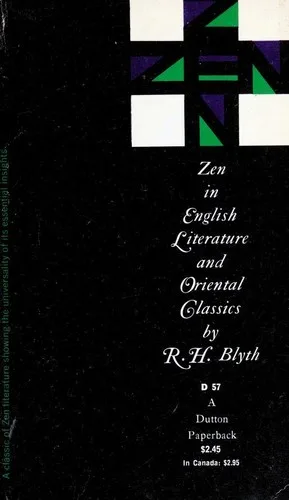
Zen in English literature and oriental classics
 83
83

Zen in English literature and oriental classics
Reginald Horace Blyth’s 1960 study, "Zen in English literature and oriental classics," offers a fascinating, if at times ambitious, exploration of Zen principles within Western literary works. Blyth’s strength lies in his deep immersion in both Japanese culture and the English literary canon, allowing him to draw compelling parallels. His analysis of how the concept of 'emptiness' (sunyata) manifests in the sparse, suggestive imagery of certain English poets is particularly illuminating. However, the book occasionally strains to fit Western expressions into a strictly Zen framework, sometimes overlooking the distinct cultural contexts. A memorable passage involves his comparison of haiku's evocative brevity to certain imagist poems, highlighting a shared aesthetic of captured moments. While the scope is broad, the depth of analysis for each example can vary. It remains a valuable, if occasionally overextended, comparative study.
📝 Description
83
Reginald Horace Blyth first published 'Zen in English literature and oriental classics' in 1960.
This comparative study examines Zen Buddhist philosophy and aesthetics within Western literature. Reginald Horace Blyth, who lived in Japan for many years, draws parallels between Zen's stark simplicity, intuitive leaps, and focus on direct experience, and similar expressions in English poetry, prose, and art. The book is not a mere anthology but a detailed examination of shared spiritual and artistic sensibilities across different cultures.
It is for students of comparative literature, religious studies, and philosophy interested in the intersection of Eastern and Western thought. Readers who want to understand how Zen principles appear outside their original Buddhist context will find it useful. The volume appeals to scholars and enthusiasts of Western literature and Eastern spirituality who appreciate careful analysis and cultural understanding. It speaks to those who consider the universal aspects of human consciousness as shown in art and writing.
Published in 1960, Blyth's work arrived during a growing Western interest in Eastern philosophies, influenced by figures like D.T. Suzuki and post-war cultural exchange. It served as a scholarly bridge between Zen Buddhism and the Western literary canon. The book offered literary evidence for the cross-cultural resonance of Zen principles at a time when Western thinkers like T.S. Eliot and Aldous Huxley were engaging with tradition and Eastern mysticism.
💡 Why Read This Book?
• Understand the manifestation of Zen's 'mushin' (no-mind) in Western artistic spontaneity, learning how unselfconscious creation appears in English verse and prose, a concept explored extensively through Blyth's comparative method. • Grasp the aesthetic of 'wabi-sabi'—the appreciation of imperfection and transience—as it is identified by Blyth within descriptions of nature and the passing of seasons in English poetry, offering a cross-cultural lens on imperfection. • Discover how the Zen concept of 'emptiness' (sunyata) is mirrored in the suggestive, minimalist language of English literature, enabling a deeper appreciation for works that imply rather than state, as demonstrated by Blyth's analysis of poetic imagery.
⭐ Reader Reviews
Honest opinions from readers who have explored this book.
❓ Frequently Asked Questions
When was Reginald Horace Blyth's "Zen in English literature and oriental classics" first published?
Reginald Horace Blyth's seminal work, "Zen in English literature and oriental classics," was first published in 1960. This places it within a period of increasing Western scholarly and popular interest in Eastern philosophies and aesthetics.
What is the primary focus of "Zen in English literature and oriental classics"?
The book's primary focus is a comparative study examining the presence and influence of Zen Buddhist philosophy, aesthetics, and sensibility within various works of English literature and Oriental classics, demonstrating cross-cultural parallels.
What specific Zen concept does Blyth explore in relation to English literature?
Blyth explores several Zen concepts, including 'sunyata' (emptiness), 'mushin' (no-mind), the 'haiku moment' of sudden insight, and 'wabi-sabi' (appreciation of imperfection and transience), finding echoes of these in Western literary expressions.
Who was Reginald Horace Blyth?
Reginald Horace Blyth was a British scholar and writer who spent many years in Japan. He was a prolific author on Zen Buddhism, haiku, and their influence on Western culture and literature.
Does the book analyze specific authors or works?
Yes, the book analyzes a wide range of English authors and works, drawing comparisons with Oriental classics and Zen principles. While specific authors are discussed, the focus remains on identifying thematic and aesthetic resonances rather than exhaustive authorial analysis.
What is the significance of the 1960 publication date for this book?
The 1960 publication date is significant as it aligns with a post-war era of heightened global cultural exchange and a growing Western appetite for understanding Eastern spiritual and philosophical traditions like Zen Buddhism.
🔮 Key Themes & Symbolism
Emptiness and Suggestion
Blyth meticulously traces the Zen concept of 'sunyata' (emptiness) within English literature, arguing that seemingly sparse or minimalist passages in poetry and prose can evoke a similar sense of vastness and potential as Zen meditation. He points to how certain Western writers, through carefully chosen imagery or deliberate omissions, achieve a resonance that suggests more than is explicitly stated, mirroring Zen's emphasis on the unmanifest. This theme challenges readers to perceive depth in restraint and significance in what is left unsaid.
The 'Haiku Moment' in Verse
A central theme is the identification of the 'haiku moment' – a flash of sudden insight, a sharp sensory perception, or an aesthetic apprehension of reality – within Western poetic traditions. Blyth examines how English poets capture fleeting moments of natural beauty or profound personal realization with a conciseness and immediacy akin to haiku. This involves analyzing the structure and impact of specific poems to demonstrate how a brief, evocative image can encapsulate a larger truth or feeling, bridging cultural gaps through shared human experience of perception.
Wabi-Sabi Aesthetics
The book examines the Japanese aesthetic of 'wabi-sabi,' which values imperfection, impermanence, and simplicity. Blyth seeks out instances in English literature where this appreciation for the rustic, the aged, the weathered, and the transient is present. This involves looking at descriptions of nature, the acceptance of aging, or the beauty found in humble objects. By highlighting these elements, Blyth suggests a universal appeal in finding profundity within the ordinary, the flawed, and the ephemeral aspects of existence.
Mushin and Spontaneity
Blyth investigates the Zen principle of 'mushin' or 'no-mind,' a state of unhindered, spontaneous action and perception. He explores how this ideal of effortless expression, free from egoic interference or overthinking, appears in the creative processes and outputs of Western artists and writers. The theme examines how certain literary works or stylistic choices exhibit a natural flow and authenticity that Blyth links to the Zen ideal of acting from a place of pure presence and intuitive understanding.
💬 Memorable Quotes
Direct passages from the work, attributed to the author.
“Zen is not a religion, but an aesthetic and a state of mind.”
— This interpretation suggests that the book views Zen not merely as a doctrinal system but as a mode of perception and artistic sensibility that can permeate various cultural expressions, including literature, independent of formal religious adherence.
“The Western poet often states the emotion, while the Zen poet implies it.”
— This highlights a key comparative strategy in Blyth's work, emphasizing the difference between direct emotional exposition in Western verse and the subtle, suggestive evocation of feeling characteristic of Zen-influenced aesthetics, particularly in haiku.
“A single dewdrop can contain the universe.”
— This aphorism, representative of Zen's microcosm-macrocosm principle, illustrates how Blyth finds parallels in literature where a small, specific detail or image is used to represent a larger truth, a concept, or a profound experience.
“The beauty of the imperfect and the transient.”
— This expresses the essence of 'wabi-sabi,' a core aesthetic concept Blyth explores, suggesting that true beauty is often found not in perfection or permanence, but in the natural processes of decay, change, and inherent flaws.
💡 Key Ideas
Editorial paraphrase of the work's core concepts — not direct quotes.
Emptiness is not absence, but potential.
This paraphrase of 'sunyata' reflects Blyth's understanding that in Zen and its literary manifestations, emptiness refers to a fertile void or a state of pure possibility, rather than mere nothingness, allowing for profound meaning to arise.
🌙 Esoteric Significance
Tradition
While not strictly adhering to a single Western esoteric lineage like Hermeticism or Kabbalah, Blyth's work intersects with the broader stream of esoteric interest in consciousness and direct experience prevalent in the mid-20th century. It aligns with the Theosophical and Anthroposophical movements' interest in universal wisdom and the interconnectedness of traditions. Blyth's approach can be seen as a literary manifestation of the perennial philosophy, seeking underlying truths shared across diverse spiritual and philosophical systems, particularly focusing on the non-dualistic and intuitive aspects of Zen.
Symbolism
The book implicitly engages with symbolism through its exploration of core Zen concepts. 'Emptiness' (sunyata) functions symbolically as a representation of boundless potential and the unmanifest source of all phenomena. The 'dewdrop' is a recurring motif symbolizing the ephemeral nature of existence and the universe contained within the smallest particular. The concept of 'no-mind' (mushin) can be seen as symbolizing a state of pure, unadulterated being, free from conceptual overlay, a state often sought in various contemplative practices.
Modern Relevance
Blyth's comparative approach remains relevant for contemporary thinkers exploring mindfulness, consciousness studies, and transpersonal psychology. Modern writers and artists investigating the intersection of Eastern aesthetics and Western forms often draw upon the groundwork laid by Blyth. His work continues to inform discussions in comparative literature, religious studies, and art criticism, demonstrating enduring pathways for understanding Zen principles through literary analysis and inspiring new explorations of cross-cultural spiritual expression.
👥 Who Should Read This Book
• Students of comparative literature seeking to understand cross-cultural influences between Eastern and Western artistic traditions, particularly concerning Zen Buddhism. • Scholars of religious studies interested in the practical and aesthetic manifestations of Buddhist philosophy beyond formal doctrine, exploring how Zen concepts appear in secular contexts. • Readers of poetry and prose who wish to deepen their appreciation for minimalist expression, intuitive insight, and the aesthetic appreciation of imperfection and transience in literature.
📜 Historical Context
Published in 1960, "Zen in English literature and oriental classics" emerged during a period of significant post-war global engagement with Eastern philosophies. The influence of D.T. Suzuki’s lectures and writings on Zen in the West, particularly in the 1950s, created fertile ground for Blyth’s work. This era also saw a burgeoning interest in comparative religion and cross-cultural studies, moving beyond earlier, often Orientalist, perspectives. Blyth’s scholarly approach, deeply rooted in his decades living in Japan, offered a nuanced bridge between Zen Buddhist thought and the Western literary canon. While figures like Alan Watts were popularizing Eastern thought, Blyth provided a more textually grounded, academic analysis. His work contributed to a broader intellectual climate where scholars and artists were exploring new forms of consciousness and aesthetic expression, challenging the perceived boundaries between Eastern and Western traditions.
📔 Journal Prompts
The 'haiku moment' in your own experience: identify a brief, sharp perception that felt significant.
Zen's 'mushin' (no-mind) and creative flow: reflect on moments of effortless action.
The concept of 'wabi-sabi' in everyday objects: find beauty in imperfection.
The literary portrayal of 'emptiness' (sunyata): analyze a text that suggests more than it states.
Blyth's comparisons: consider a Western literary work that might embody Zen principles.
🗂️ Glossary
Sunyata
A fundamental concept in Mahayana Buddhism, often translated as 'emptiness' or 'voidness.' It refers to the lack of inherent existence or self-nature in all phenomena, implying that reality is interdependent and impermanent, and often suggesting a state of boundless potential.
Mushin
A Zen Buddhist term meaning 'no-mind' or 'mind without mind.' It describes a state of unhindered, spontaneous action and perception, free from ego, conscious thought, or emotional disturbance, allowing for intuitive and effortless engagement with the present moment.
Wabi-Sabi
A Japanese aesthetic concept that embraces imperfection, impermanence, and incompleteness. It finds beauty in things that are modest, humble, natural, and aged, appreciating the transient and the flawed aspects of life and art.
Haiku Moment
Derived from the Japanese poetic form of haiku, this refers to a brief, intense moment of perception, insight, or sensory experience captured with sharp clarity and evocative imagery, often connecting the observer to nature or a profound realization.
Oriental Classics
In the context of Blyth's work, this refers to significant literary and philosophical texts originating from East Asian cultures, including Chinese and Japanese poetry, prose, and Buddhist scriptures, which are analyzed for their resonance with Zen principles.
Aesthetic
Relating to the principles of beauty and artistic taste. In Blyth's study, it refers to the specific qualities of artistic expression and perception, particularly those found in Zen Buddhism, that can be identified and appreciated within literary works.
Comparative Study
A method of analysis that examines two or more subjects (in this case, literary traditions and philosophical concepts) to identify similarities, differences, and relationships between them, aiming for a deeper understanding of each through contrast and parallel.
🔮 Readers Also Liked
Browse all →








More by Reginald Horace Blyth
All books →

More Free Occult Philosophy Books
View all →