Yoga
 75
75

Yoga
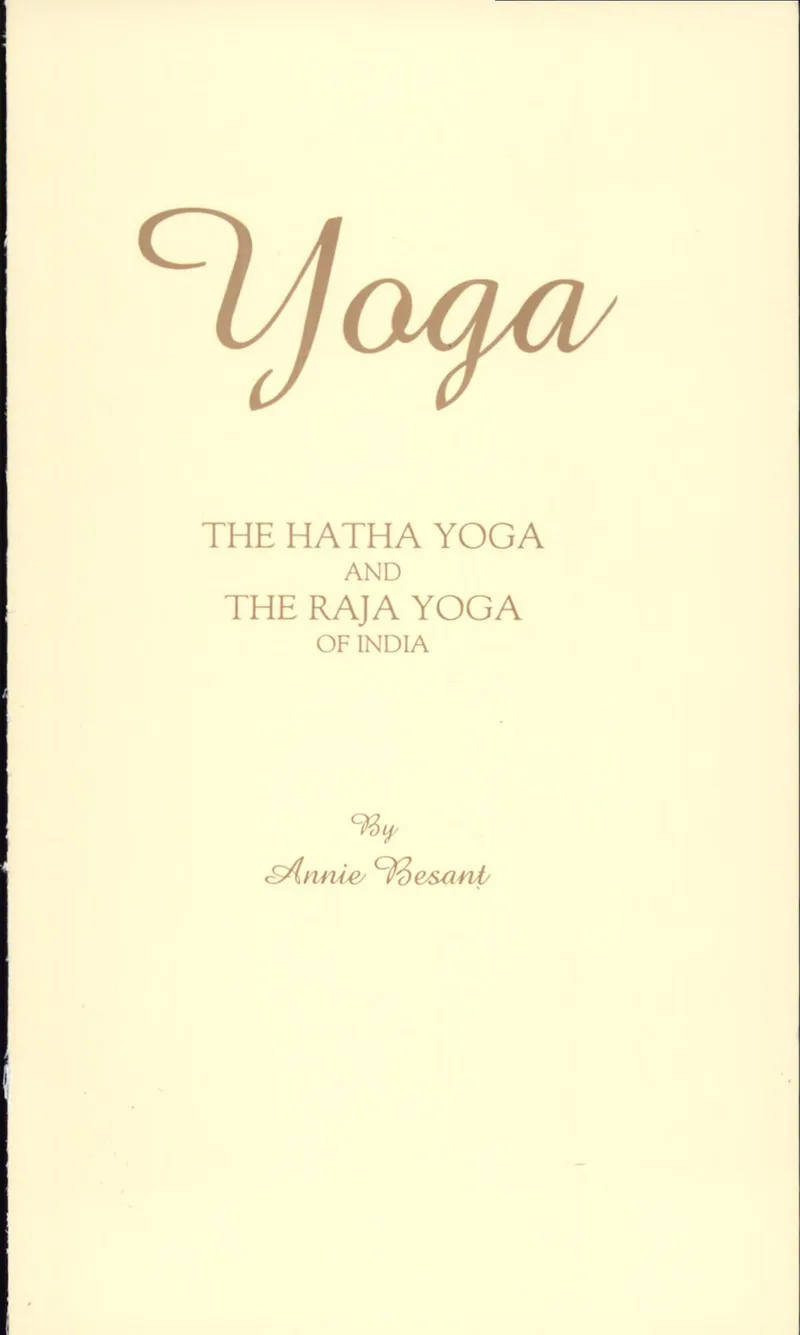
Annie Besant's "Yoga," first published in its current form in 1996, offers a fascinating, if dated, perspective on the ancient practice. It positions yoga not as the physical discipline many know today, but as a profound spiritual science aimed at the evolution of consciousness. Besant's strength lies in her ability to connect yogic principles to Theosophical cosmology, presenting a coherent, albeit specialized, worldview. A notable limitation is the relative scarcity of practical, actionable guidance for the modern practitioner; the focus remains heavily on abstract philosophy and esoteric theory. For instance, her discussion of the chakras, while detailed, assumes a familiarity with Theosophical concepts that may not be readily available to a general reader. The work serves best as a historical document illustrating one interpretation of yoga within a specific esoteric tradition. It is a scholarly examination rather than a guide to personal practice.
📝 Description
75
Annie Besant's "Yoga" (1996) examines yoga's philosophical dimensions through a Theosophical lens.
Annie Besant's "Yoga" is not a modern guide to physical postures. Instead, it presents yoga as a spiritual discipline, focusing on its mental and ethical aspects for self-realization. This early 20th-century work interprets yoga through the principles of Theosophy, emphasizing its role in spiritual development and achieving union with the divine. Besant's approach prioritizes inner transformation over the physical exercises often associated with yoga today.
The book is intended for readers interested in Western esotericism and the Theosophical movement's engagement with Eastern thought. It speaks to those who see yoga as a complete system for personal growth and ethical living. The text also offers insight into how Eastern philosophies were understood and adapted in the West during the late 19th and early 20th centuries. It provides a historical perspective on the reception of yogic traditions in a Western context.
Besant's "Yoga" is a product of the late 19th and early 20th centuries, a period marked by significant cross-cultural intellectual exchange. The Theosophical Society, co-founded by Helena Blavatsky, played a key role in introducing Eastern religions and philosophies to Western audiences. Besant's work fits within this milieu, aiming to synthesize Hindu and Buddhist concepts with Western esoteric traditions. This era saw many Western interpretations of Eastern texts, and Besant's contribution added to the growing body of esoteric literature available in Europe and America.
💡 Why Read This Book?
• Gain insight into the Theosophical interpretation of yoga, understanding its philosophical underpinnings as presented by Annie Besant in her 1996 edition, which diverges from modern physical practices. • Explore the concept of Raja Yoga and its connection to the sevenfold human constitution, a core tenet within the esoteric literature of the early 20th century. • Understand the historical reception of Eastern spirituality in the West, specifically how figures like Besant synthesized yogic ideals with Western esoteric thought.
⭐ Reader Reviews
Honest opinions from readers who have explored this book.
❓ Frequently Asked Questions
What is the primary focus of Annie Besant's "Yoga"?
Annie Besant's "Yoga" primarily focuses on the philosophical and spiritual aspects of yoga, interpreting it through the lens of Theosophy. It emphasizes mental discipline, ethical conduct, and the path to self-realization over purely physical postures.
When was Annie Besant's "Yoga" first published?
While the specific edition reviewed was published in 1996, Annie Besant's writings on yoga draw from earlier works and lectures, reflecting her engagement with Eastern philosophies during the late 19th and early 20th centuries.
Is this book suitable for beginners learning yoga poses?
No, this book is not a guide for learning physical yoga postures (asanas). It is intended for those interested in the esoteric and philosophical dimensions of yoga as a spiritual path, particularly within the context of Theosophy.
What is the connection between Besant's "Yoga" and Theosophy?
The book is deeply intertwined with Theosophy. Besant utilizes Theosophical concepts, such as the sevenfold nature of man and the evolution of consciousness, to explain and contextualize yogic philosophy and practice.
Does the book discuss Patanjali's Yoga Sutras?
Yes, the work explores Raja Yoga, largely referencing Patanjali's Yoga Sutras, but it interprets these teachings through the specific esoteric framework established by the Theosophical Society.
Where can I find Annie Besant's "Yoga"?
Annie Besant's "Yoga," first published in 1996, is available through various booksellers specializing in esoteric and metaphysical literature. As an older work, it may also be found in public domain archives or specialized library collections.
🔮 Key Themes & Symbolism
Raja Yoga and Theosophy
Besant's "Yoga" presents Raja Yoga not merely as a system of meditation but as a comprehensive path to spiritual evolution aligned with Theosophical doctrines. It interprets Patanjali's sutras through the framework of a sevenfold human constitution and the concept of manas (mind) evolving towards higher consciousness. The work emphasizes the internal disciplines—concentration, meditation, and contemplation—as means to transcend the physical and achieve union with the divine, a goal central to Theosophical aspirations for humanity's spiritual progress.
The Sevenfold Man
A core concept within Besant's interpretation is the Theosophical doctrine of the seven planes or principles of consciousness that constitute the human being. "Yoga" explores how yogic practices, particularly those involving the subtle body and chakras, are instrumental in awakening and purifying these different principles. This intricate model of human existence provides a unique esoteric context for understanding the yogic journey toward liberation (moksha), framing it as a process of mastering the lower principles to ascend to the higher spiritual awareness.
Chakras and Kundalini
The book examines the esoteric physiology of the chakras, described as centers of psychic energy and consciousness within the subtle body. Besant explains their role in the yogic path, particularly concerning the awakening of Kundalini, the latent spiritual energy. This discussion is framed within the broader Theosophical understanding of subtle anatomy and its relation to spiritual development, positioning the controlled activation of these centers as crucial for advancing on the path of yoga towards higher states of awareness.
Ethical Foundation of Yoga
Besant underscores the importance of ethical conduct (Yama and Niyama) as the indispensable foundation for any serious yogic practice. "Yoga" stresses that true spiritual progress cannot be achieved without moral purification and self-discipline. This emphasis aligns with classical yogic texts but is further elaborated through the Theosophical lens of karma and ethical evolution, suggesting that virtuous action and mental purity are paramount for the aspirant seeking to understand the deeper mysteries of existence.
💬 Memorable Quotes
Direct passages from the work, attributed to the author.
“Raja Yoga concerns the control of the mind.”
— This statement emphasizes that, within the framework of Raja Yoga as presented by Besant, the primary focus is on mental discipline and the mastery of thought processes, rather than solely physical exertion.
“The chakras are centers of psychic energy.”
— Besant views the chakras not just as anatomical points but as vital energy centers within the subtle body, crucial for spiritual awareness and the progression of consciousness.
“Yoga leads to the evolution of consciousness.”
— Besant frames yoga as a transformative practice that facilitates the expansion and refinement of human consciousness, aligning with Theosophical ideas of spiritual evolution.
💡 Key Ideas
Editorial paraphrase of the work's core concepts — not direct quotes.
The goal of yoga is union with the divine.
This paraphrased concept highlights the ultimate aim of the yogic path as described by Besant: achieving a state of oneness or integration with the Supreme Being or Universal Consciousness, a central tenet in many spiritual traditions.
Ethical conduct forms the basis of yoga.
This paraphrased idea stresses that adherence to moral principles and self-discipline (Yama and Niyama) is presented as a prerequisite for any meaningful advancement on the yogic path.
🌙 Esoteric Significance
Tradition
This work belongs to the Western Esoteric tradition, specifically the Theosophical lineage established by Helena Blavatsky. It represents an attempt to interpret and disseminate yogic philosophy within a framework that integrates Eastern spirituality with Western occult concepts, including reincarnation, karma, and the evolution of consciousness. Besant's "Yoga" fits within this tradition by offering a structured esoteric understanding of yoga as a science of the soul and mind.
Symbolism
Key symbols explored include the chakras, depicted as centers of spiritual energy within the subtle body, and Kundalini, the coiled serpent power representing latent spiritual energy. Besant interprets these within the Theosophical model of human consciousness, linking them to the awakening of higher awareness and the process of spiritual evolution. The lotus flower, often associated with chakras, also serves as a recurring motif symbolizing spiritual unfolding and purity.
Modern Relevance
Contemporary practitioners of Western Esotericism, particularly those within Theosophical study groups and related movements, continue to draw upon Besant's interpretations. Her work informs modern understandings of subtle anatomy and consciousness studies that seek to bridge Eastern and Western philosophical systems. Thinkers and authors exploring the historical development of yoga in the West or its philosophical dimensions beyond physical practice often reference Besant's unique synthesis.
👥 Who Should Read This Book
• Students of Theosophy and Western Esotericism seeking to understand the movement's interpretation of yogic philosophy and its place within spiritual evolution. • Comparative religion scholars interested in how Eastern spiritual traditions were adapted and presented in the West during the late 19th and early 20th centuries. • Individuals exploring the philosophical and mental aspects of yoga, looking beyond contemporary physical practices to its historical roots as a spiritual science.
📜 Historical Context
Annie Besant's "Yoga" emerged within the vibrant intellectual milieu of the late 19th and early 20th centuries, a period marked by intense Western interest in Eastern philosophies, largely propelled by the Theosophical Society founded in 1875. Besant, a prominent figure within Theosophy, sought to synthesize these ancient teachings with Western esoteric thought. Her work on yoga appeared during a time when figures like Swami Vivekananda were introducing Vedanta and Raja Yoga to Western audiences, notably at the 1893 Parliament of Religions in Chicago. While Vivekananda offered a more direct presentation of Hindu philosophy, Besant's approach filtered yogic concepts through the specific cosmological and evolutionary framework of Theosophy, emphasizing its role in spiritual development and the awakening of latent human potential. Her writings contributed to a broader esoteric revival, influencing subsequent generations of thinkers in Western occultism and comparative religion.
📔 Journal Prompts
The concept of the sevenfold man in Besant's Yoga: How might understanding these principles alter your perception of self?
Patanjali's Yama and Niyama: Identify one ethical precept and explore its practical application in daily life.
Raja Yoga's emphasis on mind control: Reflect on a specific mental habit you wish to cultivate or diminish.
The role of chakras in spiritual evolution: Consider your own energy levels and their connection to well-being.
Besant's interpretation of Samadhi: What does the idea of union with the divine signify in your personal spiritual framework?
🗂️ Glossary
Raja Yoga
Often translated as 'Royal Yoga,' it refers to the path of mental discipline and meditation, as systematized by Patanjali, aimed at achieving control over the mind and union with the divine.
Theosophy
A spiritual philosophy founded by Helena Blavatsky, seeking to synthesize the wisdom of all religions and to explore the divine nature of humanity and the cosmos.
Chakras
In yogic and esoteric traditions, these are centers of psychic energy located within the subtle body, often visualized as spinning wheels or lotuses.
Kundalini
A dormant spiritual energy believed to reside at the base of the spine, which, when awakened through yogic practices, ascends through the chakras to achieve higher consciousness.
Samadhi
A state of profound meditative consciousness or spiritual absorption, often described as union with the object of meditation or the divine.
Yama
The first limb of Ashtanga Yoga, comprising ethical restraints such as non-violence, truthfulness, and non-stealing.
Niyama
The second limb of Ashtanga Yoga, consisting of observances such as purity, contentment, and self-study.